I want to give a shout-out to all the writers (worldwide) out there for helping relieve stress and bolster the human spirit. These are particularly difficult times for everyone given the spread of the Coronavirus and its increasingly severe effects on the economy and on in life in general along with the bizarre and depressing political news that increases with each day, no matter which side of the aisle you sit on.
As I read more and watch more TV (particularly YouTube) with the increasing isolation and closure of so many restaurants and other public gathering spots, I come to realize how important a role writers play in our daily lives. Writers enable readers (as well as themselves) to escape into a more pleasant world, depending upon the genre of course. In all cases writers at least offer distractions in which the public can become immersed for a time and take its mind off the daily anxieties and fears around us. This is important, because taking our minds off our worries enables us to relax, however briefly, and allows us to heal psychologically and emotionally, both of which have healing effects on our bodies. These days, this nation and all others need healing in every sense I can imagine.
This week I am giving away The Scent and Other Stories: the Dark Side of Love; Nocturne: Poems of Love, Distance, and the Night, a callous and disinterested love; A Tale of Hell and Other Works of Horror: Stories of wizards, werewolves, serial killers, alien worlds, and the damned; and Click: A Police Thriller of Murder, Conspiracy, and Betrayal on a Small Texas Island. Take advantage of this offer while you can.
This week I am giving away The Scent and Other Stories: the Dark Side of Love; Nocturne: Poems of Love, Distance, and the Night, a callous and disinterested love; A Tale of Hell and Other Works of Horror: Stories of wizards, werewolves, serial killers, alien worlds, and the damned; and Click: A Police Thriller of Murder, Conspiracy, and Betrayal on a Small Texas Island. Take advantage of this offer while you can.
This week I am giving away The Scent and Other Stories: the Dark Side of Love; Nocturne: Poems of Love, Distance, and the Night, a callous and disinterested love; A Tale of Hell and Other Works of Horror: Stories of wizards, werewolves, serial killers, alien worlds, and the damned; and Click: A Police Thriller of Murder, Conspiracy, and Betrayal on a Small Texas Island. Take advantage of this offer while you can.
This week I am giving away The Scent and Other Stories: the Dark Side of Love; Nocturne: Poems of Love, Distance, and the Night, a callous and disinterested love; A Tale of Hell and Other Works of Horror: Stories of wizards, werewolves, serial killers, alien worlds, and the damned; and Click: A Police Thriller of Murder, Conspiracy, and Betrayal on a Small Texas Island. Take advantage of this offer while you can.
This week I am giving away The Scent and Other Stories: the Dark Side of Love; Nocturne: Poems of Love, Distance, and the Night, a callous and disinterested love; A Tale of Hell and Other Works of Horror: Stories of wizards, werewolves, serial killers, alien worlds, and the damned; and Click: A Police Thriller of Murder, Conspiracy, and Betrayal on a Small Texas Island. Take advantage of this offer while you can.
It was a little after half-past nine when the man fell overboard. The mail steamer was hurrying through the Red Sea in the hope of making up the time which the currents of the Indian Ocean had stolen.
The night was clear, though the moon was hidden behind clouds. The warm air was laden with moisture. The still surface of the waters was only broken by the movement of the great ship, from whose quarter the long, slanting undulations struck out like the feathers from an arrow shaft, and in whose wake the froth and air bubbles churned up by the propeller trailed in a narrowing line to the darkness of the horizon.
Winston Churchill in his later years.
There was a concert on board. All the passengers were glad to break the monotony of the voyage and gathered around the piano in the companion-house. The decks were deserted. The man had been listening to the music and joining in the songs, but the room was hot and he came out to smoke a cigarette and enjoy a breath of the wind which the speedy passage of the liner created. It was the only wind in the Red Sea that night.
The accommodation-ladder had not been unshipped since leaving Aden and the man walked out on to the platform, as on to a balcony. He leaned his back against the rail and blew a puff of smoke into the air reflectively. The piano struck up a lively tune and a voice began to sing the first verse of “The Rowdy Dowdy Boys.” The measured pulsations of the screw were a subdued but additional accompaniment.
The man knew the song, it had been the rage at all the music halls when he had started for India seven years before. It reminded him of the brilliant and busy streets he had not seen for so long, but was soon to see again. He was just going to join in the chorus when the railing, which had been insecurely fastened, gave way suddenly with a snap and he fell backwards into the warm water of the sea amid a great splash.
For a moment he was physically too much astonished to think. Then he realized he must shout. He began to do this even before he rose to the surface. He achieved a hoarse, inarticulate, half-choked scream. A startled brain suggested the word, “Help!” and he bawled this out lustily and with frantic effort six or seven times without stopping. Then he listened.
“Hi! hi! clear the way For the Rowdy Dowdy Boys.” The chorus floated back to him across the smooth water for the ship had already completely passed by. And as he heard the music, a long stab of terror drove through his heart. The possibility that he would not be picked up dawned for the first time on his consciousness. The chorus started again:
“Then–I–say–boys, Who’s for a jolly spree? Rum–tum–tiddley–um, Who’ll have a drink with me?” “Help! Help! Help!” shrieked the man, now in desperate fear.
“Fond of a glass now and then, Fond of a row or noise; Hi! hi! clear the way For the Rowdy Dowdy Boys!”
The last words drawled out fainter and fainter. The vessel was steaming fast. The beginning of the second verse was confused and broken by the ever-growing distance. The dark outline of the great hull was getting blurred. The stern light dwindled.
Then he set out to swim after it with furious energy, pausing every dozen strokes to shout long wild shouts. The disturbed waters of the sea began to settle again to their rest and widening undulations became ripples. The aerated confusion of the screw fizzed itself upwards and out. The noise of motion and the sounds of life and music died away.
The liner was but a single fading light on the blackness of the waters and a dark shadow against the paler sky.
At length full realization came to the man and he stopped swimming. He was alone — abandoned. With the understanding the brain reeled. He began again to swim, only now instead of shouting he prayed — mad, incoherent prayers, the words stumbling into one another.
Suddenly a distant light seemed to flicker and brighten.
A surge of joy and hope rushed through his mind. They were going to stop — to turn the ship and come back. And with the hope came gratitude. His prayer was answered. Broken words of thanksgiving rose to his lips. He stopped and stared after the light — his soul in his eyes. As he watched it, it grew gradually but steadily smaller. Then the man knew that his fate was certain. Despair succeeded hope; gratitude gave place to curses. Beating the water with his arms, he raved impotently. Foul oaths burst from him, as broken as his prayers — and as unheeded.
The fit of passion passed, hurried by increasing fatigue. He became silent — silent as was the sea, for even the ripples were subsiding into the glassy smoothness of the surface. He swam on mechanically along the track of the ship, sobbing quietly to himself in the misery of fear. And the stern light became a tiny speck, yellower but scarcely bigger than some of the stars, which here and there shone between the clouds.
Nearly twenty minutes passed and the man’s fatigue began to change to exhaustion. The overpowering sense of the inevitable pressed upon him. With the weariness came a strange comfort — he need not swim all the long way to Suez. There was another course. He would die. He would resign his existence since he was thus abandoned. He threw up his hands impulsively and sank.
Down, down he went through the warm water. The physical death took hold of him and he began to drown. The pain of that savage grip recalled his anger. He fought with it furiously. Striking out with arms and legs he sought to get back to the air. It was a hard struggle, but he escaped victorious and gasping to the surface. Despair awaited him. Feebly splashing with his hands, he moaned in bitter misery:
“I can’t — I must. O God! Let me die.”
The moon, then in her third quarter, pushed out from behind the concealing clouds and shed a pale, soft glitter upon the sea. Upright in the water, fifty yards away, was a black triangular object. It was a fin. It approached him slowly.
This week I am giving away The Scent and Other Stories: the Dark Side of Love; Nocturne: Poems of Love, Distance, and the Night, a callous and disinterested love; A Tale of Hell and Other Works of Horror: Stories of wizards, werewolves, serial killers, alien worlds, and the damned; and Click: A Police Thriller of Murder, Conspiracy, and Betrayal on a Small Texas Island. Take advantage of this offer while you can.
This week I am giving away The Scent and Other Stories: the Dark Side of Love; Nocturne: Poems of Love, Distance, and the Night, a callous and disinterested love; A Tale of Hell and Other Works of Horror: Stories of wizards, werewolves, serial killers, alien worlds, and the damned; and Click: A Police Thriller of Murder, Conspiracy, and Betrayal on a Small Texas Island. Take advantage of this offer while you can.
This week I am giving away The Scent and Other Stories: the Dark Side of Love; Nocturne: Poems of Love, Distance, and the Night, a callous and disinterested love; A Tale of Hell and Other Works of Horror: Stories of wizards, werewolves, serial killers, alien worlds, and the damned; and Click: A Police Thriller of Murder, Conspiracy, and Betrayal on a Small Texas Island. Take advantage of this offer while you can.
I published this on my website a few years ago, but this morning I thought I would re-post just for my followers in Romania. Enjoy. If you live in Romania or are from there originally, I would like to see your comments on this article. Tell me if I am on the spot or if I am off base.
The first thing you learn about the historical Castle Dracula is that it is a fictional location from Bram Stoker’s imagination. The Wikipedia article does a nice job of summarizing the history of the fictional abode and of analyzing the novel for clues to its supposed locale. The most precise it comes to identifying the spot of Dracula’s Castle is:
“The site of the Vampire’s home has always been one of the greatest mysteries of the novel. The route descriptions hardly mention any recognisable landmarks, but focus on evocations of a wild and snow-covered landscape, haunted by howling wolves and lit by supernatural blue flames at night. Because of this conspicuous vagueness, the annotated Dracula editions by Leonard Wolf,[6] Clive Leatherdale[7] and Leslie Klinger[8] simply assume Bram Stoker had no specific location in mind and place the Castle in or immediately next to the Borgo Pass. As a consequence, these editions take for granted that the Count’s men, pursued by Harker, Holmwood, Morris and Seward, follow the Bistrița River all the way up to Vatra Dornei and then travel the route through the Borgo Pass already taken by Van Helsing and Mina. The same view is adopted by Andrew Connell in his Google Map mark-ups.[9] These theories ignore or misinterpret Stoker’s hint that around the 47th Parallel, the Count’s men are supposed to leave the river and cross-over to Transylvanian territory:
We took it, that somewhere about the 47th degree, north latitude, would be the place chosen for crossing the country between the river and the Carpathians. (Chapter 26, Jonathan Harker’s Journal, Entry for 30 October)[10]
“Only recently, the Dutch author Hans Corneel de Roos discovered the site the Irish novelist really had in mind while shaping his narrative: an empty mountain top in the Transylvanian Kelemen Alps near the former border with Moldavia, ca. 20 miles south-east of the Borgo Pass.[11] De Roos also explains why Stoker chose to obscure this location in his novel and compares the vampire’s fortress to the Grail Castle as its anti-Christian antipole: It cannot be found on purpose, only by guidance. Harker is brought there by the Count himself, while Van Helsing and Mina – equally nodding off – rely on the instinct of their horses and the mounted men arrive there by following the Gypsies.”
If you have read the book and have seen at least the original film version of Dracula with Bela Lugosi, you know at least one place they have in common is Borgo Pass. This is where Jonathan Harker disembarks from a coach to wait in an inn for the Count’s own carriage to come and fetch him and the village people try unsuccessfully to warn him away.
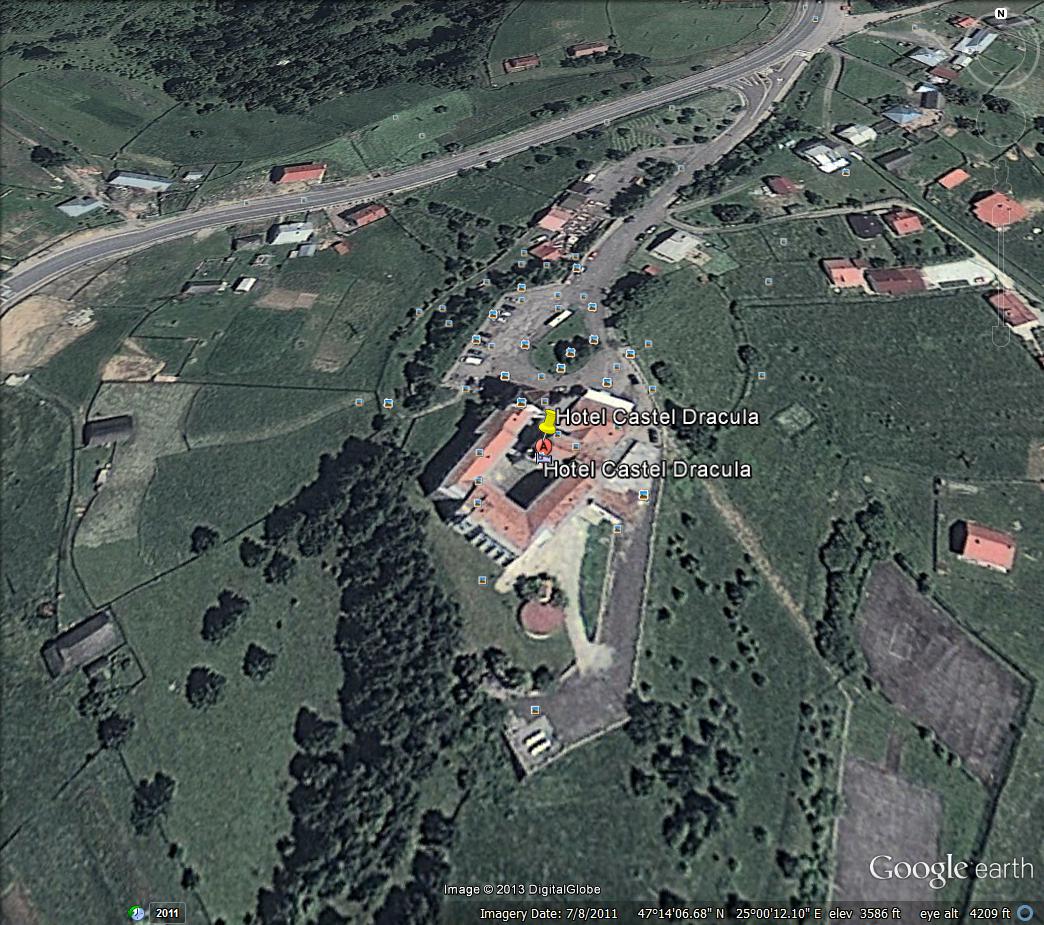
Aerial view of the Hotel Castel Dracula in the Borgo Pass from Google Earth
What you will learn from a few places on the Internet is that a hotel has been built on the spot in the Borgo Pass where Harker is supposed to have changed rides. Romanian Tourism describes it so:
Borgo Pass
(Pasul Tihuta) Where: 277 miles northwest of Bucharest / 12 miles northeast of Bistrita Note: Access by car only
Borgo Pass (Bargau in Romanian), made famous in the opening chapter of Bram Stoker’s Dracula, is an oft-trod passageway through the Carpathian Mountains in northern Transylvania. Located near the small township of Tihuta, the pass peaks at 3,840 feet.
The Bargau Valley encompasses some of the most beautiful unspoiled mountain scenery in the Carpathians with picturesque traditional villages located in valleys and on hillsides, ideal bases for hiking, riding or discovering their vivid tapestry of old customs, handicrafts and folklore.
Here, you will step into a realm that the fictional Mina Harker described in her diary as “a lovely county; full of beauties of all imaginable kinds, and the people are brave, and strong, and simple, and seem full of nice qualities.”
If you travel via Google Earth, if you search for “Borgo Pass”, you will find the location, but the name for it on Google Earth is “Pasul Tihuta”, the Romanian name, not the Hungarian “Borgo Pass” that Bram Stoker used. Once in Pasul Tihuta, search for Hotel Castel Dracula. That’s the spot where Harker is supposed to have changed carriages. Don’t be surprised that the modern hotel looks nothing like the quaint hamlet of the movie. The Wikipedia article on Tihuta Pass states:
The pass was made famous by Bram Stoker‘s novel Dracula, where, termed as “the Borgo Pass”, it was the gateway to the realm of Count Dracula. Stoker most likely found the name on a contemporary map. He never actually visited the area.
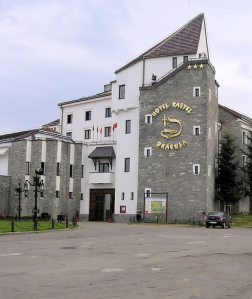
Today the pass is home to Hotel “Castel Dracula”. The hotel was built in 1974 and is located at an altitude of
Hotel Castel Dracula Borgo Pass, Romania
1,116 m (3,661 ft). The hotel has become quite an attraction due to its architectural style of a medieval villa, as well as the sheer beauty of the location.
That being said, the next question that arises is if there is no Castle Dracula, but there was a historical figure on which was based, where did the historical figure, Vlad the Impaler, actually live?
A woodcut of the historical Vlad Tepes from about the sixteenth century
If you read any summary of his life, you will find that Vlad the Impaler was constantly on the move, either attacking his enemies or running from them. Pinning down his abode to a single spot is difficult. A good, brief summary of the most famous can be found at Romania Tourism. You will note that most of the popular tourist sites have at best a tenuous connection to Vlad Tepes. This is probably similar to the number of places along the US east coast that claim to be where George Washington slept during his campaigns in the American Revolution.
From what I have found during my Internet searches one of the best and probably most reliable articles on the places associated with Vlad Tepes is this one entitled “Dracula’s Homepage” written by a man who has apparently conducted extensive research into Vlad Tepes and the places associated with him. The author describes for us which spots were locations where Vlad Tepes actually lived as opposed to ones that the tourism industry identifies with him, but which in fact may have little, if anything at all, to do with the bloodthirsty ruler. The two locations described in this article as where Vlad Tepes spent a significant amount of time are Tirgoviste Palace and Cetatea Poenari.
The Tirgoviste palace is actually called “Curtea Palace”, where Vlad Tepes built the Chindia Tower. If you search for “Chindia Tower” on Google Earth, you can hover just over Vlad Tepes’s Tirgoviste Palace and even go to street level to view the tower as if you were walking past it.
Tirgoviste Palace today (from Google Earth)
Chindia Tower from the street (from Google Earth)
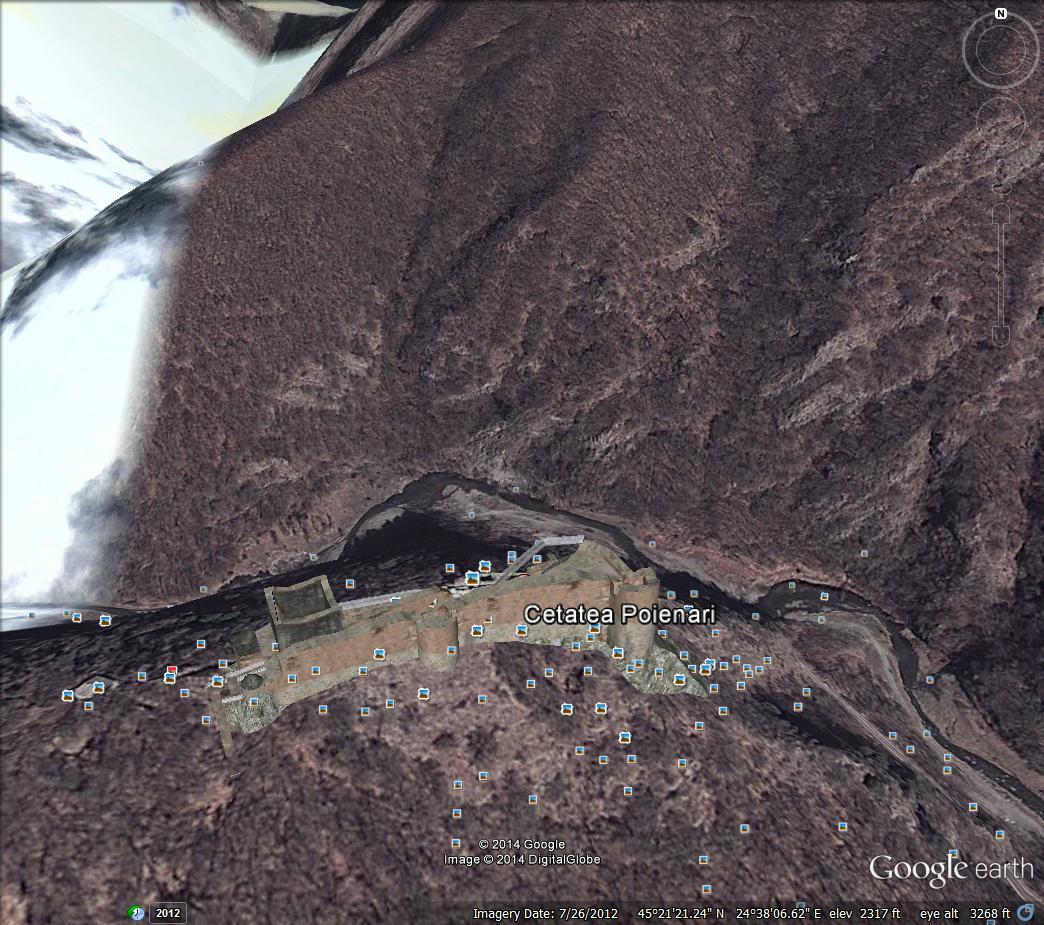
Search Google Earth for “Cetatea Poenari” and you will be taken to a secluded mountaintop over a narrow pass. This place probably captures the eerie spirit of the novel more than any other place you will find. If you have the Google Earth 3D buildings feature on (as I do in the photo below), you will see a 3D virtual representation of the castle, though the best views of it are from the dozens of photos tourists have attached to the location via Panaramio.
Cetatea Poenari (from Google Earth)
The website “Dracula’s Homepage” mentioned previously has a beautiful description of what it must be like to travel to the castle along with some of its historically horrific background:
“If there is an edifice that can be labelled Vlad Dracula’s castle, it is the ruins of Poenari. Actually, this is a fortress (“cetate” in Romanian) rather than a castle, located at the entrance to the gorge of the Arges River, north of the town of Curtea de Arges. As you leave Curtea de Arges (itself an interesting town with fortifications dating back to the 13th century and Basarab 1), you drive over a secondary road through several little villages, proceeding up the Arges valley towards the base of the Carpathian range.The road reaches the base of a group of high, heavily wooded mountains and there on the rocky top of one of them is Cetatea Poenari – Dracula’s Castle. Even from the road below it is a forbidding sight. What strikes one is its inaccessibility, high on a mountain top and the entrance to the gorges of the river (the river, by the way, has been diverted by a hydro-electric project). Poenari was the castle fortification that Vlad Tepes forced the nobles of Tirgoviste to build. The nobles were forced to walk the distance from Tirgoviste to the Arges (quite considerable by road – probably about 60 km overland) and then drag the material up that mountain to build the castle.
“To get to the top, one has to walk up almost 1500 steps. But the effort is certainly worth it. As you approach the magnificent ruin (last 50 steps or so) the scene is totally Gothic. There is the outline of the castle perched on the top of this rock, seeming to grow out of the very mountain itself. It covers the full space at the top, has a sheer drop on three sides, and is barely accessible by a small bridge near the top of the steps.
“I have returned to this site three times, as it is one of my favorite places in Romania: not only because of the sense of history but the magnificent scenery. One particular view (looking northwest) is spectacular – just the way you might picture the landscape around Dracula’s Castle in Stoker’s novel (though Stoker knew nothing about this place).
“This is the route that, according to local legend, Vlad took in order to escape into Transylvania from the Turks in 1462. He was assisted in his efforts by the villagers of nearby Arefu, where many narratives about Vlad still live in their oral culture.
“Then there is the southern wall of the castle – a sheer drop!
“This is where, according to another local legend, Vlad Tepes’ first wife flung herself, committing suicide rather than being taken captive by the advancing Turks. This castle is where Vlad would go for refuge in the face of advancing enemies. And from its towers he had a commanding view of anyone approaching from any direction. It was practically impenetrable.”
If you like horror, I highly recommend reading up on the historical Vlad Tepes and his reign. You will find actual terrors that would make any of the ficitional Draculas look like TV’s Mr. Rogers in comparison.
If, during your virtual journeys through the worlds of the fictional Count Dracula and his historical counterpart, Vlad Tepes, encounter any fascinating places or adventures, please feel free to share them via the comments section below.
This week I am giving away The Scent and Other Stories: the Dark Side of Love; Nocturne: Poems of Love, Distance, and the Night, a callous and disinterested love; A Tale of Hell and Other Works of Horror: Stories of wizards, werewolves, serial killers, alien worlds, and the damned; and Click: A Police Thriller of Murder, Conspiracy, and Betrayal on a Small Texas Island. Take advantage of this offer while you can.
This week I am giving away The Scent and Other Stories: the Dark Side of Love; Nocturne: Poems of Love, Distance, and the Night, a callous and disinterested love; A Tale of Hell and Other Works of Horror: Stories of wizards, werewolves, serial killers, alien worlds, and the damned; and Click: A Police Thriller of Murder, Conspiracy, and Betrayal on a Small Texas Island. Take advantage of this offer while you can.
As long as midnight cloaks the earth With shadows grim and stark, God save us from the Judas kiss Of a dead man in the dark.
Old Adam Farrel lay dead in the house wherein he had lived alone
for the last twenty years. A silent, churlish recluse, in his life he
had known no friends, and only two men had watched his passing.
Dr. Stein rose and glanced out the window into the gathering dusk.
“You think you can spend the night here, then?” he asked his
companion.
This man, Falred by name, assented.
“Yes, certainly. I guess it’s up to me.”
“Rather a useless and primitive custom, sitting up with the dead,”
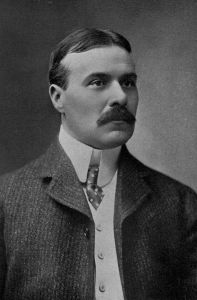
Robert E. Howard
commented the doctor, preparing to depart, “but I suppose in common
decency we will have to bow to precedence. Maybe I can find someone
who’ll come over here and help you with your vigil.”
Falred shrugged his shoulders. “I doubt it. Farrel wasn’t liked–
wasn’t known by many people. I scarcely knew him myself, but I don’t
mind sitting up with the corpse.”
Dr. Stein was removing his rubber gloves and Falred watched the
process with an interest that almost amounted to fascination. A
slight, involuntary shudder shook him at the memory of touching these
gloves–slick, cold, clammy things, like the touch of death.
“You may get lonely tonight, if I don’t find anyone,” the doctor
remarked as he opened the door. “Not superstitious, are you?”
Falred laughed. “Scarcely. To tell the truth, from what I hear of
Farrel’s disposition, I’d rather be watching his corpse than have been
his guest in life.”
The door closed and Falred took up his vigil. He seated himself in
the only chair the room boasted, glanced casually at the formless,
sheeted bulk on the bed opposite him, and began to read by the light
of the dim lamp which stood on the rough table.
Outside, the darkness gathered swiftly, and finally Falred laid
down his magazine to rest his eyes. He looked again at the shape which
had, in life, been the form of Adam Farrel, wondering what quirk in
the human nature made the sight of a corpse not so unpleasant, but
such an object of fear to man. Unthinking ignorance, seeing in dead
things a reminder of death to come, he decided lazily, and began idly
contemplating as to what life had held for this grim and crabbed old
man, who had neither relatives nor friends, and who had seldom left
the house wherein he had died. The usual tales of miser-hoarded wealth
had accumulated, but Falred felt so little interest in the whole
matter that it was not even necessary for him to overcome any
temptation to prey about the house for possible hidden treasure.
He returned to his reading with a shrug. The task was more
boresome than he had thought for. After a while he was aware that
every time he looked up from his magazine and his eyes fell upon the
bed with its grim occupant, he started involuntarily as if he had, for
an instant, forgotten the presence of the dead man and was
unpleasantly reminded of the fact. The start was slight and
instinctive, but he felt almost angered at himself. He realized, for
the first time, the utter and deadening silence which enwrapped the
house–a silence apparently shared by the night, for no sound came
through the window. Adam Farrel lived as far apart from his neighbors
as possible, and there was no other house within hearing distance.
Falred shook himself as if to rid his mind of unsavory
speculations, and went back to his reading. A sudden vagrant gust of
wind whipped through the window, in which the light in the lamp
flickered and went out suddenly. Falred, cursing softly, groped in the
darkness for matches, burning his fingers on the lamp chimney. He
struck a match, relighted the lamp, and glancing over at the bed, got
a horrible mental jolt. Adam Farrel’s face stared blindly at him, the
dead eyes wide and blank, framed in the gnarled gray features. Even as
Falred instinctively shuddered, his reason explained the apparent
phenomenon: the sheet that covered the corpse had been carelessly
thrown across the face and the sudden puff of wind had disarranged and
flung it aside.
Yet there was something grisly about the thing, something
fearsomely suggestive–as if, in the cloaking dark, a dead hand had
flung aside the sheet, just as if the corpse were about to rise….
Falred, an imaginative man, shrugged his shoulders at these
ghastly thoughts and crossed the room to replace the sheet. The dead
eyes seemed to stare malevolently, with an evilness that transcended
the dead man’s churlishness in life. The workings of a vivid
imagination, Falred knew, and he re-covered the gray face, shrinking
as his hand chanced to touch the cold flesh–slick and clammy, the
touch of death. He shuddered with the natural revulsion of the living
for the dead, and went back to his chair and magazine.
At last, growing sleepy, he lay down upon a couch which, by some
strange whim of the original owner, formed part of the room’s scant
furnishings, and composed himself for slumber. He decided to leave the
light burning, telling himself that it was in accordance with the
usual custom of leaving lights burning for the dead; for he was not
willing to admit to himself that already he was conscious of a dislike
for lying in the darkness with the corpse. He dozed, awoke with a
start and looked at the sheeted form of the bed. Silence reigned over
the house, and outside it was very dark.
The hour was approaching midnight, with its accompanying eerie
domination over the human mind. Falred glanced again at the bed where
the body lay and found the sight of the sheeted object most repellent.
A fantastic idea had birth in his mind, and grew, that beneath the
sheet, the mere lifeless body had become a strange, monstrous thing, a
hideous, conscious being, that watched him with eyes which burned
through the fabric of the cloth. This thought–a mere fantasy, of
course–he explained to himself by the legends of vampires, undead
ghosts and such like–the fearsome attributes with which the living
have cloaked the dead for countless ages, since primitive man first
recognized in death something horrid and apart from life. Man feared
death, thought Falred, and some of this fear of death took hold on the
dead so that they, too, were feared. And the sight of the dead
engendered grisly thoughts, gave rise to dim fears of hereditary
memory, lurking back in the dark corners of the brain.
At any rate, that silent, hidden thing was getting on his nerves.
He thought of uncovering the face, on the principle that familiarity
breeds contempt. The sight of the features, calm and still in death,
would banish, he thought, all such wild conjectures as were haunting
him in spite of himself. But the thought of those dead eyes staring in
the lamplight was intolerable; so at last he blew out the light and
lay down. This fear had been stealing upon him so insidiously and
gradually that he had not been aware of its growth.
With the extinguishing of the light, however, and the blotting out
of the sight of the corpse, things assumed their true character and
proportions, and Falred fell asleep almost instantly, on his lips a
faint smile for his previous folly.
He awakened suddenly. How long he had been asleep he did not know.
He sat up, his pulse pounding frantically, the cold sweat beading his
forehead. He knew instantly where he was, remembered the other
occupant of the room. But what had awakened him? A dream–yes, now he
remembered–a hideous dream in which the dead man had risen from the
bed and stalked stiffly across the room with eyes of fire and a horrid
leer frozen on his gray lips. Falred had seemed to lie motionless,
helpless; then as the corpses reached a gnarled and horrible hand, he
had awakened.
He strove to pierce the gloom, but the room was all blackness and
all without was so dark that no gleam of light came through the
window. He reached a shaking hand toward the lamp, then recoiled as if
from a hidden serpent. Sitting here in the dark with a fiendish corpse
was bad enough, but he dared not light the lamp, for fear that his
reason would be snuffed out like a candle at what he might see.
Horror, stark and unreasoning, had full possession of his soul; he no
longer questioned the instinctive fears that rose in him. All those
legends he had heard came back to him and brought a belief in them.
Death was a hideous thing, a brain-shattering horror, imbuing lifeless
men with a horrid malevolence. Adam Farrel in his life had been simply
a churlish but harmless man; now he was a terror, a monster, a fiend
lurking in the shadows of fear, ready to leap on mankind with talons
dipped deep in death and insanity.
Falred sat there, his blood freezing, and fought out his silent
battle. Faint glimmerings of reason had begun to touch his fright when
a soft, stealthy sound again froze him. He did not recognize it as the
whisper of the night wind across the windowsill. His frenzied fancy
knew it only as the tread of death and horror. He sprang from the
couch, then stood undecided. Escape was in his mind but he was too
dazed to even try to formulate a plan of escape. Even his sense of
direction was gone. Fear had so stultified his mind that he was not
able to think consciously. The blackness spread in long waves about
him and its darkness and void entered into his brain. His motions,
such as they were, were instinctive. He seemed shackled with mighty
chains and his limbs responded sluggishly, like an imbecile’s.
A terrible horror grew up in him and reared its grisly shape, that
the dead man was behind him, was stealing upon him from the rear. He
no longer thought of lighting the lamp; he no longer thought of
anything. Fear filled his whole being; there was room for nothing
else.
He backed slowly away in the darkness, hands behind him,
instinctively feeling the way. With a terrific effort he partly shook
the clinging mists of horror from him, and, the cold sweat clammy upon
his body, strove to orient himself. He could see nothing, but the bed
was across the room, in front of him. He was backing away from it.
There was where the dead man was lying, according to all rules of
nature; if the thing were, as he felt, behind him, then the old tales
were true: death did implant in lifeless bodies an unearthly
animation, and dead men did roam the shadows to work their ghastly and
evil will upon the sons of men. Then–great God!–what was man but a
wailing infant, lost in the night and beset by frightful things from
the black abysses and the terrible unknown voids of space and time?
These conclusions he did not reach by any reasoning process; they
leaped full-grown into his terror-dazed brain. He worked his way
slowly backward, groping, clinging to the thought that the dead man
must be in front of him.
Then his back-flung hands encountered something–something slick,
cold and clammy–like the touch of death. A scream shook the echoes,
followed by the crash of a falling body.
The next morning they who came to the house of death found two
corpses in the room. Adam Farrel’s sheeted body lay motionless upon
the bed, and across the room lay the body of Falred, beneath the shelf
where Dr. Stein had absent-mindedly left his gloves–rubber gloves,
slick and clammy to the touch of a hand groping in the dark–a hand of
one fleeing his own fear–rubber gloves, slick and clammy and cold,
like the touch of death.
###
This eBook is made available at no cost and with almost no restrictions
whatsoever. You may copy it, give it away or re-use it under the terms
of the Project Gutenberg of Australia License which may be viewed online at http://gutenberg.net.au/licence.html
The animal paused on the threshold, interrogative alert, ready for flight if necessary. Severn laid down his palette, and held out a hand of welcome. The cat remained motionless, her yellow eyes fastened upon Severn.
“Puss,” he said, in his low, pleasant voice, “come in.”
The tip of her thin tail twitched uncertainly.
“Come in,” he said again.
Apparently she found his voice reassuring, for she slowly settled upon all fours, her eyes still fastened upon him, her tail tucked under her gaunt flanks.
He rose from his easel smiling. She eyed him quietly, and when he walked toward her she watched him bend above her without a wince; her eyes followed his hand until it touched her head. Then she uttered a ragged mew.
It had long been Severn’s custom to converse with animals, probably because he lived so much alone; and now he said, “What’s the matter, puss?”
Her timid eyes sought his.
“I understand,” he said gently, “you shall have it at once.”
Then moving quietly about he busied himself with the duties of a host, rinsed a saucer, filled it with the rest of the milk from the bottle on the window-sill, and kneeling down, crumbled a roll into the hollow of his hand.
The creature rose and crept toward the saucer.
With the handle of a palette-knife he stirred the crumbs and milk together and stepped back as she thrust her nose into the mess. He watched her in silence. From time to time the saucer clinked upon the tiled floor as she reached for a morsel on the rim; and at last the bread was all gone, and her purple tongue travelled over every unlicked spot until the saucer shone like polished marble. Then she sat up, and coolly turning her back to him, began her ablutions.
“Keep it up,” said Severn, much interested, “you need it.”
She flattened one ear, but neither turned nor interrupted her toilet. As the grime was slowly removed Severn observed that nature had intended her for a white cat. Her fur had disappeared in patches, from disease or the chances of war, her tail was bony and her spine sharp. But what charms she had were becoming apparent under vigorous licking, and he waited until she had finished before re-opening the conversation. When at last she closed her eyes and folded her forepaws under her breast, he began again very gently: “Puss, tell me your troubles.”
At the sound of his voice she broke into a harsh rumbling which he recognized as an attempt to purr. He bent over to rub her cheek and she mewed again, an amiable inquiring little mew, to which he replied, “Certainly, you are greatly improved, and when you recover your plumage you will be a gorgeous bird.” Much flattered, she stood up and marched around and around his legs, pushing her head between them and making pleased remarks, to which he responded with grave politeness.
“Now, what sent you here,” he said—”here into the Street of the Four Winds, and up five flights to the very door where you would be welcome? What was it that prevented your meditated flight when I turned from my canvas to encounter your yellow eyes? Are you a Latin Quarter cat as I am a Latin Quarter man? And why do you wear a rose-coloured flowered garter buckled about your neck?” The cat had climbed into his lap, and now sat purring as he passed his hand over her thin coat.
Robert W. Chambers 1903
“Excuse me,” he continued in lazy soothing tones, harmonizing with her purring, “if I seem indelicate, but I cannot help musing on this rose-coloured garter, flowered so quaintly and fastened with a silver clasp. For the clasp is silver; I can see the mint mark on the edge, as is prescribed by the law of the French Republic. Now, why is this garter woven of rose silk and delicately embroidered,—why is this silken garter with its silver clasp about your famished throat? Am I indiscreet when I inquire if its owner is your owner? Is she some aged dame living in memory of youthful vanities, fond, doting on you, decorating you with her intimate personal attire? The circumference of the garter would suggest this, for your neck is thin, and the garter fits you. But then again I notice—I notice most things—that the garter is capable of being much enlarged. These small silver-rimmed eyelets, of which I count five, are proof of that. And now I observe that the fifth eyelet is worn out, as though the tongue of the clasp were accustomed to lie there. That seems to argue a well-rounded form.”
The cat curled her toes in contentment. The street was very still outside.
He murmured on: “Why should your mistress decorate you with an article most necessary to her at all times? Anyway, at most times. How did she come to slip this bit of silk and silver about your neck? Was it the caprice of a moment,—when you, before you had lost your pristine plumpness, marched singing into her bedroom to bid her good-morning? Of course, and she sat up among the pillows, her coiled hair tumbling to her shoulders, as you sprang upon the bed purring: ‘Good-day, my lady.’ Oh, it is very easy to understand,” he yawned, resting his head on the back of the chair. The cat still purred, tightening and relaxing her padded claws over his knee.
“Shall I tell you all about her, cat? She is very beautiful—your mistress,” he murmured drowsily, “and her hair is heavy as burnished gold. I could paint her,—not on canvas—for I should need shades and tones and hues and dyes more splendid than the iris of a splendid rainbow. I could only paint her with closed eyes, for in dreams alone can such colours as I need be found. For her eyes, I must have azure from skies untroubled by a cloud—the skies of dreamland. For her lips, roses from the palaces of slumberland, and for her brow, snow-drifts from mountains which tower in fantastic pinnacles to the moons;—oh, much higher than our moon here,—the crystal moons of dreamland. She is—very—beautiful, your mistress.”
The words died on his lips and his eyelids drooped.
The cat, too, was asleep, her cheek turned up upon her wasted flank, her paws relaxed and limp.
II
“It is fortunate,” said Severn, sitting up and stretching, “that we have tided over the dinner hour, for I have nothing to offer you for supper but what may be purchased with one silver franc.”
The cat on his knee rose, arched her back, yawned, and looked up at him.
“What shall it be? A roast chicken with salad? No? Possibly you prefer beef? Of course,—and I shall try an egg and some white bread. Now for the wines. Milk for you? Good. I shall take a little water, fresh from the wood,” with a motion toward the bucket in the sink.
He put on his hat and left the room. The cat followed to the door, and after he had closed it behind him, she settled down, smelling at the cracks, and cocking one ear at every creak from the crazy old building.
The door below opened and shut. The cat looked serious, for a moment doubtful, and her ears flattened in nervous expectation. Presently she rose with a jerk of her tail and started on a noiseless tour of the studio. She sneezed at a pot of turpentine, hastily retreating to the table, which she presently mounted, and having satisfied her curiosity concerning a roll of red modelling wax, returned to the door and sat down with her eyes on the crack over the threshold. Then she lifted her voice in a thin plaint.
When Severn returned he looked grave, but the cat, joyous and demonstrative, marched around him, rubbing her gaunt body against his legs, driving her head enthusiastically into his hand, and purring until her voice mounted to a squeal.
He placed a bit of meat, wrapped in brown paper, upon the table, and with a penknife cut it into shreds. The milk he took from a bottle which had served for medicine, and poured it into the saucer on the hearth.
The cat crouched before it, purring and lapping at the same time.
He cooked his egg and ate it with a slice of bread, watching her busy with the shredded meat, and when he had finished, and had filled and emptied a cup of water from the bucket in the sink, he sat down, taking her into his lap, where she at once curled up and began her toilet. He began to speak again, touching her caressingly at times by way of emphasis.
“Cat, I have found out where your mistress lives. It is not very far away;—it is here, under this same leaky roof, but in the north wing which I had supposed was uninhabited. My janitor tells me this. By chance, he is almost sober this evening. The butcher on the rue de Seine, where I bought your meat, knows you, and old Cabane the baker identified you with needless sarcasm. They tell me hard tales of your mistress which I shall not believe. They say she is idle and vain and pleasure-loving; they say she is hare-brained and reckless. The little sculptor on the ground floor, who was buying rolls from old Cabane, spoke to me to-night for the first time, although we have always bowed to each other. He said she was very good and very beautiful. He has only seen her once, and does not know her name. I thanked him;—I don’t know why I thanked him so warmly. Cabane said, ‘Into this cursed Street of the Four Winds, the four winds blow all things evil.’ The sculptor looked confused, but when he went out with his rolls, he said to me, ‘I am sure, Monsieur, that she is as good as she is beautiful.'”
The cat had finished her toilet, and now, springing softly to the floor, went to the door and sniffed. He knelt beside her, and unclasping the garter held it for a moment in his hands. After a while he said: “There is a name engraved upon the silver clasp beneath the buckle. It is a pretty name, Sylvia Elven. Sylvia is a woman’s name, Elven is the name of a town. In Paris, in this quarter, above all, in this Street of the Four Winds, names are worn and put away as the fashions change with the seasons. I know the little town of Elven, for there I met Fate face to face and Fate was unkind. But do you know that in Elven Fate had another name, and that name was Sylvia?”
He replaced the garter and stood up looking down at the cat crouched before the closed door.
“The name of Elven has a charm for me. It tells me of meadows and clear rivers. The name of Sylvia troubles me like perfume from dead flowers.”
The cat mewed.
“Yes, yes,” he said soothingly, “I will take you back. Your Sylvia is not my Sylvia; the world is wide and Elven is not unknown. Yet in the darkness and filth of poorer Paris, in the sad shadows of this ancient house, these names are very pleasant to me.”
He lifted her in his arms and strode through the silent corridors to the stairs. Down five flights and into the moonlit court, past the little sculptor’s den, and then again in at the gate of the north wing and up the worm-eaten stairs he passed, until he came to a closed door. When he had stood knocking for a long time, something moved behind the door; it opened and he went in. The room was dark. As he crossed the threshold, the cat sprang from his arms into the shadows. He listened but heard nothing. The silence was oppressive and he struck a match. At his elbow stood a table and on the table a candle in a gilded candlestick. This he lighted, then looked around. The chamber was vast, the hangings heavy with embroidery. Over the fireplace towered a carved mantel, grey with the ashes of dead fires. In a recess by the deep-set windows stood a bed, from which the bedclothes, soft and fine as lace, trailed to the polished floor. He lifted the candle above his head. A handkerchief lay at his feet. It was faintly perfumed. He turned toward the windows. In front of them was a canapé and over it were flung, pell-mell, a gown of silk, a heap of lace-like garments, white and delicate as spiders’ meshes, long, crumpled gloves, and, on the floor beneath, the stockings, the little pointed shoes, and one garter of rosy silk, quaintly flowered and fitted with a silver clasp. Wondering, he stepped forward and drew the heavy curtains from the bed. For a moment the candle flared in his hand; then his eyes met two other eyes, wide open, smiling, and the candle-flame flashed over hair heavy as gold.
She was pale, but not as white as he; her eyes were untroubled as a child’s; but he stared, trembling from head to foot, while the candle flickered in his hand.
At last he whispered: “Sylvia, it is I.”
Again he said, “It is I.”
Then, knowing that she was dead, he kissed her on the mouth. And through the long watches of the night the cat purred on his knee, tightening and relaxing her padded claws, until the sky paled above the Street of the Four Winds.





 To get to the top, one has to walk up almost 1500 steps. But the effort is certainly worth it. As you approach the magnificent ruin (last 50 steps or so) the scene is totally Gothic. There is the outline of the castle perched on the top of this rock, seeming to grow out of the very mountain itself. It covers the full space at the top, has a sheer drop on three sides, and is barely accessible by a small bridge near the top of the steps.

 Phil Slattery, Writer, Publisher