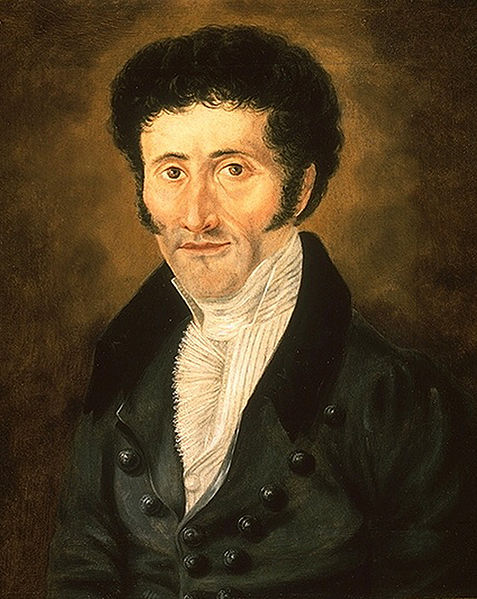
Unless you are a literature/horror aficinado, you may never have heard of Ernst Theodor Amadeus Hoffmann, a German writer from the late 18th century. He predated Poe by almost half a century and in his time was probably as well known then as Stephen King and Clive Barker are today. His stories were considered terrifying in his time. Several of his stories were the basis for the well-known opera by Jacques Offenbach “Tales of Hoffmann”. If you have never heard the music from this, it would be worthwhile to listen for it or to buy a CD of it. It is very impressive. As with the photo of Stoker, I obtained this image from Wikimedia Commons, where it is listed as being in the public domain.
Tag: writing
Bram Stoker
Balance
Writing horror is a grim pastime. One spends many hours delving into the darkest aspects of the human soul. One’s mind is filled with murder, torture, violence, hatred, as well as characters, places, and situations that belong in the deepest pits of Dante’s Inferno. Granted, out of these depths often arise heroes who triumph over the evil surrounding them and thus bring out the highest and noblest aspects of the human spirit, which may provide psychological comfort and spiritual salvation to the author, but journeying into darkness periodically will take its toll on anyone to some degree. I have to ask myself how many authors of horror fall victim to depression and other maladies of the spirit.
But now, let us take this scenario and turn it about into something positive, something uplifting. Let me pose this question to you, my readership, in hopes that the answers I receive will benefit not only myself, but everyone else who reads them: how do you, writers of horror, find relief from the psychological toll encountered during your sojourns into darkness? How do you balance out your lives so that you continue to see the beauty of the world around you and do no not stay imprisoned in the worlds of evil you create? Do you watch comedies at the movies? Do you take long walks along a tranquil coast? Do you cuddle with your children and pets? Do you collect the artworks of Thomas Kinkade or someone else who paints idyllic scenes of light and earthly paradise? Please let me and my readers know so that we can find new avenues out of our horror-filled ruts and blood-stained dungeons.
Whose skill with grammar do you admire most?
Most writers think of modeling their style after that of a famous writer. A large part of any writer’s style is his use of grammar. For example, Hemingway’s lean, muscular, sparse, style is well-known. His use of punctuation (which I am including under grammar) is also spare, using and where most writers would use commas in a rhetorical technique known as syndeton. Whereas Hemingway’s minimalist approach is masterful, somewhere in the middle of the scale is Mario Puzo (The Godfather) whose mediocre grammar skills often show up in comma splices and dangling prepositions. The writer I consider a master of both style and grammar is F.Scott Fitzgerald (The Great Gatsby).
My question to you is: whom do you consider to be a master grammarian/stylist?
The Unrecognized Masters of Horror
If they tried really hard, the majority of the public could perhaps name only four writers of horror: Stephen King, H.P.Lovecraft, Edgar Allan Poe, and Clive Barker. Fans of the horror genre could doubtlessly name many more with the number of the authors they could name reflecting the intensity of their interest. For example, a person who can name fifteen authors of horror most likely has a more intense interest in the genre than someone who can name only five.
I would say that it is a safe bet that one or more of these authors are the topics in least 75% of all the conversations about horror literature going on at any one moment. While we amateurs can improve our skills from studying these four, I think we have a lot to learn from studying authors other than these four.
I recently read a compilation of stories that Lovecraft cites in his work “Supernatural Horror in Literature”. Of course, only Poe appears among his cited predecessors. Most of his influences are writers probably most of the modern public has never heard of (Lord Dunsany, Edward Lucas White, Arthur Machen, etc.) though they were as well known in their time as Dean Koontz and Peter Straub are today.
My question to you is: who are the unrecognized masters of horror that the modern public should know but in all likelihood do not? Whose name does not usually make it into any top ten list of masters of horror but should?