 Here’s a good little bit of crime/horror over at The Drabble.
Source: Regrets: She Had a Few

Here’s a good little bit of crime/horror over at The Drabble.
Source: Regrets: She Had a Few
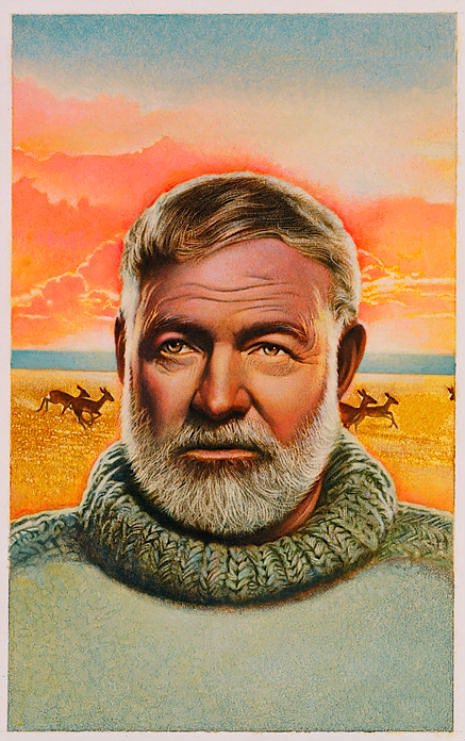
The primary influences on my writing have always been Hemingway and Fitzgerald. Based on what I have read, neither was a fan of metaphors. Somewhere in the back of my mind I seem to recall Hemingway once calling metaphors “the weakest of animals” or “the “weakest of literary devices” or something like that (I have searched for this quote and haven’t found it yet). Ergo, I have always shied away from metaphors and I have found that it has helped my writing immensely by forcing me to be creative in my comparisons and analogies. While searching in vain for Hemingway’s quotation on metaphors tonight, I ran across this quotation from George Orwell which makes a few good points:
“By using stale metaphors, similes and idioms, you save much mental effort, at the cost of leaving your meaning vague, not only for your reader but for yourself. This is the significance of mixed metaphors. The sole aim of a metaphor is to call up a visual image. When these images dash [sic] … it can be taken as certain that the writer is not seeing a mental image of the objects he is naming; in other words he is not really thinking.”
Metaphors are a bridge to another idea; they take the reader onto a tangent. If I say, “The hunter stumbled through the woods like a wounded bear,” I am shifting the reader’s visual image from that of the hunter to that of a bear. Yes, I give the reader a concise description of how the hunter was stumbling, and the reader can probably visualize the stumbling rather accurately, but wouldn’t the reader become more involved with the hunter and be able to visualize the scene more precisely if the hunter is described as if he were a wounded bear stumbling. Wouldn’t it also be a bit more of an intriguing psychological puzzle for the reader to solve and come to his own sudden epiphany of something like “Oh, he’s moving like a wounded bear!” For example:
The hunter, half-dazed from a blow to the head, his dark eyes fixed on some point on the dim horizon, staggered back and forth, bumping into trees, sometimes leaning against them to keep from collapsing into the hard-packed snow, dropping to one knee then rising slowly, painfully catching his breath, limping, often groaning, sometimes bellowing out in a desperate hope that someone passing through the distant shadows might come to his aid.
Isn’t that more dramatic? Doesn’t that involve the reader more into the actions and situation of the main character? Yes, it’s considerably longer, but now the reader can visualize precisely the hunter’s agonizing movements. Now, instead of having to visualize a bear, all attention is focused entirely on visualizing the hunter. Now you are forced to be creative, to use something other than Orwell’s “stale metaphors, similes and idioms” and have to use something more dynamic. No one can accuse you of not really thinking or of being lazy in your descriptions.
In short, if I want to compare two objects, I describe one using the characteristics and attributes of the other. If I have done it well, the reader will see the likeness between the two, but will still remained focused, and maybe even more intensely, on the subject.

I have used this method for some time now, and I believe it has strengthened my works considerably.
For more on this method of describing objects, see my article on the Tao of Writing Part 3: Talking about Dogs.
Thoughts? Comments?
 Source: Victim/Victor
Good story from The Drabble. If you are not familiar with them, they are dedicated to publishing fiction and non-fiction of 100 words or less. They occasionally post a story that breaks into horror, such as this one (reminiscent of the French conte cruel), but the site is definitely worth visiting just to see how writers handle the challenge of extreme brevity. The Drabble generally publishes one story per day, and you can be included in their feed to have it sent to you. You can find them at https://thedrabble.wordpress.com.
Thoughts? Comments?
Today on Twitter I stumbled on a good source of nano horror: https://twitter.com/tweetsthecreeps. Their tagline reads “For when

horror flash fiction isn’t quite short enough, these tweets seek to elicit a shudder, shock, or wicked laugh within the strict limit of 140 characters.” I look forward to @tweetsthecreeps submitting to this blog. Here are four samples:
The smell of death was something the neighbors got used to. When an arm came unearthed, everyone assumed it was a Halloween decoration.
I’m applying for a job at the blood bank but #MyResumeDoesntMention any of my early job history covering the period from 1837 until 1972.
I finally decided who I want to be for Halloween. Her skin will fit me beautifully if I get it off in one piece.
I always thought my bed’s warmth was just a matter of quality, ’til I turned in early & saw someone scramble out of it, into the crawlspace.
Thoughts? Comments?

After some consideration, I have decided to change the format of this blog from publishing only my own thoughts on the horror genre to that of a magazine printing submitted articles and works of fiction. I would like to explore the breadth and depth of horror as an art form, but that will never happen so long as I am showcasing only my own works, viewpoints, discoveries, and analyses, for which my other commitments allow little time. I am doing this for my own education and enlightenment as well as for that of my readership. Please visit my Submissions page to read the guidelines for what I would like to publish.

As I was preparing to go to the local theatre this evening, I was thinking about how I can improve my writing and what distinguishes the great writers of horror. Of course, the first two that came into my mind as being easily discernible from all others were Poe and Lovecraft. Obviously, what distinguishes them is their use of language. Both use very intense, muscular language with a distinctly archaic tone. Not knowing if there a precise term already exists for this style, I decided to call it “the dark language”, because of its tight connection with the horror genre and with the horrifying in general. For me, there seems to be something archetypal about this, arising out of the Jungian collective unconscious. Perhaps it is just that Poe bound the Dark Language so intimately with scenes of horror, terror, and suspense, which is also bound with genres such as the Gothic novel, that the sound of it automatically brings forth societal memories of dread.
I need to finish dressing if I am to dine at my favorite local sushi restaurant before heading to the play. Somehow, I just have the taste for something raw tonight.
Thoughts? Comments?
Just now, I created a facebook page for the Art of Horror at https://www.facebook.com/slatterysartofhorror. Drop by, check it out, and friend me. Posts from this blog should feed automatically to Facebook as well as from my Twitter account.
The other day I found and posted a good article on submitting to magazines. Today I found a good article on cover letters (via Nightmare Magazine) at Inkpunks.com. In my experience, this is some sage advice. I recommend highly that you visit Nightmare Magazine, peruse their guidelines, and then follow their link to the Inkpunks.com page on cover letters. As with Jersey Devil Press, I recommend visiting both sites and maybe submitting something, if the sites are to your taste and if you think your work is to their tastes. Below the article I have posted an example of one of my own cover letters and give a few comments on it.
The following is a slightly modified repost from my personal blog, http://inkhaven.net.
Submitting to short fiction markets can be very scary for newcomers, and there is a whole lot of confusing advice out there. I’m here to help.
First, though: you guys with the long lists of publications, who have your editors on your Christmas card lists and are now submitting reprints and selling rights I’ve never even heard of, you can wait over there in the bar. And you too, you newly-minted pros who have been doing the submission/rejection slog for a few years now–you should go buy those other guys drinks and network a little. We’ll come join you in a minute.
The rest of you, huddle up.
We’re going to talk about our cover letters today: those things that we agonize over, that First Impression that we are all SO WORRIED about. Do I sound like a real writer? Did I rank high enough in that contest entry? Do my college credits count as professional credits? What about my work as an astrophysicist, that surely qualifies me to write SF, doesn’t it?
Stop worrying.
I will tell you a secret: when submitting fiction to SFF markets, your cover letter is meant to do THE EXACT OPPOSITE of what it’s supposed to do in the rest of the world.
I’ll explain.
Out There–in the job market, academia, whatever–your cover letter is meant to impress. You are expected to drop names. You are supposed to include the most tangentially related accomplishments you can think of. You are meant to inflate it with every credit you can muster. Out There, cover letters become masterful works of fiction: spells cast to cloud the reader’s perception, to convince them to trust us and believe that we are the right person for the task. It is absolutely natural to assume that the same holds true when writing a cover letter for an SFF market.
Natural, but wrong.
The information on the internet reinforces the myth of the Inflated Cover Letter. You’ll see this perfectly reasonable-sounding advice given to writers on a regular basis. Sometimes it’s even in the submission guidelines of your favorite publication:
– Include your publication credits
This is terrifying to a new writer who doesn’t have any. We want to do it right, so we wrack our brains, thinking we have to put something there. Do I include my high school newspaper experience? What about that essay I published in our local Arts & Entertainment paper? I placed 15th in that one fiction contest–that means I was better than the other contestants who placed lower, right?
I know! It’s a horrible mental knot that we tie ourselves into, but the answer is really very simple: Leave it out.
If you do not have semi-pro or pro publication credits, anything less is not a substitute for them. This includes college courses, workshops, contests, university publications, and anything else that did not pay you Actual Money of at least 3 cents/word. Those other things are not examples of professional quality work, and including them can actually hurt you if the reader has a low opinion of any of them.
There are exceptions: there are fanzines with immaculate reputations; a contest that comes to mind that is considered very credible in the field; workshops that most of us would give our eyeteeth to get into. You know which ones those are, if you’ve published in them, placed in it, or attended them. If not, don’t list lesser ones.
And then there’s the advice that sends us all into sweating fits of anxiety:
– Explain why you’re the best person to write this story
No. Stop. Just…NO.
I’d seen this advice treated on the internet as general wisdom for years, but it never made any sense to me, not for what I was writing. What comes of this ABSOLUTELY TERRIBLE advice are sorrowful, worry-filled cover letters that say things like “I’m a stay-at-home mother, but I’ve been reading SFF for as long as I could read, and have taken several creative writing classes at Local Community College.”
When an agent at a conference offered it up again to the workshop I was in, I seized the opportunity to clarify. I said approximately the following:
“WTF. I’m writing about DRAGONS/WIZARDS/ZOMBIES/VAMPIRES/SPACESHIPS/ALIENS. I do not have direct experience with any of those things. I’m the best person to write this story because…I have an active imagination?”
He changed the subject. It was almost as if he himself didn’t know why he was advising it. Or it might have been my demeanor, which was admittedly exasperated. Either way, my class didn’t get an answer.
What I’ve since learned is that it’s advice that came from non-fiction publishing, where yeah, your experience with your subject matter counts. It does not scale to SFF short fiction. Ignore it. STOP WORRYING. NOW.
One more thing you want to leave out of your cover letter is what rights you’re offering. If you read the guidelines (and you DID read the guidelines, and followed them TO THE LETTER, didn’t you?) you know which rights they’re buying. They are not going to negotiate with you on that. Including it tells the reader that a) you didn’t read the guidelines, and b) you are concerned that the publisher is going to steal your rights from you. They’re not. It’s okay. They’re professionals.
That’s what not to include in your cover letter. Let’s talk about what you should include. You’ll be shocked. Seriously. This is the easiest, most worry-free thing you have ever done. It never needs to take up another cycle in your brain that would be better spent making art. Ready?
Dear Sue Doe, [Editor’s actual name. Many editors are INCREDIBLY PICKY about this. My boss is not, but many are. If there are many editors and sub-editors, use the name of the highest-ranking editor.]
Please find attached my short story “Epic Tale You Totally Want To Buy” (2500 words, Fantasy) for your consideration. [Title. Word count. Genre if market accepts more than one. If they only accept one genre, do not submit a different genre to them. Natch.]
My work has previously appeared in Realms of Fantasy and Fantasy & Science Fiction. [THIS IS OPTIONAL.] I am a graduate of the Odyssey Fantasy Writing workshop. [ALSO OPTIONAL.]
Thank you for your time and attention.
Regards,
Jane Smith
123 Main Street
Smalltown, PA 12345
jane.smith@somewhere.com
123.456.7890
THAT’S IT. That’s all. Do not inflate. Do not be clever. Do not include a bio unless the guidelines specifically ask for one.
So here’s the point: in the rest of the world, cover letters are meant to impress. In the SFF world, they just need to not bias the reader against you.
Look, we’re already up against how the reader’s day job went, how much sleep they got, whether their kids are driving them crazy, the state of their general health, their financial troubles, and whether or not their relationship is working. We’ve got a LOT working against us. As new writers and budding professionals we do not want to add to that.
I’m going to keep hammering these numbers home: 400-600 submissions PER MONTH. 2-5 available slots PER MONTH. They are not looking for reasons to love your words; they’re looking for reasons to cull them from an overwhelming pile. Do not give them a reason to doubt your ability before they’ve even seen your story. Let the work speak for itself.
So tell them what they need to know and tell them nothing that they don’t. Click Send, and update your submissions spreadsheet.
Now go take your rightful place over there in the bar with the rest of the writers. It’s where you belong. You earned it.
(And then get to work on your next story.)
This is the format I generally follow, but I will be modifying it, when appropriate, according to the Nightmare Magazine’s Guidelines.
Dear Editor(s), [I use this if I cannot find the editor’s name.]
Please accept my story for publication. It is entitled “Alien Embrace” and it is 4,954 words long. It has not been previously published and it is not being submitted elsewhere at this time. [The three most common questions editors have in my experience is word count, is the story being submitted elsewhere, and has it been previously published. Therefore, I make these part of my cover letter’s boilerplate and state the answers up front in their own paragraph.]
Bio: Phil Slattery is a native of Kentucky. He has traveled extensively and currently resides in Aztec, New Mexico. His fiction has been published in Futures Mysterious Anthology Magazine, Ascent Aspirations, Medicinal Purposes Literary Review, Dream Fantasy International, Wilmington Blues, Möbius, Spoiled Ink, Midnight Times, Six Sentences, Sorcerous Signals, Every Day Fiction, Flash Fiction World, Through the Gaps, and Fiction on the Web. More on his writing can be found at www.philslattery.wordpress.com. His twitter handle is @philslattery201. [The Nightmare guidelines are great advice if you have been published at semi-pro or pro rates, but I have not been yet. Therefore, I list where I have been published, unless the editor states not to. I never know if or which any of my previous publication credits will impress an editor, so I list them all. After I start being paid regularly at semi-pro or pro rates, then I will whittle these down. I always write the bio in the third person, so that the editor can simply copy and paste it into place. ]
Sincerely,
Phil Slattery
I keep this standard format and a few variations in a Word file and update it whenever something else of mine is published. If I have to modify it substantially for a particular editor, then I keep that format on file as well, in case someone else wants it that way.
Bottom line: the best advice I can give for formatting a cover letter and what to include in it is to read carefully what that editor wants and follow it to a T. If the editor is not specific, then the above guidelines are a good, solid, professional way of introducing yourself and stating what most editors want to know. I have found that the easiest way to be published is to make it as easy as possible for the editor to publish me.
Thoughts? Comments?

Around 8:30 tonight I sent off a bit of nanofiction entitled “Warehouses and All” to Beechwood Review, hoping to hear from them in 1-2 weeks. I went to the grocery and when I returned about 9:15 I checked my e-mail to find that it had already been accepted. The editor, Richard Heby, commented “Touching, sharp, very good Phil! I’ll accept it for issue 2.”
The story is based on a story told to me by the assistant agricultural attache to Sudan (though the story is set in Somalia), when I happened to meet her on a tour to the temple of Luxor, when I was stationed at the US embassy in Cairo in 1989. “Warehouses and All” was first published in Six Sentences (www.sixsentences.blogspot.com) on September 22, 2009.
I do not know when issue 2 will come out, but issue 1 was for Summer, 2015. I assume issue 2 will be out soon.
Many thanks to Mr. Heby for accepting my work.
Thoughts? Comments?

This I share with you tonight for entertainment and because it addresses one or two issues affecting writers in general.
I was searching for somewhere to publish a very short work (probably nanofiction) of mine tonight and I came across the submission guidelines at Jersey Devil Press. I love guidelines that show a sense of humor and a free spirit while being straightforward and honest and theirs does just that. They also offered more detailed guidelines, which I found a quite enjoyable read. I also found that these guidelines do not provide just good advice for their own publication, they provide good advice that any author submitting to any publication would be wise to heed: advice on formatting, staying away from overused topics, good taste, sensitive subjects, etc. As they use at least one or two examples that touch on horror, I thought I would post the part on their selection process tonight for your perusal. If you have a chance and the time, check out their guidelines on their website and the rest of the publication as well…and maybe submit something as well…and maybe give them a pat on the back for a job well done.
By the way, I ended up not submitting to them, because my story did not meet a requirement. That’s why I read guidelines.
Thoughts? Comments?
We thought we’d take a moment to shore up our submissions guidelines and give you a little peek into our selection process.
First, our goal: To publish stories non-writers would actually want to read. We prefer funny, weird, and, above all, entertaining; sober melodramas generally don’t fly so well with us. There are certainly exceptions, but that’s largely because they’re exceptional.
Second, previously published works: We accept them, but we want to clarify that a bit. By “previously,” we literally mean “previously.” If it’s currently published, i.e. something that is available online elsewhere, or if it’s part of the book you just released, that seems a little greedy to us. If it’s only on your own personal website or a forum or something, though, don’t sweat it.
Accepting and rejecting story submissions is, by nature, subjective. Short of grading them entirely on quantifiable variables, like the number of adverbs or something, there’s not much we can do to change that. So, to level the playing field a bit, we thought we’d give you a little heads up regarding our own personal peeves and predilections.
Also, a pre-emptive apology to anyone who thinks we’re singling out their story: We’re not. Not a single theme mentioned below is a one-off. These are all popular, repeat offenders that we’re simply not that fond of.
Eirik’s list of things that should be stopped forever:
Vampires. I think Twilight is stupid. I’m sorry, but I haven’t been even moderately interested in vampires since “Angel” got cancelled.
Mob stories. If the entire story is just two guys talking in “goomba” speak, please don’t. I’ve met people with mob ties in real life and they’re generally assholes. And, honestly, you’re never going to out-Soprano the Sopranos.
College professors seducing/being seduced by young, nubile co-eds. What college did you go to where this was actually happening? In general, any regularly used plot line in a porno is a no-no.
Thinly veiled drug metaphors. You think drugs are bad. We get it. We don’t care. At the very least get a thicker veil.
Monica’s justifiable grounds for homicide:
Male writers writing female narrators. While it’s not impossible to do this, the vast majority of men writing women don’t seem to have ever talked to a woman before in their life. If your female narrator is shallow, stupid, and unable to do anything in her life that does not revolve around men, don’t send it.
And if you’re reading this thinking, “Well, of course she’d think this, she’s a woman,” then YOU’RE THE FUCKING PROBLEM. You can keep trying, though, if you really want to. Interesting side note, Monica once stared at a man with such disdain that he actually BURST INTO FLAMES. Don’t say you weren’t warned.
Stereotypical minority characters. This kind of goes hand in hand with the above. If you’re writing a black man, try actually talking to one. It’s 2010, people. We shouldn’t be getting offended anywhere near as often as we do by the way people are treating characters of various backgrounds.
Unanimously awful topics:
Erotica. Actually, this one doesn’t bother us, but we’re never going to publish it. If you want to keep sending it though, for our own personal amusement, knock yourself out.
Rape. No. Bad. We don’t really need there to be any more rape in the world than there already is. Monica would also like to clarify that any sort of sexual act perpetrated without both parties’ consent is rape. Again, we’re surprised how often people don’t seem to know what the fuck they’re writing.
Relationship drama. While this seems to be a staple of literature, it is also very often boring as all hell. If your story’s just two people moping around, maybe find somewhere else to send it. If they’re doing it while juggling cats, though, you’ve got our attention.
On the flip side, here are a few things we wouldn’t mind seeing more of:
Strong female voices. We know you’re out there.
A light-hearted view of the world. Fiction does not have to be so God damned grim.
Truly bat-shit insane fiction. If you’re worried that what you just wrote is too ridiculous to be published, send it.
Again, please don’t take any of the above personally. We’re simply giving you a glimpse into our own tastes. We’re not saying that the themes mentioned above are bad or shouldn’t be written about (well, we’re not saying it about most of them anyway), but simply that we’re really not that interested in them. Your story about a bunch of mobsters being raped by vampires may very well be the best story about mobsters getting raped by vampires ever written. It may deserve to win the Nobel Prize for Literature. And we may even say as much. But it doesn’t mean we have to like it.
Besides, there are plenty of other fish in the sea. Of course, you better make damn sure you read THEIR submission guidelines before you start sending shit. I don’t want to get blamed for a rash of vampire stories getting sent to a site looking for memoirs and poetry.
But if your heart’s still set on submitting to JDP, head on over to submishmash
A few minutes ago I received an e-mail saying that my short story “Sorcerer” has been accepted by Creepy Campfire Quarterly. It will appear in their third issue, which will appear on July 20, 2016. Please check them out and buy a copy or two. Also check them out on Facebook. There are several users with a name containing “creepy campfire”, but theirs is Creepy Campfire Quarterly. Their Facebook address is https://www.facebook.com/Creepy-Campfire-Quarterly-CCQ-1580122065546001/timeline/. Their website is http://www.emppublishing.com/creepy-campfire-quarterly.html.
This marks the first time I will be paid for my prose (not a lot, but enough to know my work is appreciated).
“Sorcerer” is a tale of horror and revenge about a modern day sorcerer who comes out of retirement to take a unique vengeance on the callous Don Juan who seduced and abandoned his daughter, who dies during childbirth.
Many thanks to Jennifer Word and her staff for publishing my work.
This is the sixteenth time “Sorcerer” was submitted for publication since I first sent it out on December 29, 2012. Persistence pays off. However, I feel lucky that this was only the 16th time. I know a lot of stories have to be submitted many more times before they finally see success. I think I have at least a few that surpass sixteen submissions (though I haven’t compiled the statistics yet).
Thoughts? Comments?

Today I finished reading “The Vampyre” by John William Polidori. Polidori was a friend of Lord Byron and wrote this story during the famous writing contest between Byron, Polidori, Percy Bysshe Shelley, and Mary Shelley, in which Mary Shelley wrote the initial draft of “Frankenstein” (see my post on Polidori and “The Vampyre” dated July 12, 2013). Tonight I wrote up a quick review for Goodreads, which I have pasted here for your enjoyment. I gave the story three stars out of five.
“The action was somewhat fast moving and the ending unexpected, but the plot is rather simple and the narration is hampered by a lack of dialog. There are probably less than five lines of dialog in the entire story of 9,223 words (I copied and pasted the story from the Project Gutenberg version minus the “Extract of a Letter from Geneva” and the “Extract of a Letter Containing an Account of Lord Byron’s Residence in the Island of Mitylene” into Word then used their word count feature). One interesting aspect of Lord Ruthven’s (the vampire) character is that he cannot survive on just anyone’s blood; he has to feed only on the blood of those he loves. That would make an interesting twist to any vampire tale. As the Goodreads summary notes, this is also the start of the motif of the vampire as aristocratic seducer. While this story is probably of mediocre quality at best for today’s literary audiences, it is interesting from the perspective of literary history as the origin of today’s vampire stories and all the cultural offshoots that have sprung from those (such as the Goth movement). Bottom line: it’s worth taking the time to read, especially if one has an interest in the historical basis for today’s horror literature and the vampire subculture.”
Thoughts? Comments?
I was sitting here writing a short story when it occurred to me that most characters in classic fiction seldom have detailed descriptions of their physical characteristics. In fact, many have none at all. If they are described, it is usually in a broad, general way, unless there is some detail the author wants to bring out that reveals something about the character. While this is a good technique for lean, muscular writing, it also has the benefit of not limiting how the character appears in the reader’s mind. For example, here is the initial description of Victor Frankenstein when the narrator’s ship rescues him in the arctic in letter 4 (which functions in essence as part of a preface):
“Upon hearing this he appeared satisfied and consented to come on board. Good God! Margaret, if you had seen the man who thus capitulated for his safety, your surprise would have been boundless. His limbs were nearly frozen, and his body dreadfully emaciated by fatigue and suffering. I never saw a man in so wretched a condition. We attempted to carry him into the cabin, but as soon as he had quitted the fresh air he fainted. We accordingly brought him back to the deck and restored him to animation by rubbing him with brandy and forcing him to swallow a small quantity. As soon as he showed signs of life we wrapped him up in blankets and placed him near the chimney of the kitchen stove. By slow degrees he recovered and ate a little soup, which restored him wonderfully.
“Two days passed in this manner before he was able to speak, and I often feared that his sufferings had deprived him of understanding. When he had in some measure recovered, I removed him to my own cabin and attended on him as much as my duty would permit. I never saw a more interesting creature: his eyes have generally an expression of wildness, and even madness, but there are moments when, if anyone performs an act of kindness towards him or does him any the most trifling service, his whole countenance is lighted up, as it were, with a beam of benevolence and sweetness that I never saw equalled. But he is generally melancholy and despairing, and sometimes he gnashes his teeth, as if impatient of the weight of woes that oppresses him.”
Very little is said about Frankenstein’s physical state except where it reveals something about his state of mind or gives an idea of the hardships he has suffered in pursuit of his creation. Because the physical description is so minimal, the reader may envision Frankenstein in any physical form that he wants or whatever is easiest for him to envision (there is a difference between what we may want to envision and what is easiest or most natural for us to envision). Frankenstein could be short and dark-haired and dark-complected or tall and blonde and sunburned. Later on, we learn his family is from Geneva, therefore the reader could envision him as whatever his stereotype of a Swiss man from Geneva happens to be.
Using minimal physical description is therefore an advantage to the author, because it allows the reader to more easily visualize and thus more easily experience the story vicariously, i.e., it allows the reader to more easily immerse himself in the story. We have all experienced the feeling of being completely immersed in the world of a novel, what Henry James called “the atmosphere of the mind” (see the definition in the Lexicon of Horror) and that is a feeling I want my readers to experience.
Thoughts? Comments?
Just now, I finished pasting Stephen King’s famous quotation on the three types of terror into my page on “Thoughts on Horror from the Masters” and I remembered that yesterday I was trying to remember the quotation, but could only recall a vague impression of it. Thinking on that impression now, I think that it was just as valid and true a one as the one by Mr. King, but simpler, more compact, and easier to remember. The concept is (I’ll refine this a little for the sake of clarity):
The three most common types of horror are: suspense (knowing someone runs the risk of decapitation at any moment), terror (seeing him/her being decapitated), and disgust (watching the head roll down the stairs).
I don’t think this idea should replace Mr. King’s by any means, but should probably be viewed as a simplification of his rather lengthy statement.
There are also probably a hundred more different flavors (i.e. variations of the sensation) of horror but these are the three that seem to me to be the most common, at least in movies and other popular media.
Thoughts? Comments?
 I added verbocrap, verism, logorrhoea, macrology, the Vice, ficelle, and several others.
 Phil Slattery, Writer, Publisher