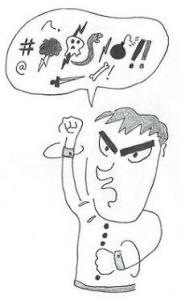
Here’s an interesting with an interesting perspective. It discusses all the non-verbal obscenities that appear in film, such as obscenities on t-shirts or in graffiti in the background. I am not a prude by any stretch of the imagination, but I believe that too much obscenity turns off a certain portion of a writer’s readership. On the other hand, sometimes a scene is of such intensity that it demands obscenities just to keep it plausible (e.g. some of the stories I am working on are set in hell, where obscenity-littered speech would be the norm). As is said in Ecclesiastes: “For everything there is a season.”
What this article inspires in me though, is not half-assed prudery or some type of literary caution or self-imposed censorship, but it opens up my mind to subtle places where I might place obscenities to express some subtlety of meaning or atmosphere.
I received this writing prompt from The Daily Post on November 8: “What’s the date today? Write it down, remove all dashes and slashes, and write a post that mentions that number.”
I started to write a glib response about numerology, but then a bell went off in the back of my mind.
While I don’t believe in numerology, I do like to toy with things like this in my writing for the enjoyment of people who do. Having been a graduate student at one time, I know how grad students and other literati like to analyze a text to the nth degree, searching for hidden but profound meaning in every nuanced word or misplaced comma. I seldom do this with the intent of relaying some arcane theme (people will interpret stories however best fits their worldview anyway), but just so the literati will have some fun analyzing and arguing about the story. For me, this is part of the fun of writing. But the more practical side of me also sees it as a way to build up a readership.
One way for a story to become known is via word of mouth. They will discuss the book if they find it interesting or they find something in it to argue about with their colleagues in the English Department or with friends at work or with like-minded enthusiasts at the local book club. So I give them something to debate.
Mostly, the understated connections I use are meaningless. For example, I have been working on a sci-fi short story in which I wanted to mention a sidearm astronauts 200 years from now might carry, but I did not want to use a type of space weapon that has become a cliché in the sci-fi world like a Star Trek phaser or a Star Wars blaster or a Flash Gordon ray gun. I named it the Hawking S-505 Black Particle sidearm. Hawking, obviously, for Stephen Hawking, who I am sure will have tons of scientific stuff named for him in the future including spaceports and starships. “Black Particle” as a form of dark energy relating to dark matter, which is cutting edge science these days, but will probably be trite in two centuries. S-550: the “S” is for sidearm; 550 is a US highway that runs through the town where I live currently. If I need a number, such as a serial number, I often use an old phone number or my birthdate or some other useless bit of trivia. As the original post from The Daily Post suggested, I might use a form of today’s date or some other date with meaning in my life. If the subject relates to magic(k), I might consult a book on numerology and choose/compose something appropriate. For example, in one horror story I have been writing for a long time, the protagonist walks through a tunnel under a dilapidated castle, where black magick was once practiced. The sides of the tunnel are covered in symbols and numbers including the number “4”, which symbolizes evil in some traditions.
For the names of characters, I frequently glance at the bookshelf to the right of my easy chair, where I write on my laptop, and combine the names of two authors to produce a name that has the right “sound” for the character or I might combine names from history or art or some other field. For example, I see I have one book by Bill Moyers and another by George Plimpton. I might name a character Bill Plimpton. In another sci-fi work (yet to be published) I needed the names for a nine man reconnaissance team to go aboard a derelict starship. I went to Google Translate and took the word for “warrior” from nine languages ranging from Gaelic to Swahili, so none would be immediately recognizable as a word for warrior (at least in the US), yet the names would express the cultural diversity of the crew.
Anyway, for me that is part of the fun of writing. How do you have fun with your writing?
Good story from The Drabble. If you are not familiar with them, they are dedicated to publishing fiction and non-fiction of 100 words or less. They occasionally post a story that breaks into horror, such as this one (reminiscent of the French conte cruel), but the site is definitely worth visiting just to see how writers handle the challenge of extreme brevity. The Drabble generally publishes one story per day, and you can be included in their feed to have it sent to you. You can find them at https://thedrabble.wordpress.com.
Working on a play in Hasting’s Hardback Café, late evening, October 16, 2015.
As I was preparing to go to the local theatre this evening, I was thinking about how I can improve my writing and what distinguishes the great writers of horror. Of course, the first two that came into my mind as being easily discernible from all others were Poe and Lovecraft. Obviously, what distinguishes them is their use of language. Both use very intense, muscular language with a distinctly archaic tone. Not knowing if there a precise term already exists for this style, I decided to call it “the dark language”, because of its tight connection with the horror genre and with the horrifying in general. For me, there seems to be something archetypal about this, arising out of the Jungian collective unconscious. Perhaps it is just that Poe bound the Dark Language so intimately with scenes of horror, terror, and suspense, which is also bound with genres such as the Gothic novel, that the sound of it automatically brings forth societal memories of dread.
I need to finish dressing if I am to dine at my favorite local sushi restaurant before heading to the play. Somehow, I just have the taste for something raw tonight.
Relaxing by the front yard firepit on a chilly New Mexico evening circa 2013.
I was sitting here writing a short story when it occurred to me that most characters in classic fiction seldom have detailed descriptions of their physical characteristics. In fact, many have none at all. If they are described, it is usually in a broad, general way, unless there is some detail the author wants to bring out that reveals something about the character. While this is a good technique for lean, muscular writing, it also has the benefit of not limiting how the character appears in the reader’s mind. For example, here is the initial description of Victor Frankenstein when the narrator’s ship rescues him in the arctic in letter 4 (which functions in essence as part of a preface):
“Upon hearing this he appeared satisfied and consented to come on board. Good God! Margaret, if you had seen the man who thus capitulated for his safety, your surprise would have been boundless. His limbs were nearly frozen, and his body dreadfully emaciated by fatigue and suffering. I never saw a man in so wretched a condition. We attempted to carry him into the cabin, but as soon as he had quitted the fresh air he fainted. We accordingly brought him back to the deck and restored him to animation by rubbing him with brandy and forcing him to swallow a small quantity. As soon as he showed signs of life we wrapped him up in blankets and placed him near the chimney of the kitchen stove. By slow degrees he recovered and ate a little soup, which restored him wonderfully.
“Two days passed in this manner before he was able to speak, and I often feared that his sufferings had deprived him of understanding. When he had in some measure recovered, I removed him to my own cabin and attended on him as much as my duty would permit. I never saw a more interesting creature: his eyes have generally an expression of wildness, and even madness, but there are moments when, if anyone performs an act of kindness towards him or does him any the most trifling service, his whole countenance is lighted up, as it were, with a beam of benevolence and sweetness that I never saw equalled. But he is generally melancholy and despairing, and sometimes he gnashes his teeth, as if impatient of the weight of woes that oppresses him.”
Very little is said about Frankenstein’s physical state except where it reveals something about his state of mind or gives an idea of the hardships he has suffered in pursuit of his creation. Because the physical description is so minimal, the reader may envision Frankenstein in any physical form that he wants or whatever is easiest for him to envision (there is a difference between what we may want to envision and what is easiest or most natural for us to envision). Frankenstein could be short and dark-haired and dark-complected or tall and blonde and sunburned. Later on, we learn his family is from Geneva, therefore the reader could envision him as whatever his stereotype of a Swiss man from Geneva happens to be.
Using minimal physical description is therefore an advantage to the author, because it allows the reader to more easily visualize and thus more easily experience the story vicariously, i.e., it allows the reader to more easily immerse himself in the story. We have all experienced the feeling of being completely immersed in the world of a novel, what Henry James called “the atmosphere of the mind” (see the definition in the Lexicon of Horror) and that is a feeling I want my readers to experience.
Just now, I finished pasting Stephen King’s famous quotation on the three types of terror into my page on “Thoughts on Horror from the Masters” and I remembered that yesterday I was trying to remember the quotation, but could only recall a vague impression of it. Thinking on that impression now, I think that it was just as valid and true a one as the one by Mr. King, but simpler, more compact, and easier to remember. The concept is (I’ll refine this a little for the sake of clarity):
The three most common types of horror are: suspense (knowing someone runs the risk of decapitation at any moment), terror (seeing him/her being decapitated), and disgust (watching the head roll down the stairs).
I don’t think this idea should replace Mr. King’s by any means, but should probably be viewed as a simplification of his rather lengthy statement.
There are also probably a hundred more different flavors (i.e. variations of the sensation) of horror but these are the three that seem to me to be the most common, at least in movies and other popular media.
I was just sitting here contemplating a couple of my stories and how I could improve them before I send them out for publication once again, when something occurred to me. At the moment I was thinking about what makes a satisfactory ending to a story for the general public. A story can be either simple or complex (in characterization, plot, backstory, all of the aforementioned, or whatever) and it can have either a simple or complex ending. How they are paired determines how the reader emotionally and intellectually responds to the story.
A simple story with a simple ending is probably the least satisfactory type of story. It is no challenge to most people and is not likely to stimulate interest. It is boring.
A simple story with a complex ending is probably not entertaining or satisfactory to most people, but it will stimulate the interest of a few. Not many people like or tolerate complex solutions to simple problems.
A complex story with a complex ending is satisfactory to some people, i.e. those intellectuals or faux intellectuals who enjoy complex matters, but these won’t be the majority.
A complex story with a simple denouement is probably the most satisfactory to most people. It stimulates the mind and enlightens the reader, helping him/her to see reality or the problems of reality in a new light. I have written often about a reader enjoying the vicarious experience of a story. It is the same with a complex story with a simple ending. The reader experiences the story vicariously; he/she feels the vicarious joy of having solved the problem along with the protagonist and any other characters accompanying the protagonist through the story.
About. Here is an interesting blog on writing. As you can see by my comment on the About page, it delves into the essence of writing: communication, the clear transmission of an idea from one person to another.
With Iced Tea, Farmington, New Mexico, March 20, 2015
As you may already know, I am on Goodreads quote of the day mailing list. Today’s I found particularly interesting on a couple of levels:
“Atticus told me to delete the adjectives and I’d have the facts.” Harper Lee
First, there is the literary perspective. Eliminating the adjectives and other modifiers from a story leaves you with the simple, cold hard facts, the bones, of the story. I have read several bits of writing advice that advocate keeping modifiers to a minimum and using nouns and verbs to their fullest by using them precisely, trying to match the exact word to its underlying concept. To my mind, that leaves one with the essence of the story.
Second, there is the deeper, philosophical perspective. Like with the literary perspective above, if you observe or learn of an event, if you cut away all the extraneous opinions and descriptors and other crap, you will have the cold, hard facts of the matter. This is echoed in Hannibal Lecter’s famous quote from Marcus Aurelius (though this is actually a paraphrase…at least in my copy of Meditations of Marcus Aurelius): “Read Marcus Aurelius. Of each particular thing ask: what is it in itself? What is its nature?”. It is also echoed in Hemingway’s remark made during an interview in The Paris Review: “The most essential gift for a good writer is a built-in, shockproof, shit detector.”
Portrait of Nikolai Gogol circa 1840 from Wikipedia
This morning I have been going through all the daily updates I have been getting from Goodreads, but have not read. Here’s an interesting one.
“I am fated to journey hand in hand with my strange heroes and to survey the surging immensity of life, to survey it through the laughter that all can see and through the tears unseen and unknown by anyone.” –Nikolai Gogol
Goodreads notes: “Novelist and playwright Nikolai Gogol (born March 31, 1809) feared being buried alive. When his grave was exhumed, his body was lying face down, giving rise to the rumor that the author’s greatest fear had come to pass.” I read some of Gogol’s most famous works as an undergraduate and loved them. I need to re-read them just for the sheer pleasure of reading them. Gogol was an eccentric Russian (though born in the Ukraine) author/satirist of the early nineteenth century and is best known for his unfinished novel “Dead Souls” about a man who travels through the country buying up the dead. He is also known for his short stories, particularly “The Nose” a fantasy about a nose that detaches itself from its owner one day and takes on a life of its own and “The Overcoat”, a story about an impoverished government clerk (copyist, if I recall correctly), whose prize possession is a beautiful overcoat and who comes back from the dead to find it. He was known for being a satirist, rather than a writer of horror, but a few of his most famous works verge on what might be termed ghost stories or fantasy as can be seen above. He is a master author, however, and his works bear checking out no matter what your preferred modern genre is. Wikipedia has this to say about his style:
D.S. Mirsky characterized Gogol’s universe as “one of the most marvellous, unexpected – in the strictest sense, original[28] – worlds ever created by an artist of words.”[29] The other main characteristic of Gogol’s writing is his impressionist vision of reality and people. He saw the outer world romantically metamorphosed, a singular gift particularly evident from the fantastic spatial transformations in his Gothic stories, A Terrible Vengeance and A Bewitched Place. His pictures of nature are strange mounds of detail heaped on detail, resulting in an unconnected chaos of things. His people are caricatures, drawn with the method of the caricaturist – which is to exaggerate salient features and to reduce them to geometrical pattern. But these cartoons have a convincingness, a truthfulness, and inevitability – attained as a rule by slight but definitive strokes of unexpected reality – that seems to beggar the visible world itself.[30] The aspect under which the mature Gogol sees reality is expressed by the Russian word poshlost’, which means something similar to “triviality, banality, inferiority”, moral and spiritual, widespread in some group or society. Like Sterne before him, Gogol was a great destroyer of prohibitions and romantic illusions. It was he who undermined Russian Romanticism by making vulgarity reign where only the sublime and the beautiful had reigned.[31] “Characteristic of Gogol is a sense of boundless superfluity that is soon revealed as utter emptiness and a rich comedy that suddenly turns into metaphysical horror.”[32] His stories often interweave pathos and mockery, while “The Tale of How Ivan Ivanovich Quarreled with Ivan Nikiforovich” begins as a merry farce and ends with the famous dictum, “It is dull in this world, gentlemen!”
Relaxing by the front yard firepit on a chilly New Mexico evening circa 2013.
I recently purchased seasons 8 and 9 of the X-Files to complete my collection of the entire series. As you can note above, I am up to episode 6 of season 8: Redrum. No, it’s not based on The Shining or the famous line that sprang from there. This is a completely original script and I think one of the best X-Files. Why am I mentioning a Sci-Fi series in an article that should be about horror? This article is about good writing, whatever the genre.
I will endeavor to avoid spoiling the story for you.
As we all know, “redrum” is murder spelled backwards. This story is about a murder, but the alleged murderer finds himself traveling back in time to the day of the murder with the knowledge of how to prevent it.
I find the plot’s basic concept fascinating. A prosecutor (and friend of Agent Doggett) wakes up one morning to find himself in prison for the murder of his wife, about which he remembers nothing. As he is transferred to another facility for his safekeeping, he is assassinated. However, at that point time starts to flow backwards for him. Each morning he wakes up another day in the past (first he wakes up on Saturday, then on Friday, then on Thursday, etc.). With each day he learns a bit more about his predicament until finally he wakes up on the day of the murder and he has an opportunity to prevent it.
Unexpectedly traveling back in time is not a common theme, but it’s not rare either. I have to ask myself how Maeda and Arkin came up with the idea for this episode. Maybe it was based on amnesia; someone can’t recall his crime or immediate past and has to learn about it bit by bit, day by day, as the prosecutor does here. Maybe it arose out of a philosophical question such as “if we could travel back in time, we could change our future but would the ultimate destination be the same and all we change is the route we take to get there?” Maybe it was a thought that most stories show a protagonist going back in time to a certain point in time and then returning to the present; what if going back in time was not one big step, but several little steps. How could we change our lives in that case? What if as we traveled back in time, we knew as little about the past as we do about the future? We wouldn’t be able to convince those around us that we are traveling back in time, because we wouldn’t know any history to prove our story. They would believe us to be insane.
The whole scenario intrigues me. One man goes back in time for unknown reasons while the rest of the world around him proceeds as normal.
I have to ask myself what their creative process was.
This scenario opens up so many questions and possibilities. I love its originality. If you haven’t seen it, I recommend renting it as soon as possible.
We never find out what causes the protagonist to travel back in time. Like in a Stephen King novel, paranormal events happen out of the blue and at random. But according to Lovecraft’s theories of weird fiction, not knowing the cause/origin of a horrible event, makes the event more horrifying, because the event could happen to any one of us at any time.
A common principle of writing is “to suspend belief” (some say “to suspend disbelief”). In stories like this though, it is the natural laws of the universe that are suspended. Everything else, all the world/universe surrounding the event. is quite believable, which emphasizes just how weird the event is.
The story was written by Steven Maeda and Daniel Arkin. A quick search in Imdb shows that Steven Maeda has an extensive list of credits as either a writer or producer for such television series as X-Files, Lost, CSI:Miami, Helix, Lie to Me, and many others. Likewise Daniel Arkin has an extensive list of credits as a writer or producer for such shows as X-Files, Suits, Las Vegas, Alias, Medical Investigation, and others. I will have to watch for more shows with which either one is involved.
Relaxing by the front yard firepit on a chilly New Mexico evening circa 2013.
I picked up a copy of the latest issue of “Cemetery Dance” this evening and read the Stephen King short story “Summer Thunder”. This is a very interesting piece. I won’t spoil the ending for you, but the story is about a man, his dog, and his neighbor, who have survived a nuclear holocaust and are slowly succumbing to radiation poisoning.
This story was quite different from the other Stephen King stories I have read (which have been quite a few, though not all by any means). There is no supernatural factor in the story. There are also no twists or surprises. The story maintains the same pace throughout, just as the protagonists face the same things day in and day out until they die.
I would classify this story as horror-tragedy, because, even though it has very little of the blood and gore normally associated with the horror genre, it definitely has a horror “feel” to it, but that horror is subtle and understated. “Summer Thunder” sets up a tragic scenario and the horror finds its basis in watching these people suffer through no fault of their own. They were not involved in starting the war in any way; that was done by world leaders thousands of miles away. These are the common citizens, the “Everymen” that normally populate King’s works as protagonists, and who must pay the horrific price for their government’s actions. That is the tragedy and that is a large part of the horror.
What is also horrifying about the story is not the action described in it, but the scenario it describes, because this scenario is definitely one that could literally happen to each of us, should our government and/or other governments decide for whatever reason, to push the proverbial button. Each of us can (or perhaps should) see ourselves as the main character, who will be forced to watch his or her world disintegrate after a nuclear apocalypse.
That concept alone should be enough to bring the true horror of this story: that this scenario is, and has been for a long time, a real possibility for each of us.
The article is brief, but I won’t copy it here, because everyone with an interest in the art of writing should watch the accompanying five minute video of Steinbeck’s profound acceptance speech of the 1962 Nobel Prize. I will, however, copy below a short paragraph immediately preceding his six tips (I also highly recommend following the link to an entertaining and insightful Paris Review article on his observations on the art of fiction):
And for insights into how Steinbeck reached that pinnacle, you can read a collection of his observations on the art of fiction from the Fall, 1975 edition of The Paris Review, including six writing tips jotted down in a letter to a friend the same year he won the Nobel Prize. “The following,” Steinbeck writes, “are some of the things I have had to do to keep from going nuts.”
In earlier posts I mentioned that if one is to learn the art of writing, one must study the masters–regardless of genre. Writing well is writing well whether in mainstream literature, horror, romance, mystery, or whatever. After the basics of writing are mastered, then one can tailor stories to the accepted practices and traditions of his/her chosen genre. That is why I have been posting these articles with advice from horror and non-horror writers. Most of what they say is as applicable to horror as it is to mainstream literature or any other genre.
Tonight’s post is from Ray Bradbury. If you have not read The Martian Chronicles, run out and buy a copy or download one before you finish reading this article. You will find that it contains some of the most beautiful, poignant writing that you will ever encounter. I wish I could develop the skill that Bradbury shows and apply it to anything I write, whether it be a horror novel or a shopping list. Although this article will not help you do that, it will show you some of the important lessons that Mr. Bradbury learned in the school of literary hard knocks. The focus of the Open Culture article is a fifty-four minute video. The author of the article, Colin Marshall, summarizes the video into twelve points immediately below the video. I recommend watching the entire video before reading the twelve points, because you may or may not agree with Mr. Marshall’s summary.

 Source: Visual swears in film






 Phil Slattery, Writer, Publisher