Yes, I am once again opening up The Chamber Magazine. Click on the photo or the link to go to its revamped homepage. Check out the submissions page for what I am seeking and details on publishing with The Chamber (they are long but they boil down to pretty much the same standard policy at most online magazines).
Please retweet and reblog this, so that I can reach the most people.
Yes, I am once again opening up The Chamber Magazine. Click on the photo or the link to go to its revamped homepage. Check out the submissions page for what I am seeking and details on publishing with The Chamber (they are long but they boil down to pretty much the same standard policy at most online magazines).
Please retweet and reblog this, so that I can reach the most people.
Being a Fourth Extract from the Legacy of the Late F. Purcell, P. P. of Drumcoolagh
“All this he told with some confusion and
Dismay, the usual consequence of dreams
Of the unpleasant kind, with none at hand
To expound their vain and visionary gleams.
I’ve known some odd ones which seemed really planned
Prophetically, as that which one deems
‘A strange coincidence,’ to use a phrase
By which such things are settled now-a-days.”
BYRON.
Dreams–What age, or what country of the world has not felt and acknowledged the mystery of their origin and end? I have thought not a little upon the subject, seeing it is one which has been often forced upon my attention, and sometimes strangely enough; and yet I have never arrived at any thing which at all appeared a satisfactory conclusion. It does appear that a mental phenomenon so extraordinary cannot be wholly without its use. We know, indeed, that in the olden times it has been made the organ of communication between the Deity and his creatures; and when, as I have seen, a dream produces upon a mind, to all appearance hopelessly reprobate and depraved, an effect so powerful and so lasting as to break down the
Joseph Thomas Sheridan Le Fanu 1814-1873
inveterate habits, and to reform the life of an abandoned sinner. We see in the result, in the reformation of morals, which appeared incorrigible in the reclamation of a human soul which seemed to be irretrievably lost, something more than could be produced by a mere chimaera of the slumbering fancy, something more than could arise from the capricious images of a terrified imagination; but once prevented, we behold in all these things, in the tremendous and mysterious results, the operation of the hand of God. And while Reason rejects as absurd the superstition which will read a prophecy in every dream, she may, without violence to herself, recognize, even in the wildest and most incongruous of the wanderings of a slumbering intellect, the evidences and the fragments of a language which may be spoken, which has been spoken to terrify, to warn, and to command. We have reason to believe too, by the promptness of action, which in the age of the prophets, followed all intimations of this kind, and by the strength of conviction and strange permanence of the effects resulting from certain dreams in latter times, which effects ourselves may have witnessed, that when this medium of communication has been employed by the Deity, the evidences of his presence have been unequivocal. My thoughts were directed to this subject, in a manner to leave a lasting impression upon my mind, by the events which I shall now relate, the statement of which, however extraordinary, is nevertheless accurately correct.
About the year l7– having been appointed to the living of C—-h, I rented a small house in the town, which bears the same name: one morning, in the month of November, I was awakened before my usual time, by my servant, who bustled into my bedroom for the purpose of announcing a sick call. As the Catholic Church holds her last rites to be totally indispensable to the safety of the departing sinner, no conscientious clergyman can afford a moment’s unnecessary delay, and in little more than five minutes I stood ready cloaked and booted for the road in the small front parlour, in which the messenger, who was to act as my guide, awaited my coming. I found a poor little girl crying piteously near the door, and after some slight difficulty I ascertained that her father was either dead, or just dying.
“And what may be your father’s name, my poor child?” said I. She held down her head, as if ashamed. I repeated the question, and the wretched little creature burst into floods of tears, still more bitter than she had shed before. At length, almost provoked by conduct which appeared to me so unreasonable, I began to lose patience, spite of the pity which I could not help feeling towards her, and I said rather harshly, “If you will not tell me the name of the person to whom you would lead me, your silence can arise from no good motive, and I might be justified in refusing to go with you at all.”
“Oh! don’t say that, don’t say that,” cried she. “Oh! sir, it was that I was afeard of when I would not tell you–I was afeard when you heard his name you would not come with me; but it is no use hidin’ it now–it’s Pat Connell, the carpenter, your honour.”
She looked in my face with the most earnest anxiety, as if her very existence depended upon what she should read there; but I relieved her at once. The name, indeed, was most unpleasantly familiar to me; but, however fruitless my visits and advice might have been at another time, the present was too fearful an occasion to suffer my doubts of their utility as my reluctance to re-attempting what appeared a hopeless task to weigh even against the lightest chance, that a consciousness of his imminent danger might produce in him a more docile and tractable disposition. Accordingly I told the child to lead the way, and followed her in silence. She hurried rapidly through the long narrow street which forms the great thoroughfare of the town. The darkness of the hour, rendered still deeper by the close approach of the old fashioned houses, which lowered in tall obscurity on either side of the way; the damp dreary chill which renders the advance of morning peculiarly cheerless, combined with the object of my walk, to visit the death-bed of a presumptuous sinner, to endeavour, almost against my own conviction, to infuse a hope into the heart of a dying reprobate–a drunkard, but too probably perishing under the consequences of some mad fit of intoxication; all these circumstances united served to enhance the gloom and solemnity of my feelings, as I silently followed my little guide, who with quick steps traversed the uneven pavement of the main street. After a walk of about five minutes she turned off into a narrow lane, of that obscure and comfortless class which are to be found in almost all small old fashioned towns, chill without ventilation, reeking with all manner of offensive effluviae, dingy, smoky, sickly and pent-up buildings, frequently not only in a wretched but in a dangerous condition.
“Your father has changed his abode since I last visited him, and, I am afraid, much for the worse,” said I.
“Indeed he has, sir, but we must not complain,” replied she; “we have to thank God that we have lodging and food, though it’s poor enough, it is, your honour.”
Poor child! thought I, how many an older head might learn wisdom from thee–how many a luxurious philosopher, who is skilled to preach but not to suffer, might not thy patient words put to the blush! The manner and language of this child were alike above her years and station; and, indeed, in all cases in which the cares and sorrows of life have anticipated their usual date, and have fallen, as they sometimes do, with melancholy prematurity to the lot of childhood, I have observed the result to have proved uniformly the same. A young mind, to which joy and indulgence have been strangers, and to which suffering and self-denial have been familiarised from the first, acquires a solidity and an elevation which no other discipline could have bestowed, and which, in the present case, communicated a striking but mournful peculiarity to the manners, even to the voice of the child. We paused before a narrow, crazy door, which she opened by means of a latch, and we forthwith began to ascend the steep and broken stairs, which led upwards to the sick man’s room. As we mounted flight after flight towards the garret floor, I heard more and more distinctly the hurried talking of many voices. I could also distinguish the low sobbing of a female. On arriving upon the uppermost lobby, these sounds became fully audible.
“This way, your honor,” said my little conductress, at the same time pushing open a door of patched and half rotten plank, she admitted me into the squalid chamber of death and misery. But one candle, held in the fingers of a scared and haggard-looking child, was burning in the room, and that so dim that all was twilight or darkness except within its immediate influence. The general obscurity, however, served to throw into prominent and startling relief the death-bed and its occupant. The light was nearly approximated to, and fell with horrible clearness upon, the blue and swollen features of the drunkard. I did not think it possible that a human countenance could look so terrific. The lips were black and drawn apart–the teeth were firmly set–the eyes a little unclosed, and nothing but the whites appearing–every feature was fixed and livid, and the whole face wore a ghastly and rigid expression of despairing terror such as I never saw equalled; his hands were crossed upon his breast, and firmly clenched, while, as if to add to the corpse-like effect of the whole, some white cloths, dipped in water, were wound about the forehead and temples. As soon as I could remove my eyes from this horrible spectacle, I observed my friend Dr. D—-, one of the most humane of a humane profession, standing by the bedside. He had been attempting, but unsuccessfully, to bleed the patient, and had now applied his finger to the pulse.
“Is there any hope?” I inquired in a whisper.
A shake of the head was the reply. There was a pause while he continued to hold the wrist; but he waited in vain for the throb of life, it was not there, and when he let go the hand it fell stiffly back into its former position upon the other.
“The man is dead,” said the physician, as he turned from the bed where the terrible figure lay.
Dead! thought I, scarcely venturing to look upon the tremendous and revolting spectacle–dead! without an hour for repentance, even a moment for reflection–dead! without the rites which even the best should have. Is there a hope for him? The glaring eyeball, the grinning mouth, the distorted brow–that unutterable look in which a painter would have sought to embody the fixed despair of the nethermost hell–these were my answer.
The poor wife sat at a little distance, crying as if her heart would break–the younger children clustered round the bed, looking, with wondering curiosity, upon the form of death, never seen before. When the first tumult of uncontrollable sorrow had passed away, availing myself of the solemnity and impressiveness of the scene, I desired the heart-stricken family to accompany me in prayer, and all knelt down, while I solemnly and fervently repeated some of those prayers which appeared most applicable to the occasion. I employed myself thus in a manner which, I trusted, was not unprofitable, at least to the living, for about ten minutes, and having accomplished my task, I was the first to arise. I looked upon the poor, sobbing, helpless creatures who knelt so humbly around me, and my heart bled for them. With a natural transition, I turned my eyes from them to the bed in which the body lay, and, great God! what was the revulsion, the horror which I experienced on seeing the corpse-like, terrific thing seated half upright before me–the white cloths, which had been wound about the head, had now partly slipped from their position, and were hanging in grotesque festoons about the face and shoulders, while the distorted eyes leered from amid them–
“A sight to dream of, not to tell.”
I stood actually rivetted to the spot. The figure nodded its head and lifted its arm, I thought with a menacing gesture. A thousand confused and horrible thoughts at once rushed upon my mind. I had often read that the body of a presumptuous sinner, who, during life, had been the willing creature of every satanic impulse, after the human tenant had deserted it, had been known to become the horrible sport of demoniac possession. I was roused from the stupefaction of terror in which I stood, by the piercing scream of the mother, who now, for the first time, perceived the change which had taken place. She rushed towards the bed, but, stunned by the shock and overcome by the conflict of violent emotions, before she reached it, she fell prostrate upon the floor. I am perfectly convinced that had I not been startled from the torpidity of horror in which I was bound, by some powerful and arousing stimulant, I should have gazed upon this unearthly apparition until I had fairly lost my senses. As it was, however, the spell was broken, superstition gave way to reason: the man whom all believed to have been actually dead, was living! Dr. D—- was instantly standing by the bedside, and, upon examination, he found that a sudden and copious flow of blood had taken place from the wound which the lancet had left, and this, no doubt, had effected his sudden and almost preternatural restoration to an existence from which all thought he had been for ever removed. The man was still speechless, but he seemed to understand the physician when he forbid his repeating the painful and fruitless attempts which he made to articulate, and he at once resigned himself quietly into his hands.
I left the patient with leeches upon his temples, and bleeding freely–apparently with little of the drowsiness which accompanies apoplexy; indeed, Dr. D—- told me that he had never before witnessed a seizure which seemed to combine the symptoms of so many kinds, and yet which belonged to none of the recognized classes; it certainly was not apoplexy, catalepsy, nor delirium tremens, and yet it seemed, in some degree, to partake of the properties of all–it was strange, but stranger things are coming.
During two or three days Dr. D—- would not allow his patient to converse in a manner which could excite or exhaust him, with any one; he suffered him merely, as briefly as possible, to express his immediate wants, and it was not until the fourth day after my early visit, the particulars of which I have just detailed, that it was thought expedient that I should see him, and then only because it appeared that his extreme importunity and impatience were likely to retard his recovery more than the mere exhaustion attendant upon a short conversation could possibly do; perhaps, too, my friend entertained some hope that if by holy confession his patient’s bosom were eased of the perilous stuff, which no doubt, oppressed it, his recovery would be more assured and rapid. It was, then, as I have said, upon the fourth day after my first professional call, that I found myself once more in the dreary chamber of want and sickness. The man was in bed, and appeared low and restless. On my entering the room he raised himself in the bed, and muttered twice or thrice–“Thank God! thank God.” I signed to those of his family who stood by, to leave the room, and took a chair beside the bed. So soon as we were alone, he said, rather doggedly–“There’s no use now in telling me of the sinfulness of bad ways–I know it all–I know where they lead to–I seen everything about it with my own eyesight, as plain as I see you.” He rolled himself in the bed, as if to hide his face in the clothes, and then suddenly raising himself, he exclaimed with startling vehemence–“Look, sir, there is no use in mincing the matter; I’m blasted with the fires of hell; I have been in hell; what do you think of that?–in hell–I’m lost for ever–I have not a chance–I am damned already–damned–damned–.” The end of this sentence he actually shouted; his vehemence was perfectly terrific; he threw himself back, and laughed, and sobbed hysterically. I poured some water into a tea-cup, and gave it to him. After he had swallowed it, I told him if he had anything to communicate, to do so as briefly as he could, and in a manner as little agitating to himself as possible; threatening at the same time, though I had no intention of doing so, to leave him at once, in case he again gave way to such passionate excitement. “It’s only foolishness,” he continued, “for me to try to thank you for coming to such a villain as myself at all; it’s no use for me to wish good to you, or to bless you; for such as me has no blessings to give.” I told him that I had but done my duty, and urged him to proceed to the matter which weighed upon his mind; he then spoke nearly as follows:–“I came in drunk on Friday night last, and got to my bed here, I don’t remember how; sometime in the night, it seemed to me, I wakened, and feeling unasy in myself, I got up out of the bed. I wanted the fresh air, but I would not make a noise to open the window, for fear I’d waken the crathurs. It was very dark, and throublesome to find the door; but at last I did get it, and I groped my way out, and went down as asy as I could. I felt quite sober, and I counted the steps one after another, as I was going down, that I might not stumble at the bottom. When I came to the first landing-place, God be about us always! the floor of it sunk under me, and I went down, down, down, till the senses almost left me. I do not know how long I was falling, but it seemed to me a great while. When I came rightly to myself at last, I was sitting at a great table, near the top of it; and I could not see the end of it, if it had any, it was so far off; and there was men beyond reckoning, sitting down, all along by it, at each side, as far as I could see at all. I did not know at first was it in the open air; but there was a close smothering feel in it, that was not natural, and there was a kind of light that my eyesight never saw before, red and unsteady, and I did not see for a long time where it was coming from, until I looked straight up, and then I seen that it came from great balls of blood-coloured fire, that were rolling high over head with a sort of rushing, trembling sound, and I perceived that they shone on the ribs of a great roof of rock that was arched overhead instead of the sky. When I seen this, scarce knowing what I did, I got up, and I said, ‘I have no right to be here; I must go,’ and the man that was sitting at my left hand, only smiled, and said, ‘sit down again, you can never leave this place,’ and his voice was weaker than any child’s voice I ever heerd, and when he was done speaking he smiled again. Then I spoke out very loud and bold, and I said–‘in the name of God, let me out of this bad place.’ And there was a great man, that I did not see before, sitting at the end of the table that I was near, and he was taller than twelve men, and his face was very proud and terrible to look at, and he stood up and stretched out his hand before him, and when he stood up, all that was there, great and small, bowed down with a sighing sound, and a dread came on my heart, and he looked at me, and I could not speak. I felt I was his own, to do what he liked with, for I knew at once who he was, and he said, ‘if you promise to return, you may depart for a season’; and the voice he spoke with was terrible and mournful, and the echoes of it went rolling and swelling down the endless cave, and mixing with the trembling of the fire overhead; so that, when he sate down, there was a sound after him, all through the place like the roaring of a furnace, and I said, with all the strength I had, ‘I promise to come back; in God’s name let me go,’ and with that I lost the sight and the hearing of all that was there, and when my senses came to me again, I was sitting in the bed with the blood all over me, and you and the rest praying around the room.” Here he paused and wiped away the chill drops of horror which hung upon his forehead.
I remained silent for some moments. The vision which he had just described struck my imagination not a little, for this was long before Vathek and the “Hall of Iblis” had delighted the world; and the description which he gave had, as I received it, all the attractions of novelty beside the impressiveness which always belongs to the narration of an eye-witness, whether in the body or in the spirit, of the scenes which he describes. There was something, too, in the stern horror with which the man related these things, and in the incongruity of his description, with the vulgarly received notions of the great place of punishment, and of its presiding spirit, which struck my mind with awe, almost with fear. At length he said, with an expression of horrible, imploring earnestness, which I shall never forget–“Well, sir, is there any hope; is there any chance at all? or, is my soul pledged and promised away for ever? is it gone out of my power? must I go back to the place?”
In answering him I had no easy task to perform; for however clear might be my internal conviction of the groundlessness of his fears, and however strong my scepticism respecting the reality of what he had described, I nevertheless felt that his impression to the contrary, and his humility and terror resulting from it, might be made available as no mean engines in the work of his conversion from profligacy, and of his restoration to decent habits, and to religious feeling. I therefore told him that he was to regard his dream rather in the light of a warning than in that of a prophecy; that our salvation depended not upon the word or deed of a moment, but upon the habits of a life; that, in fine, if he at once discarded his idle companions and evil habits, and firmly adhered to a sober, industrious, and religious course of life, the powers of darkness might claim his soul in vain, for that there were higher and firmer pledges than human tongue could utter, which promised salvation to him who should repent and lead a new life.
I left him much comforted, and with a promise to return upon the next day. I did so, and found him much more cheerful, and without any remains of the dogged sullenness which I suppose had arisen from his despair. His promises of amendment were given in that tone of deliberate earnestness, which belongs to deep and solemn determination; and it was with no small delight that I observed, after repeated visits, that his good resolutions, so far from failing, did but gather strength by time; and when I saw that man shake off the idle and debauched companions, whose society had for years formed alike his amusement and his ruin, and revive his long discarded habits of industry and sobriety, I said within myself, there is something more in all this than the operation of an idle dream. One day, sometime after his perfect restoration to health, I was surprised on ascending the stairs, for the purpose of visiting this man, to find him busily employed in nailing down some planks upon the landing place, through which, at the commencement of his mysterious vision, it seemed to him that he had sunk. I perceived at once that he was strengthening the floor with a view to securing himself against such a catastrophe, and could scarcely forbear a smile as I bid “God bless his work.”
He perceived my thoughts, I suppose, for he immediately said,
“I can never pass over that floor without trembling. I’d leave this house if I could, but I can’t find another lodging in the town so cheap, and I’ll not take a better till I’ve paid off all my debts, please God; but I could not be asy in my mind till I made it as safe as I could. You’ll hardly believe me, your honor, that while I’m working, maybe a mile away, my heart is in a flutter the whole way back, with the bare thoughts of the two little steps I have to walk upon this bit of a floor. So it’s no wonder, sir, I’d thry to make it sound and firm with any idle timber I have.”
I applauded his resolution to pay off his debts, and the steadiness with which he pursued his plans of conscientious economy, and passed on.
Many months elapsed, and still there appeared no alteration in his resolutions of amendment. He was a good workman, and with his better habits he recovered his former extensive and profitable employment. Every thing seemed to promise comfort and respectability. I have little more to add, and that shall be told quickly. I had one evening met Pat Connell, as he returned from his work, and as usual, after a mutual, and on his side respectful salutation, I spoke a few words of encouragement and approval. I left him industrious, active, healthy–when next I saw him, not three days after, he was a corpse. The circumstances which marked the event of his death were somewhat strange–I might say fearful. The unfortunate man had accidentally met an early friend, just returned, after a long absence, and in a moment of excitement, forgetting everything in the warmth of his joy, he yielded to his urgent invitation to accompany him into a public house, which lay close by the spot where the encounter had taken place. Connell, however, previously to entering the room, had announced his determination to take nothing more than the strictest temperance would warrant. But oh! who can describe the inveterate tenacity with which a drunkard’s habits cling to him through life. He may repent–he may reform–he may look with actual abhorrence upon his past profligacy; but amid all this reformation and compunction, who can tell the moment in which the base and ruinous propensity may not recur, triumphing over resolution, remorse, shame, everything, and prostrating its victim once more in all that is destructive and revolting in that fatal vice.
The wretched man left the place in a state of utter intoxication. He was brought home nearly insensible, and placed in his bed, where he lay in the deep calm lethargy of drunkenness. The younger part of the family retired to rest much after their usual hour; but the poor wife remained up sitting by the fire, too much grieved and shocked at the recurrence of what she had so little expected, to settle to rest; fatigue, however, at length overcame her, and she sunk gradually into an uneasy slumber. She could not tell how long she had remained in this state, when she awakened, and immediately on opening her eyes, she perceived by the faint red light of the smouldering turf embers, two persons, one of whom she recognized as her husband noiselessly gliding out of the room.
“Pat, darling, where are you going?” said she. There was no answer–the door closed after them; but in a moment she was startled and terrified by a loud and heavy crash, as if some ponderous body had been hurled down the stair. Much alarmed, she started up, and going to the head of the staircase, she called repeatedly upon her husband, but in vain. She returned to the room, and with the assistance of her daughter, whom I had occasion to mention before, she succeeded in finding and lighting a candle, with which she hurried again to the head of the staircase. At the bottom lay what seemed to be a bundle of clothes, heaped together, motionless, lifeless–it was her husband. In going down the stairs, for what purpose can never now be known, he had fallen helplessly and violently to the bottom, and coming head foremost, the spine at the neck had been dislocated by the shock, and instant death must have ensued. The body lay upon that landing-place to which his dream had referred. It is scarcely worth endeavouring to clear up a single point in a narrative where all is mystery; yet I could not help suspecting that the second figure which had been seen in the room by Connell’s wife on the night of his death, might have been no other than his own shadow. I suggested this solution of the difficulty; but she told me that the unknown person had been considerably in advance of the other, and on reaching the door, had turned back as if to communicate something to his companion–it was then a mystery. Was the dream verified?–whither had the disembodied spirit sped?–who can say? We know not. But I left the house of death that day in a state of horror which I could not describe. It seemed to me that I was scarce awake. I heard and saw everything as if under the spell of a nightmare. The coincidence was terrible.
I’m thinking of changing the cover of my short story collection Sorcerer. What do you think of this? Does it grab the eye? Does it make you curious to pick it up and find out more? How do the fonts look? Are they boring or cliche? Does their placement draw you across the text? Would this be better for Kindle, print, or both? Does it capture the spirit of the book? Drop a comment and let me know.
It was a little after half-past nine when the man fell overboard. The mail steamer was hurrying through the Red Sea in the hope of making up the time which the currents of the Indian Ocean had stolen.
The night was clear, though the moon was hidden behind clouds. The warm air was laden with moisture. The still surface of the waters was only broken by the movement of the great ship, from whose quarter the long, slanting undulations struck out like the feathers from an arrow shaft, and in whose wake the froth and air bubbles churned up by the propeller trailed in a narrowing line to the darkness of the horizon.
Winston Churchill in his later years.
There was a concert on board. All the passengers were glad to break the monotony of the voyage and gathered around the piano in the companion-house. The decks were deserted. The man had been listening to the music and joining in the songs, but the room was hot and he came out to smoke a cigarette and enjoy a breath of the wind which the speedy passage of the liner created. It was the only wind in the Red Sea that night.
The accommodation-ladder had not been unshipped since leaving Aden and the man walked out on to the platform, as on to a balcony. He leaned his back against the rail and blew a puff of smoke into the air reflectively. The piano struck up a lively tune and a voice began to sing the first verse of “The Rowdy Dowdy Boys.” The measured pulsations of the screw were a subdued but additional accompaniment.
The man knew the song, it had been the rage at all the music halls when he had started for India seven years before. It reminded him of the brilliant and busy streets he had not seen for so long, but was soon to see again. He was just going to join in the chorus when the railing, which had been insecurely fastened, gave way suddenly with a snap and he fell backwards into the warm water of the sea amid a great splash.
For a moment he was physically too much astonished to think. Then he realized he must shout. He began to do this even before he rose to the surface. He achieved a hoarse, inarticulate, half-choked scream. A startled brain suggested the word, “Help!” and he bawled this out lustily and with frantic effort six or seven times without stopping. Then he listened.
“Hi! hi! clear the way For the Rowdy Dowdy Boys.” The chorus floated back to him across the smooth water for the ship had already completely passed by. And as he heard the music, a long stab of terror drove through his heart. The possibility that he would not be picked up dawned for the first time on his consciousness. The chorus started again:
“Then–I–say–boys, Who’s for a jolly spree? Rum–tum–tiddley–um, Who’ll have a drink with me?” “Help! Help! Help!” shrieked the man, now in desperate fear.
“Fond of a glass now and then, Fond of a row or noise; Hi! hi! clear the way For the Rowdy Dowdy Boys!”
The last words drawled out fainter and fainter. The vessel was steaming fast. The beginning of the second verse was confused and broken by the ever-growing distance. The dark outline of the great hull was getting blurred. The stern light dwindled.
Then he set out to swim after it with furious energy, pausing every dozen strokes to shout long wild shouts. The disturbed waters of the sea began to settle again to their rest and widening undulations became ripples. The aerated confusion of the screw fizzed itself upwards and out. The noise of motion and the sounds of life and music died away.
The liner was but a single fading light on the blackness of the waters and a dark shadow against the paler sky.
At length full realization came to the man and he stopped swimming. He was alone — abandoned. With the understanding the brain reeled. He began again to swim, only now instead of shouting he prayed — mad, incoherent prayers, the words stumbling into one another.
Suddenly a distant light seemed to flicker and brighten.
A surge of joy and hope rushed through his mind. They were going to stop — to turn the ship and come back. And with the hope came gratitude. His prayer was answered. Broken words of thanksgiving rose to his lips. He stopped and stared after the light — his soul in his eyes. As he watched it, it grew gradually but steadily smaller. Then the man knew that his fate was certain. Despair succeeded hope; gratitude gave place to curses. Beating the water with his arms, he raved impotently. Foul oaths burst from him, as broken as his prayers — and as unheeded.
The fit of passion passed, hurried by increasing fatigue. He became silent — silent as was the sea, for even the ripples were subsiding into the glassy smoothness of the surface. He swam on mechanically along the track of the ship, sobbing quietly to himself in the misery of fear. And the stern light became a tiny speck, yellower but scarcely bigger than some of the stars, which here and there shone between the clouds.
Nearly twenty minutes passed and the man’s fatigue began to change to exhaustion. The overpowering sense of the inevitable pressed upon him. With the weariness came a strange comfort — he need not swim all the long way to Suez. There was another course. He would die. He would resign his existence since he was thus abandoned. He threw up his hands impulsively and sank.
Down, down he went through the warm water. The physical death took hold of him and he began to drown. The pain of that savage grip recalled his anger. He fought with it furiously. Striking out with arms and legs he sought to get back to the air. It was a hard struggle, but he escaped victorious and gasping to the surface. Despair awaited him. Feebly splashing with his hands, he moaned in bitter misery:
“I can’t — I must. O God! Let me die.”
The moon, then in her third quarter, pushed out from behind the concealing clouds and shed a pale, soft glitter upon the sea. Upright in the water, fifty yards away, was a black triangular object. It was a fin. It approached him slowly.
I published this on my website a few years ago, but this morning I thought I would re-post just for my followers in Romania. Enjoy. If you live in Romania or are from there originally, I would like to see your comments on this article. Tell me if I am on the spot or if I am off base.
The first thing you learn about the historical Castle Dracula is that it is a fictional location from Bram Stoker’s imagination. The Wikipedia article does a nice job of summarizing the history of the fictional abode and of analyzing the novel for clues to its supposed locale. The most precise it comes to identifying the spot of Dracula’s Castle is:
“The site of the Vampire’s home has always been one of the greatest mysteries of the novel. The route descriptions hardly mention any recognisable landmarks, but focus on evocations of a wild and snow-covered landscape, haunted by howling wolves and lit by supernatural blue flames at night. Because of this conspicuous vagueness, the annotated Dracula editions by Leonard Wolf,[6] Clive Leatherdale[7] and Leslie Klinger[8] simply assume Bram Stoker had no specific location in mind and place the Castle in or immediately next to the Borgo Pass. As a consequence, these editions take for granted that the Count’s men, pursued by Harker, Holmwood, Morris and Seward, follow the Bistrița River all the way up to Vatra Dornei and then travel the route through the Borgo Pass already taken by Van Helsing and Mina. The same view is adopted by Andrew Connell in his Google Map mark-ups.[9] These theories ignore or misinterpret Stoker’s hint that around the 47th Parallel, the Count’s men are supposed to leave the river and cross-over to Transylvanian territory:
We took it, that somewhere about the 47th degree, north latitude, would be the place chosen for crossing the country between the river and the Carpathians. (Chapter 26, Jonathan Harker’s Journal, Entry for 30 October)[10]
“Only recently, the Dutch author Hans Corneel de Roos discovered the site the Irish novelist really had in mind while shaping his narrative: an empty mountain top in the Transylvanian Kelemen Alps near the former border with Moldavia, ca. 20 miles south-east of the Borgo Pass.[11] De Roos also explains why Stoker chose to obscure this location in his novel and compares the vampire’s fortress to the Grail Castle as its anti-Christian antipole: It cannot be found on purpose, only by guidance. Harker is brought there by the Count himself, while Van Helsing and Mina – equally nodding off – rely on the instinct of their horses and the mounted men arrive there by following the Gypsies.”
If you have read the book and have seen at least the original film version of Dracula with Bela Lugosi, you know at least one place they have in common is Borgo Pass. This is where Jonathan Harker disembarks from a coach to wait in an inn for the Count’s own carriage to come and fetch him and the village people try unsuccessfully to warn him away.
Aerial view of the Hotel Castel Dracula in the Borgo Pass from Google Earth
What you will learn from a few places on the Internet is that a hotel has been built on the spot in the Borgo Pass where Harker is supposed to have changed rides. Romanian Tourism describes it so:
Borgo Pass
(Pasul Tihuta) Where: 277 miles northwest of Bucharest / 12 miles northeast of Bistrita Note: Access by car only
Borgo Pass (Bargau in Romanian), made famous in the opening chapter of Bram Stoker’s Dracula, is an oft-trod passageway through the Carpathian Mountains in northern Transylvania. Located near the small township of Tihuta, the pass peaks at 3,840 feet.
The Bargau Valley encompasses some of the most beautiful unspoiled mountain scenery in the Carpathians with picturesque traditional villages located in valleys and on hillsides, ideal bases for hiking, riding or discovering their vivid tapestry of old customs, handicrafts and folklore.
Here, you will step into a realm that the fictional Mina Harker described in her diary as “a lovely county; full of beauties of all imaginable kinds, and the people are brave, and strong, and simple, and seem full of nice qualities.”
If you travel via Google Earth, if you search for “Borgo Pass”, you will find the location, but the name for it on Google Earth is “Pasul Tihuta”, the Romanian name, not the Hungarian “Borgo Pass” that Bram Stoker used. Once in Pasul Tihuta, search for Hotel Castel Dracula. That’s the spot where Harker is supposed to have changed carriages. Don’t be surprised that the modern hotel looks nothing like the quaint hamlet of the movie. The Wikipedia article on Tihuta Pass states:
The pass was made famous by Bram Stoker‘s novel Dracula, where, termed as “the Borgo Pass”, it was the gateway to the realm of Count Dracula. Stoker most likely found the name on a contemporary map. He never actually visited the area.
Today the pass is home to Hotel “Castel Dracula”. The hotel was built in 1974 and is located at an altitude of
Hotel Castel Dracula Borgo Pass, Romania
1,116 m (3,661 ft). The hotel has become quite an attraction due to its architectural style of a medieval villa, as well as the sheer beauty of the location.
That being said, the next question that arises is if there is no Castle Dracula, but there was a historical figure on which was based, where did the historical figure, Vlad the Impaler, actually live?
A woodcut of the historical Vlad Tepes from about the sixteenth century
If you read any summary of his life, you will find that Vlad the Impaler was constantly on the move, either attacking his enemies or running from them. Pinning down his abode to a single spot is difficult. A good, brief summary of the most famous can be found at Romania Tourism. You will note that most of the popular tourist sites have at best a tenuous connection to Vlad Tepes. This is probably similar to the number of places along the US east coast that claim to be where George Washington slept during his campaigns in the American Revolution.
From what I have found during my Internet searches one of the best and probably most reliable articles on the places associated with Vlad Tepes is this one entitled “Dracula’s Homepage” written by a man who has apparently conducted extensive research into Vlad Tepes and the places associated with him. The author describes for us which spots were locations where Vlad Tepes actually lived as opposed to ones that the tourism industry identifies with him, but which in fact may have little, if anything at all, to do with the bloodthirsty ruler. The two locations described in this article as where Vlad Tepes spent a significant amount of time are Tirgoviste Palace and Cetatea Poenari.
The Tirgoviste palace is actually called “Curtea Palace”, where Vlad Tepes built the Chindia Tower. If you search for “Chindia Tower” on Google Earth, you can hover just over Vlad Tepes’s Tirgoviste Palace and even go to street level to view the tower as if you were walking past it.
Tirgoviste Palace today (from Google Earth)
Chindia Tower from the street (from Google Earth)
Search Google Earth for “Cetatea Poenari” and you will be taken to a secluded mountaintop over a narrow pass. This place probably captures the eerie spirit of the novel more than any other place you will find. If you have the Google Earth 3D buildings feature on (as I do in the photo below), you will see a 3D virtual representation of the castle, though the best views of it are from the dozens of photos tourists have attached to the location via Panaramio.
Cetatea Poenari (from Google Earth)
The website “Dracula’s Homepage” mentioned previously has a beautiful description of what it must be like to travel to the castle along with some of its historically horrific background:
“If there is an edifice that can be labelled Vlad Dracula’s castle, it is the ruins of Poenari. Actually, this is a fortress (“cetate” in Romanian) rather than a castle, located at the entrance to the gorge of the Arges River, north of the town of Curtea de Arges. As you leave Curtea de Arges (itself an interesting town with fortifications dating back to the 13th century and Basarab 1), you drive over a secondary road through several little villages, proceeding up the Arges valley towards the base of the Carpathian range.The road reaches the base of a group of high, heavily wooded mountains and there on the rocky top of one of them is Cetatea Poenari – Dracula’s Castle. Even from the road below it is a forbidding sight. What strikes one is its inaccessibility, high on a mountain top and the entrance to the gorges of the river (the river, by the way, has been diverted by a hydro-electric project). Poenari was the castle fortification that Vlad Tepes forced the nobles of Tirgoviste to build. The nobles were forced to walk the distance from Tirgoviste to the Arges (quite considerable by road – probably about 60 km overland) and then drag the material up that mountain to build the castle.
“To get to the top, one has to walk up almost 1500 steps. But the effort is certainly worth it. As you approach the magnificent ruin (last 50 steps or so) the scene is totally Gothic. There is the outline of the castle perched on the top of this rock, seeming to grow out of the very mountain itself. It covers the full space at the top, has a sheer drop on three sides, and is barely accessible by a small bridge near the top of the steps.
“I have returned to this site three times, as it is one of my favorite places in Romania: not only because of the sense of history but the magnificent scenery. One particular view (looking northwest) is spectacular – just the way you might picture the landscape around Dracula’s Castle in Stoker’s novel (though Stoker knew nothing about this place).
“This is the route that, according to local legend, Vlad took in order to escape into Transylvania from the Turks in 1462. He was assisted in his efforts by the villagers of nearby Arefu, where many narratives about Vlad still live in their oral culture.
“Then there is the southern wall of the castle – a sheer drop!
“This is where, according to another local legend, Vlad Tepes’ first wife flung herself, committing suicide rather than being taken captive by the advancing Turks. This castle is where Vlad would go for refuge in the face of advancing enemies. And from its towers he had a commanding view of anyone approaching from any direction. It was practically impenetrable.”
If you like horror, I highly recommend reading up on the historical Vlad Tepes and his reign. You will find actual terrors that would make any of the ficitional Draculas look like TV’s Mr. Rogers in comparison.
If, during your virtual journeys through the worlds of the fictional Count Dracula and his historical counterpart, Vlad Tepes, encounter any fascinating places or adventures, please feel free to share them via the comments section below.
“And what are these, Paul?” asked Evelyn, opening a tarnished gold box
and examining its contents curiously.
“Seeds of some unknown Egyptian plant,” replied Forsyth, with a sudden
shadow on his dark face, as he looked down at the three scarlet grains
lying in the white hand lifted to him.
“Where did you get them?” asked the girl.
“That is a weird story, which will only haunt you if I tell it,” said
Forsyth, with an absent expression that strongly excited the girl’s
curiosity.
Piramida Cheopsa Photo by Janusz Reclaw, 2000
“Please tell it, I like weird tales, and they never trouble me. Ah, do tell it; your stories are always so interesting,” she cried, looking up with such a pretty blending of entreaty and command in her charming face, that refusal was impossible.
“You’ll be sorry for it, and so shall I, perhaps; I warn you
beforehand, that harm is foretold to the possessor of those mysterious seeds,” said Forsyth, smiling, even while he knit his black brows, and regarded the blooming creature before him with a fond yet foreboding glance.
“Tell on, I’m not afraid of these pretty atoms,” she answered, with an
imperious nod.
“To hear is to obey. Let me read the facts, and then I will begin,”
returned Forsyth, pacing to and fro with the far-off look of one who
turns the pages of the past.
Evelyn watched him a moment, and then returned to her work, or play,
rather, for the task seemed well suited to the vivacious little
creature, half-child, half-woman.
“While in Egypt,” commenced Forsyth, slowly, “I went one day with my
guide and Professor Niles, to explore the Cheops. Niles had a mania
for antiquities of all sorts, and forgot time, danger and fatigue in
the ardor of his pursuit. We rummaged up and down the narrow passages,
half choked with dust and close air; reading inscriptions on the
walls, stumbling over shattered mummy-cases, or coming face to face
with some shriveled specimen perched like a hobgoblin on the little
shelves where the dead used to be stowed away for ages. I was
desperately tired after a few hours of it, and begged the professor to
return. But he was bent on exploring certain places, and would not
desist. We had but one guide, so I was forced to stay; but Jumal, my
man, seeing how weary I was, proposed to us to rest in one of the
larger passages, while he went to procure another guide for Niles. We
consented, and assuring us that we were perfectly safe, if we did not
quit the spot, Jumal left us, promising to return speedily. The
professor sat down to take notes of his researches, and stretching my
self on the soft sand, I fell asleep.
“I was roused by that indescribable thrill which instinctively warns
us of danger, and springing up, I found myself alone. One torch burned
faintly where Jumal had struck it, but Niles and the other light were
gone. A dreadful sense of loneliness oppressed me for a moment; then I
collected myself and looked well about me. A bit of paper was pinned
to my hat, which lay near me, and on it, in the professor’s writing
were these words:
“‘I’ve gone back a little to refresh my memory on certain points.
Don’t follow me till Jumal comes. I can find my way back to you, for I
have a clue. Sleep well, and dream gloriously of the Pharaohs. N N.’
“I laughed at first over the old enthusiast, then felt anxious then
restless, and finally resolved to follow him, for I discovered a
strong cord fastened to a fallen stone, and knew that this was the
clue he spoke of. Leaving a line for Jumal, I took my torch and
retraced my steps, following the cord along the winding ways. I often
shouted, but received no reply, and pressed on, hoping at each turn to
see the old man poring over some musty relic of antiquity. Suddenly
the cord ended, and lowering my torch, I saw that the footsteps had
gone on.
“‘Rash fellow, he’ll lose himself, to a certainty,’ I thought, really
alarmed now.
“As I paused, a faint call reached me, and I answered it, waited,
shouted again, and a still fainter echo replied.
“Niles was evidently going on, misled by the reverberations of the low
passages. No time was to be lost, and, forgetting myself, I stuck my
torch in the deep sand to guide me back to the clue, and ran down the
straight path before me, whooping like a madman as I went. I did not
mean to lose sight of the light, but in my eagerness to find Niles I
turned from the main passage, and, guided by his voice, hastened on.
His torch soon gladdened my eyes, and the clutch of his trembling
hands told me what agony he had suffered.
“‘Let us get out of this horrible place at once,’ he said, wiping the
great drops off his forehead.
“‘Come, we’re not far from the clue. I can soon reach it, and then we
are safe’; but as I spoke, a chill passed over me, for a perfect
labyrinth of narrow paths lay before us.
“Trying to guide myself by such land-marks as I had observed in my
hasty passage, I followed the tracks in the sand till I fancied we
must be near my light. No glimmer appeared, however, and kneeling down
to examine the footprints nearer, I discovered, to my dismay, that I
had been following the wrong ones, for among those marked by a deep
boot-heel, were prints of bare feet; we had had no guide there, and
Jumal wore sandals.
“Rising, I confronted Niles, with the one despairing word, ‘Lost!’ as
I pointed from the treacherous sand to the fast-waning light.
“I thought the old man would be overwhelmed but, to my surprise, he
grew quite calm and steady, thought a moment, and then went on,
saying, quietly:
“‘Other men have passed here before us; let us follow their steps,
for, if I do not greatly err, they lead toward great passages, where
one’s way is easily found.’
“On we went, bravely, till a misstep threw the professor violently to
the ground with a broken leg, and nearly extinguished the torch. It
was a horrible predicament, and I gave up all hope as I sat beside the
poor fellow, who lay exhausted with fatigue, remorse and pain, for I
would not leave him.
“‘Paul,’ he said suddenly, ‘if you will not go on, there is one more
effort we can make. I remember hearing that a party lost as we are,
saved themselves by building a fire. The smoke penetrated further than
sound or light, and the guide’s quick wit understood the unusual mist;
he followed it, and rescued the party. Make a fire and trust to
Jumal.’
“‘A fire without wood?’ I began; but he pointed to a shelf behind me,
which had escaped me in the gloom; and on it I saw a slender mummy-
case. I understood him, for these dry cases, which lie about in
hundreds, are freely used as firewood. Reaching up, I pulled it down,
believing it to be empty, but as it fell, it burst open, and out
rolled a mummy. Accustomed as I was to such sights, it startled me a
little, for danger had unstrung my nerves. Laying the little brown
chrysalis aside, I smashed the case, lit the pile with my torch, and
soon a light cloud of smoke drifted down the three passages which
diverged from the cell-like place where we had paused.
“While busied with the fire, Niles, forgetful of pain and peril, had
dragged the mummy nearer, and was examining it with the interest of a
man whose ruling passion was strong even in death.
“‘Come and help me unroll this. I have always longed to be the first
to see and secure the curious treasures put away among the folds of
these uncanny winding-sheets. This is a woman, and we may find
something rare and precious here,’ he said, beginning to unfold the
outer coverings, from which a strange aromatic odor came.
“Reluctantly I obeyed, for to me there was something sacred in the
bones of this unknown woman. But to beguile the time and amuse the
poor fellow, I lent a hand, wondering as I worked, if this dark, ugly
thing had ever been a lovely, soft-eyed Egyptian girl.
“From the fibrous folds of the wrappings dropped precious gums and
spices, which half intoxicated us with their potent breath, antique
coins, and a curious jewel or two, which Niles eagerly examined.
“All the bandages but one were cut off at last, and a small head laid
bare, round which still hung great plaits of what had once been
luxuriant hair. The shriveled hands were folded on the breast, and
clasped in them lay that gold box.”
“Ah!” cried Evelyn, dropping it from her rosy palm with a shudder.
“Nay; don’t reject the poor little mummy’s treasure. I never have
quite forgiven myself for stealing it, or for burning her,” said
Forsyth, painting rapidly, as if the recollection of that experience
lent energy to his hand.
“Burning her! Oh, Paul, what do you mean?” asked the girl, sitting up
with a face full of excitement.
“I’ll tell you. While busied with Madame la Momie, our fire had burned
low, for the dry case went like tinder. A faint, far-off sound made
our hearts leap, and Niles cried out: ‘Pile on the wood; Jumal is
tracking us; don’t let the smoke fail now or we are lost!’
“‘There is no more wood; the case was very small, and is all gone,’ I
answered, tearing off such of my garments as would burn readily, and
piling them upon the embers.
“Niles did the same, but the light fabrics were quickly consumed, and
made no smoke.
“‘Burn that!’ commanded the professor, pointing to the mummy.
“I hesitated a moment. Again came the faint echo of a horn. Life was
dear to me. A few dry bones might save us, and I obeyed him in
silence.
“A dull blaze sprung up, and a heavy smoke rose from the burning
mummy, rolling in volumes through the low passages, and threatening to
suffocate us with its fragrant mist. My brain grew dizzy, the light
danced before my eyes, strange phantoms seemed to people the air, and,
in the act of asking Niles why he gasped and looked so pale, I lost
consciousness.”
Evelyn drew a long breath, and put away the scented toys from her lap
as if their odor oppressed her.
Forsyth’s swarthy face was all aglow with the excitement of his story,
and his black eyes glittered as he added, with a quick laugh:
“That’s all; Jumal found and got us out, and we both forswore pyramids
for the rest of our days.”
“But the box: how came you to keep it?” asked Evelyn, eyeing it
askance as it lay gleaming in a streak of sunshine.
“Oh, I brought it away as a souvenir, and Niles kept the other
trinkets.”
“But you said harm was foretold to the possessor of those scarlet
seeds,” persisted the girl, whose fancy was excited by the tale, and
who fancied all was not told.
“Among his spoils, Niles found a bit of parchment, which he
deciphered, and this inscription said that the mummy we had so
ungallantly burned was that of a famous sorceress who bequeathed her
curse to whoever should disturb her rest. Of course I don’t believe
that curse has anything to do with it, but it’s a fact that Niles
never prospered from that day. He says it’s because he has never
recovered from the fall and fright and I dare say it is so; but I
sometimes wonder if I am to share the curse, for I’ve a vein of
superstition in me, and that poor little mummy haunts my dreams
still.”
A long silence followed these words. Paul painted mechanically and
Evelyn lay regarding him with a thoughtful face. But gloomy fancies
were as foreign to her nature as shadows are to noonday, and presently
she laughed a cheery laugh, saying as she took up the box again:
“Why don’t you plant them, and see what wondrous flower they will
bear?”
“I doubt if they would bear anything after lying in a mummy’s hand for
centuries,” replied Forsyth, gravely.
“Let me plant them and try. You know wheat has sprouted and grown that
was taken from a mummy’s coffin; why should not these pretty seeds? I
should so like to watch them grow; may I, Paul?”
“No, I’d rather leave that experiment untried. I have a queer feeling
about the matter, and don’t want to meddle myself or let anyone I love
meddle with these seeds. They may be some horrible poison, or possess
some evil power, for the sorceress evidently valued them, since she
clutched them fast even in her tomb.”
“Now, you are foolishly superstitious, and I laugh at you. Be
generous; give me one seed, just to learn if it will grow. See I’ll
pay for it,” and Evelyn, who now stood beside him, dropped a kiss on
his forehead as she made her request, with the most engaging air.
But Forsyth would not yield. He smiled and returned the embrace with
lover-like warmth, then flung the seeds into the fire, and gave her
back the golden box, saying, tenderly:
“My darling, I’ll fill it with diamonds or bonbons, if you please, but
I will not let you play with that witch’s spells. You’ve enough of
your own, so forget the ‘pretty seeds’ and see what a Light of the
Harem I’ve made of you.”
Evelyn frowned, and smiled, and presently the lovers were out in the
spring sunshine reveling in their own happy hopes, untroubled by one
foreboding fear.
II
“I have a little surprise for you, love,” said Forsyth, as he greeted
his cousin three months later on the morning of his wedding day.
“And I have one for you,” she answered, smiling faintly.
“How pale you are, and how thin you grow! All this bridal bustle is
too much for you, Evelyn.” he said, with fond anxiety, as he watched
the strange pallor of her face, and pressed the wasted little hand in his.
“I am so tired,” she said, and leaned her head wearily on her lover’s
breast. “Neither sleep, food, nor air gives me strength, and a curious
mist seems to cloud my mind at times. Mamma says it is the heat, but I
shiver even in the sun, while at night I burn with fever. Paul, dear,
I’m glad you are going to take me away to lead a quiet, happy life
with you, but I’m afraid it will be a very short one.”
“My fanciful little wife! You are tired and nervous with all this
worry, but a few weeks of rest in the country will give us back our
blooming Eve again. Have you no curiosity to learn my surprise?” he
asked, to change her thoughts.
The vacant look stealing over the girl’s face gave place to one of
interest, but as she listened it seemed to require an effort to fix
her mind on her lover’s words.
“You remember the day we rummaged in the old cabinet?”
“Yes,” and a smile touched her lips for a moment.
“And how you wanted to plant those queer red seeds I stole from the
mummy?”
“I remember,” and her eyes kindled with sudden fire.
“Well, I tossed them into the fire, as I thought, and gave you the
box. But when I went back to cover up my picture, and found one of
those seeds on the rug, a sudden fancy to gratify your whim led me to
send it to Niles and ask him to plant and report on its progress.
Today I hear from him for the first time, and he reports that the seed
has grown marvelously, has budded, and that he intends to take the
first flower, if it blooms in time, to a meeting of famous scientific
men, after which he will send me its true name and the plant itself.
From his description, it must be very curious, and I’m impatient to
see it.”
“You need not wait; I can show you the flower in its bloom,” and
Evelyn beckoned with the mechante smile so long a stranger to her
lips.
Much amazed, Forsyth followed her to her own little boudoir, and
there, standing in the sunshine, was the unknown plant. Almost rank in
their luxuriance were the vivid green leaves on the slender purple
stems, and rising from the midst, one ghostly-white flower, shaped
like the head of a hooded snake, with scarlet stamens like forked
tongues, and on the petals glittered spots like dew.
“A strange, uncanny flower! Has it any odor?” asked Forsyth, bending
to examine it, and forgetting, in his interest, to ask how it came
there.
“None, and that disappoints me, I am so fond of perfumes,” answered
the girl, caressing the green leaves which trembled at her touch,
while the purple stems deepened their tint.
“Now tell me about it,” said Forsyth, after standing silent for
several minutes.
“I had been before you, and secured one of the seeds, for two fell on
the rug. I planted it under a glass in the richest soil I could find,
watered it faithfully, and was amazed at the rapidity with which it
grew when once it appeared above the earth. I told no-one, for I meant
to surprise you with it; but this bud has been so long in blooming, I
have had to wait. It is a good omen that it blossoms today, and as it
is nearly white, I mean to wear it, for I’ve learned to love it,
having been my pet for so long.”
“I would not wear it, for, in spite of its innocent color, it is an
evil-looking plant, with its adder’s tongue and unnatural dew. Wait
till Niles tells us what it is, then pet it if it is harmless.”
“Perhaps my sorceress cherished it for some symbolic beauty–those old
Egyptians were full of fancies. It was very sly of you to turn the
tables on me in this way. But I forgive you, since in a few hours, I
shall chain this mysterious hand forever. How cold it is! Come out
into the garden and get some warmth and color for tonight, my love.”
But when night came, no-one could reproach the girl with her pallor,
for she glowed like a pomegranate-flower, her eyes were full of fire,
her lips scarlet, and all her old vivacity seemed to have returned. A
more brilliant bride never blushed under a misty veil, and when her
lover saw her, he was absolutely startled by the almost unearthly
beauty which transformed the pale, languid creature of the morning
into this radiant woman.
They were married, and if love, many blessings, and all good gifts
lavishly showered upon them could make them happy, then this young
pair were truly blest. But even in the rapture of the moment that made
her his, Forsyth observed how icy cold was the little hand he held,
how feverish the deep color on the soft cheek he kissed, and what a
strange fire burned in the tender eyes that looked so wistfully at
him.
Blithe and beautiful as a spirit, the smiling bride played her part in
all the festivities of that long evening, and when at last light, life
and color began to fade, the loving eyes that watched her thought it
but the natural weariness of the hour. As the last guest departed,
Forsyth was met by a servant, who gave him a letter marked “Haste.”
Tearing it open, he read these lines, from a friend of the
professor’s:
“DEAR SIR–Poor Niles died suddenly two days ago, while at the
Scientific Club, and his last words were: ‘Tell Paul Forsyth to beware
of the Mummy’s Curse, for this fatal flower has killed me.’ The
circumstances of his death were so peculiar, that I add them as a
sequel to this message. For several months, as he told us, he had been
watching an unknown plant, and that evening he brought us the flower
to examine. Other matters of interest absorbed us till a late hour,
and the plant was forgotten. The professor wore it in his buttonhole–
a strange white, serpent-headed blossom, with pale glittering spots,
which slowly changed to a glittering scarlet, till the leaves looked
as if sprinkled with blood. It was observed that instead of the pallor
and feebleness which had recently come over him, that the professor
was unusually animated, and seemed in an almost unnatural state of
high spirits. Near the close of the meeting, in the midst of a lively
discussion, he suddenly dropped, as if smitten with apoplexy. He was
conveyed home insensible, and after one lucid interval, in which he
gave me the message I have recorded above, he died in great agony,
raving of mummies, pyramids, serpents, and some fatal curse which had
fallen upon him.
“After his death, livid scarlet spots, like those on the flower,
appeared upon his skin, and he shriveled like a withered leaf. At my
desire, the mysterious plant was examined, and pronounced by the best
authority one of the most deadly poisons known to the Egyptian
sorceresses. The plant slowly absorbs the vitality of whoever
cultivates it, and the blossom, worn for two or three hours, produces
either madness or death.”
Down dropped the paper from Forsyth’s hand; he read no further, but
hurried back into the room where he had left his young wife. As if
worn out with fatigue, she had thrown herself upon a couch, and lay
there motionless, her face half-hidden by the light folds of the veil,
which had blown over it.
“Evelyn, my dearest! Wake up and answer me. Did you wear that strange
flower today?” whispered Forsyth, putting the misty screen away.
There was no need for her to answer, for there, gleaming spectrally on
her bosom, was the evil blossom, its white petals spotted now with
flecks of scarlet, vivid as drops of newly spilt blood.
But the unhappy bridegroom scarcely saw it, for the face above it
appalled him by its utter vacancy. Drawn and pallid, as if with some
wasting malady, the young face, so lovely an hour ago, lay before him
aged and blighted by the baleful influence of the plant which had
drunk up her life. No recognition in the eyes, no word upon the lips,
no motion of the hand–only the faint breath, the fluttering pulse,
and wide-opened eyes, betrayed that she was alive.
Alas for the young wife! The superstitious fear at which she had
smiled had proved true: the curse that had bided its time for ages was
fulfilled at last, and her own hand wrecked her happiness for ever.
Death in life was her doom, and for years Forsyth secluded himself to
tend with pathetic devotion the pale ghost, who never, by word or
look, could thank him for the love that outlived even such a fate as
this.
###
This eBook is made available at no cost and with almost no restrictions
whatsoever. You may copy it, give it away or re-use it under the terms
of the Project Gutenberg of Australia License which may be viewed online at http://gutenberg.net.au/licence.html
Being a Fourth Extract from the Legacy of the Late F. Purcell, P. P. of Drumcoolagh
“All this he told with some confusion and
Dismay, the usual consequence of dreams
Of the unpleasant kind, with none at hand
To expound their vain and visionary gleams.
I’ve known some odd ones which seemed really planned
Prophetically, as that which one deems
‘A strange coincidence,’ to use a phrase
By which such things are settled now-a-days.”
BYRON.
Dreams–What age, or what country of the world has not felt and acknowledged the mystery of their origin and end? I have thought not a little upon the subject, seeing it is one which has been often forced upon my attention, and sometimes strangely enough; and yet I have never arrived at any thing which at all appeared a satisfactory conclusion. It does appear that a mental phenomenon so extraordinary cannot be wholly without its use. We know, indeed, that in the olden times it has been made the organ of communication between the Deity and his creatures; and when, as I have seen, a dream produces upon a mind, to all appearance hopelessly reprobate and depraved, an effect so powerful and so lasting as to break down the
Joseph Thomas Sheridan Le Fanu 1814-1873
inveterate habits, and to reform the life of an abandoned sinner. We see in the result, in the reformation of morals, which appeared incorrigible in the reclamation of a human soul which seemed to be irretrievably lost, something more than could be produced by a mere chimaera of the slumbering fancy, something more than could arise from the capricious images of a terrified imagination; but once prevented, we behold in all these things, in the tremendous and mysterious results, the operation of the hand of God. And while Reason rejects as absurd the superstition which will read a prophecy in every dream, she may, without violence to herself, recognize, even in the wildest and most incongruous of the wanderings of a slumbering intellect, the evidences and the fragments of a language which may be spoken, which has been spoken to terrify, to warn, and to command. We have reason to believe too, by the promptness of action, which in the age of the prophets, followed all intimations of this kind, and by the strength of conviction and strange permanence of the effects resulting from certain dreams in latter times, which effects ourselves may have witnessed, that when this medium of communication has been employed by the Deity, the evidences of his presence have been unequivocal. My thoughts were directed to this subject, in a manner to leave a lasting impression upon my mind, by the events which I shall now relate, the statement of which, however extraordinary, is nevertheless accurately correct.
About the year l7– having been appointed to the living of C—-h, I rented a small house in the town, which bears the same name: one morning, in the month of November, I was awakened before my usual time, by my servant, who bustled into my bedroom for the purpose of announcing a sick call. As the Catholic Church holds her last rites to be totally indispensable to the safety of the departing sinner, no conscientious clergyman can afford a moment’s unnecessary delay, and in little more than five minutes I stood ready cloaked and booted for the road in the small front parlour, in which the messenger, who was to act as my guide, awaited my coming. I found a poor little girl crying piteously near the door, and after some slight difficulty I ascertained that her father was either dead, or just dying.
“And what may be your father’s name, my poor child?” said I. She held down her head, as if ashamed. I repeated the question, and the wretched little creature burst into floods of tears, still more bitter than she had shed before. At length, almost provoked by conduct which appeared to me so unreasonable, I began to lose patience, spite of the pity which I could not help feeling towards her, and I said rather harshly, “If you will not tell me the name of the person to whom you would lead me, your silence can arise from no good motive, and I might be justified in refusing to go with you at all.”
“Oh! don’t say that, don’t say that,” cried she. “Oh! sir, it was that I was afeard of when I would not tell you–I was afeard when you heard his name you would not come with me; but it is no use hidin’ it now–it’s Pat Connell, the carpenter, your honour.”
She looked in my face with the most earnest anxiety, as if her very existence depended upon what she should read there; but I relieved her at once. The name, indeed, was most unpleasantly familiar to me; but, however fruitless my visits and advice might have been at another time, the present was too fearful an occasion to suffer my doubts of their utility as my reluctance to re-attempting what appeared a hopeless task to weigh even against the lightest chance, that a consciousness of his imminent danger might produce in him a more docile and tractable disposition. Accordingly I told the child to lead the way, and followed her in silence. She hurried rapidly through the long narrow street which forms the great thoroughfare of the town. The darkness of the hour, rendered still deeper by the close approach of the old fashioned houses, which lowered in tall obscurity on either side of the way; the damp dreary chill which renders the advance of morning peculiarly cheerless, combined with the object of my walk, to visit the death-bed of a presumptuous sinner, to endeavour, almost against my own conviction, to infuse a hope into the heart of a dying reprobate–a drunkard, but too probably perishing under the consequences of some mad fit of intoxication; all these circumstances united served to enhance the gloom and solemnity of my feelings, as I silently followed my little guide, who with quick steps traversed the uneven pavement of the main street. After a walk of about five minutes she turned off into a narrow lane, of that obscure and comfortless class which are to be found in almost all small old fashioned towns, chill without ventilation, reeking with all manner of offensive effluviae, dingy, smoky, sickly and pent-up buildings, frequently not only in a wretched but in a dangerous condition.
“Your father has changed his abode since I last visited him, and, I am afraid, much for the worse,” said I.
“Indeed he has, sir, but we must not complain,” replied she; “we have to thank God that we have lodging and food, though it’s poor enough, it is, your honour.”
Poor child! thought I, how many an older head might learn wisdom from thee–how many a luxurious philosopher, who is skilled to preach but not to suffer, might not thy patient words put to the blush! The manner and language of this child were alike above her years and station; and, indeed, in all cases in which the cares and sorrows of life have anticipated their usual date, and have fallen, as they sometimes do, with melancholy prematurity to the lot of childhood, I have observed the result to have proved uniformly the same. A young mind, to which joy and indulgence have been strangers, and to which suffering and self-denial have been familiarised from the first, acquires a solidity and an elevation which no other discipline could have bestowed, and which, in the present case, communicated a striking but mournful peculiarity to the manners, even to the voice of the child. We paused before a narrow, crazy door, which she opened by means of a latch, and we forthwith began to ascend the steep and broken stairs, which led upwards to the sick man’s room. As we mounted flight after flight towards the garret floor, I heard more and more distinctly the hurried talking of many voices. I could also distinguish the low sobbing of a female. On arriving upon the uppermost lobby, these sounds became fully audible.
“This way, your honor,” said my little conductress, at the same time pushing open a door of patched and half rotten plank, she admitted me into the squalid chamber of death and misery. But one candle, held in the fingers of a scared and haggard-looking child, was burning in the room, and that so dim that all was twilight or darkness except within its immediate influence. The general obscurity, however, served to throw into prominent and startling relief the death-bed and its occupant. The light was nearly approximated to, and fell with horrible clearness upon, the blue and swollen features of the drunkard. I did not think it possible that a human countenance could look so terrific. The lips were black and drawn apart–the teeth were firmly set–the eyes a little unclosed, and nothing but the whites appearing–every feature was fixed and livid, and the whole face wore a ghastly and rigid expression of despairing terror such as I never saw equalled; his hands were crossed upon his breast, and firmly clenched, while, as if to add to the corpse-like effect of the whole, some white cloths, dipped in water, were wound about the forehead and temples. As soon as I could remove my eyes from this horrible spectacle, I observed my friend Dr. D—-, one of the most humane of a humane profession, standing by the bedside. He had been attempting, but unsuccessfully, to bleed the patient, and had now applied his finger to the pulse.
“Is there any hope?” I inquired in a whisper.
A shake of the head was the reply. There was a pause while he continued to hold the wrist; but he waited in vain for the throb of life, it was not there, and when he let go the hand it fell stiffly back into its former position upon the other.
“The man is dead,” said the physician, as he turned from the bed where the terrible figure lay.
Dead! thought I, scarcely venturing to look upon the tremendous and revolting spectacle–dead! without an hour for repentance, even a moment for reflection–dead! without the rites which even the best should have. Is there a hope for him? The glaring eyeball, the grinning mouth, the distorted brow–that unutterable look in which a painter would have sought to embody the fixed despair of the nethermost hell–these were my answer.
The poor wife sat at a little distance, crying as if her heart would break–the younger children clustered round the bed, looking, with wondering curiosity, upon the form of death, never seen before. When the first tumult of uncontrollable sorrow had passed away, availing myself of the solemnity and impressiveness of the scene, I desired the heart-stricken family to accompany me in prayer, and all knelt down, while I solemnly and fervently repeated some of those prayers which appeared most applicable to the occasion. I employed myself thus in a manner which, I trusted, was not unprofitable, at least to the living, for about ten minutes, and having accomplished my task, I was the first to arise. I looked upon the poor, sobbing, helpless creatures who knelt so humbly around me, and my heart bled for them. With a natural transition, I turned my eyes from them to the bed in which the body lay, and, great God! what was the revulsion, the horror which I experienced on seeing the corpse-like, terrific thing seated half upright before me–the white cloths, which had been wound about the head, had now partly slipped from their position, and were hanging in grotesque festoons about the face and shoulders, while the distorted eyes leered from amid them–
“A sight to dream of, not to tell.”
I stood actually rivetted to the spot. The figure nodded its head and lifted its arm, I thought with a menacing gesture. A thousand confused and horrible thoughts at once rushed upon my mind. I had often read that the body of a presumptuous sinner, who, during life, had been the willing creature of every satanic impulse, after the human tenant had deserted it, had been known to become the horrible sport of demoniac possession. I was roused from the stupefaction of terror in which I stood, by the piercing scream of the mother, who now, for the first time, perceived the change which had taken place. She rushed towards the bed, but, stunned by the shock and overcome by the conflict of violent emotions, before she reached it, she fell prostrate upon the floor. I am perfectly convinced that had I not been startled from the torpidity of horror in which I was bound, by some powerful and arousing stimulant, I should have gazed upon this unearthly apparition until I had fairly lost my senses. As it was, however, the spell was broken, superstition gave way to reason: the man whom all believed to have been actually dead, was living! Dr. D—- was instantly standing by the bedside, and, upon examination, he found that a sudden and copious flow of blood had taken place from the wound which the lancet had left, and this, no doubt, had effected his sudden and almost preternatural restoration to an existence from which all thought he had been for ever removed. The man was still speechless, but he seemed to understand the physician when he forbid his repeating the painful and fruitless attempts which he made to articulate, and he at once resigned himself quietly into his hands.
I left the patient with leeches upon his temples, and bleeding freely–apparently with little of the drowsiness which accompanies apoplexy; indeed, Dr. D—- told me that he had never before witnessed a seizure which seemed to combine the symptoms of so many kinds, and yet which belonged to none of the recognized classes; it certainly was not apoplexy, catalepsy, nor delirium tremens, and yet it seemed, in some degree, to partake of the properties of all–it was strange, but stranger things are coming.
During two or three days Dr. D—- would not allow his patient to converse in a manner which could excite or exhaust him, with any one; he suffered him merely, as briefly as possible, to express his immediate wants, and it was not until the fourth day after my early visit, the particulars of which I have just detailed, that it was thought expedient that I should see him, and then only because it appeared that his extreme importunity and impatience were likely to retard his recovery more than the mere exhaustion attendant upon a short conversation could possibly do; perhaps, too, my friend entertained some hope that if by holy confession his patient’s bosom were eased of the perilous stuff, which no doubt, oppressed it, his recovery would be more assured and rapid. It was, then, as I have said, upon the fourth day after my first professional call, that I found myself once more in the dreary chamber of want and sickness. The man was in bed, and appeared low and restless. On my entering the room he raised himself in the bed, and muttered twice or thrice–“Thank God! thank God.” I signed to those of his family who stood by, to leave the room, and took a chair beside the bed. So soon as we were alone, he said, rather doggedly–“There’s no use now in telling me of the sinfulness of bad ways–I know it all–I know where they lead to–I seen everything about it with my own eyesight, as plain as I see you.” He rolled himself in the bed, as if to hide his face in the clothes, and then suddenly raising himself, he exclaimed with startling vehemence–“Look, sir, there is no use in mincing the matter; I’m blasted with the fires of hell; I have been in hell; what do you think of that?–in hell–I’m lost for ever–I have not a chance–I am damned already–damned–damned–.” The end of this sentence he actually shouted; his vehemence was perfectly terrific; he threw himself back, and laughed, and sobbed hysterically. I poured some water into a tea-cup, and gave it to him. After he had swallowed it, I told him if he had anything to communicate, to do so as briefly as he could, and in a manner as little agitating to himself as possible; threatening at the same time, though I had no intention of doing so, to leave him at once, in case he again gave way to such passionate excitement. “It’s only foolishness,” he continued, “for me to try to thank you for coming to such a villain as myself at all; it’s no use for me to wish good to you, or to bless you; for such as me has no blessings to give.” I told him that I had but done my duty, and urged him to proceed to the matter which weighed upon his mind; he then spoke nearly as follows:–“I came in drunk on Friday night last, and got to my bed here, I don’t remember how; sometime in the night, it seemed to me, I wakened, and feeling unasy in myself, I got up out of the bed. I wanted the fresh air, but I would not make a noise to open the window, for fear I’d waken the crathurs. It was very dark, and throublesome to find the door; but at last I did get it, and I groped my way out, and went down as asy as I could. I felt quite sober, and I counted the steps one after another, as I was going down, that I might not stumble at the bottom. When I came to the first landing-place, God be about us always! the floor of it sunk under me, and I went down, down, down, till the senses almost left me. I do not know how long I was falling, but it seemed to me a great while. When I came rightly to myself at last, I was sitting at a great table, near the top of it; and I could not see the end of it, if it had any, it was so far off; and there was men beyond reckoning, sitting down, all along by it, at each side, as far as I could see at all. I did not know at first was it in the open air; but there was a close smothering feel in it, that was not natural, and there was a kind of light that my eyesight never saw before, red and unsteady, and I did not see for a long time where it was coming from, until I looked straight up, and then I seen that it came from great balls of blood-coloured fire, that were rolling high over head with a sort of rushing, trembling sound, and I perceived that they shone on the ribs of a great roof of rock that was arched overhead instead of the sky. When I seen this, scarce knowing what I did, I got up, and I said, ‘I have no right to be here; I must go,’ and the man that was sitting at my left hand, only smiled, and said, ‘sit down again, you can never leave this place,’ and his voice was weaker than any child’s voice I ever heerd, and when he was done speaking he smiled again. Then I spoke out very loud and bold, and I said–‘in the name of God, let me out of this bad place.’ And there was a great man, that I did not see before, sitting at the end of the table that I was near, and he was taller than twelve men, and his face was very proud and terrible to look at, and he stood up and stretched out his hand before him, and when he stood up, all that was there, great and small, bowed down with a sighing sound, and a dread came on my heart, and he looked at me, and I could not speak. I felt I was his own, to do what he liked with, for I knew at once who he was, and he said, ‘if you promise to return, you may depart for a season’; and the voice he spoke with was terrible and mournful, and the echoes of it went rolling and swelling down the endless cave, and mixing with the trembling of the fire overhead; so that, when he sate down, there was a sound after him, all through the place like the roaring of a furnace, and I said, with all the strength I had, ‘I promise to come back; in God’s name let me go,’ and with that I lost the sight and the hearing of all that was there, and when my senses came to me again, I was sitting in the bed with the blood all over me, and you and the rest praying around the room.” Here he paused and wiped away the chill drops of horror which hung upon his forehead.
I remained silent for some moments. The vision which he had just described struck my imagination not a little, for this was long before Vathek and the “Hall of Iblis” had delighted the world; and the description which he gave had, as I received it, all the attractions of novelty beside the impressiveness which always belongs to the narration of an eye-witness, whether in the body or in the spirit, of the scenes which he describes. There was something, too, in the stern horror with which the man related these things, and in the incongruity of his description, with the vulgarly received notions of the great place of punishment, and of its presiding spirit, which struck my mind with awe, almost with fear. At length he said, with an expression of horrible, imploring earnestness, which I shall never forget–“Well, sir, is there any hope; is there any chance at all? or, is my soul pledged and promised away for ever? is it gone out of my power? must I go back to the place?”
In answering him I had no easy task to perform; for however clear might be my internal conviction of the groundlessness of his fears, and however strong my scepticism respecting the reality of what he had described, I nevertheless felt that his impression to the contrary, and his humility and terror resulting from it, might be made available as no mean engines in the work of his conversion from profligacy, and of his restoration to decent habits, and to religious feeling. I therefore told him that he was to regard his dream rather in the light of a warning than in that of a prophecy; that our salvation depended not upon the word or deed of a moment, but upon the habits of a life; that, in fine, if he at once discarded his idle companions and evil habits, and firmly adhered to a sober, industrious, and religious course of life, the powers of darkness might claim his soul in vain, for that there were higher and firmer pledges than human tongue could utter, which promised salvation to him who should repent and lead a new life.
I left him much comforted, and with a promise to return upon the next day. I did so, and found him much more cheerful, and without any remains of the dogged sullenness which I suppose had arisen from his despair. His promises of amendment were given in that tone of deliberate earnestness, which belongs to deep and solemn determination; and it was with no small delight that I observed, after repeated visits, that his good resolutions, so far from failing, did but gather strength by time; and when I saw that man shake off the idle and debauched companions, whose society had for years formed alike his amusement and his ruin, and revive his long discarded habits of industry and sobriety, I said within myself, there is something more in all this than the operation of an idle dream. One day, sometime after his perfect restoration to health, I was surprised on ascending the stairs, for the purpose of visiting this man, to find him busily employed in nailing down some planks upon the landing place, through which, at the commencement of his mysterious vision, it seemed to him that he had sunk. I perceived at once that he was strengthening the floor with a view to securing himself against such a catastrophe, and could scarcely forbear a smile as I bid “God bless his work.”
He perceived my thoughts, I suppose, for he immediately said,
“I can never pass over that floor without trembling. I’d leave this house if I could, but I can’t find another lodging in the town so cheap, and I’ll not take a better till I’ve paid off all my debts, please God; but I could not be asy in my mind till I made it as safe as I could. You’ll hardly believe me, your honor, that while I’m working, maybe a mile away, my heart is in a flutter the whole way back, with the bare thoughts of the two little steps I have to walk upon this bit of a floor. So it’s no wonder, sir, I’d thry to make it sound and firm with any idle timber I have.”
I applauded his resolution to pay off his debts, and the steadiness with which he pursued his plans of conscientious economy, and passed on.
Many months elapsed, and still there appeared no alteration in his resolutions of amendment. He was a good workman, and with his better habits he recovered his former extensive and profitable employment. Every thing seemed to promise comfort and respectability. I have little more to add, and that shall be told quickly. I had one evening met Pat Connell, as he returned from his work, and as usual, after a mutual, and on his side respectful salutation, I spoke a few words of encouragement and approval. I left him industrious, active, healthy–when next I saw him, not three days after, he was a corpse. The circumstances which marked the event of his death were somewhat strange–I might say fearful. The unfortunate man had accidentally met an early friend, just returned, after a long absence, and in a moment of excitement, forgetting everything in the warmth of his joy, he yielded to his urgent invitation to accompany him into a public house, which lay close by the spot where the encounter had taken place. Connell, however, previously to entering the room, had announced his determination to take nothing more than the strictest temperance would warrant. But oh! who can describe the inveterate tenacity with which a drunkard’s habits cling to him through life. He may repent–he may reform–he may look with actual abhorrence upon his past profligacy; but amid all this reformation and compunction, who can tell the moment in which the base and ruinous propensity may not recur, triumphing over resolution, remorse, shame, everything, and prostrating its victim once more in all that is destructive and revolting in that fatal vice.
The wretched man left the place in a state of utter intoxication. He was brought home nearly insensible, and placed in his bed, where he lay in the deep calm lethargy of drunkenness. The younger part of the family retired to rest much after their usual hour; but the poor wife remained up sitting by the fire, too much grieved and shocked at the recurrence of what she had so little expected, to settle to rest; fatigue, however, at length overcame her, and she sunk gradually into an uneasy slumber. She could not tell how long she had remained in this state, when she awakened, and immediately on opening her eyes, she perceived by the faint red light of the smouldering turf embers, two persons, one of whom she recognized as her husband noiselessly gliding out of the room.
“Pat, darling, where are you going?” said she. There was no answer–the door closed after them; but in a moment she was startled and terrified by a loud and heavy crash, as if some ponderous body had been hurled down the stair. Much alarmed, she started up, and going to the head of the staircase, she called repeatedly upon her husband, but in vain. She returned to the room, and with the assistance of her daughter, whom I had occasion to mention before, she succeeded in finding and lighting a candle, with which she hurried again to the head of the staircase. At the bottom lay what seemed to be a bundle of clothes, heaped together, motionless, lifeless–it was her husband. In going down the stairs, for what purpose can never now be known, he had fallen helplessly and violently to the bottom, and coming head foremost, the spine at the neck had been dislocated by the shock, and instant death must have ensued. The body lay upon that landing-place to which his dream had referred. It is scarcely worth endeavouring to clear up a single point in a narrative where all is mystery; yet I could not help suspecting that the second figure which had been seen in the room by Connell’s wife on the night of his death, might have been no other than his own shadow. I suggested this solution of the difficulty; but she told me that the unknown person had been considerably in advance of the other, and on reaching the door, had turned back as if to communicate something to his companion–it was then a mystery. Was the dream verified?–whither had the disembodied spirit sped?–who can say? We know not. But I left the house of death that day in a state of horror which I could not describe. It seemed to me that I was scarce awake. I heard and saw everything as if under the spell of a nightmare. The coincidence was terrible.
As long as midnight cloaks the earth With shadows grim and stark, God save us from the Judas kiss Of a dead man in the dark.
Old Adam Farrel lay dead in the house wherein he had lived alone
for the last twenty years. A silent, churlish recluse, in his life he
had known no friends, and only two men had watched his passing.
Dr. Stein rose and glanced out the window into the gathering dusk.
“You think you can spend the night here, then?” he asked his
companion.
This man, Falred by name, assented.
“Yes, certainly. I guess it’s up to me.”
“Rather a useless and primitive custom, sitting up with the dead,”
Robert E. Howard
commented the doctor, preparing to depart, “but I suppose in common
decency we will have to bow to precedence. Maybe I can find someone
who’ll come over here and help you with your vigil.”
Falred shrugged his shoulders. “I doubt it. Farrel wasn’t liked–
wasn’t known by many people. I scarcely knew him myself, but I don’t
mind sitting up with the corpse.”
Dr. Stein was removing his rubber gloves and Falred watched the
process with an interest that almost amounted to fascination. A
slight, involuntary shudder shook him at the memory of touching these
gloves–slick, cold, clammy things, like the touch of death.
“You may get lonely tonight, if I don’t find anyone,” the doctor
remarked as he opened the door. “Not superstitious, are you?”
Falred laughed. “Scarcely. To tell the truth, from what I hear of
Farrel’s disposition, I’d rather be watching his corpse than have been
his guest in life.”
The door closed and Falred took up his vigil. He seated himself in
the only chair the room boasted, glanced casually at the formless,
sheeted bulk on the bed opposite him, and began to read by the light
of the dim lamp which stood on the rough table.
Outside, the darkness gathered swiftly, and finally Falred laid
down his magazine to rest his eyes. He looked again at the shape which
had, in life, been the form of Adam Farrel, wondering what quirk in
the human nature made the sight of a corpse not so unpleasant, but
such an object of fear to man. Unthinking ignorance, seeing in dead
things a reminder of death to come, he decided lazily, and began idly
contemplating as to what life had held for this grim and crabbed old
man, who had neither relatives nor friends, and who had seldom left
the house wherein he had died. The usual tales of miser-hoarded wealth
had accumulated, but Falred felt so little interest in the whole
matter that it was not even necessary for him to overcome any
temptation to prey about the house for possible hidden treasure.
He returned to his reading with a shrug. The task was more
boresome than he had thought for. After a while he was aware that
every time he looked up from his magazine and his eyes fell upon the
bed with its grim occupant, he started involuntarily as if he had, for
an instant, forgotten the presence of the dead man and was
unpleasantly reminded of the fact. The start was slight and
instinctive, but he felt almost angered at himself. He realized, for
the first time, the utter and deadening silence which enwrapped the
house–a silence apparently shared by the night, for no sound came
through the window. Adam Farrel lived as far apart from his neighbors
as possible, and there was no other house within hearing distance.
Falred shook himself as if to rid his mind of unsavory
speculations, and went back to his reading. A sudden vagrant gust of
wind whipped through the window, in which the light in the lamp
flickered and went out suddenly. Falred, cursing softly, groped in the
darkness for matches, burning his fingers on the lamp chimney. He
struck a match, relighted the lamp, and glancing over at the bed, got
a horrible mental jolt. Adam Farrel’s face stared blindly at him, the
dead eyes wide and blank, framed in the gnarled gray features. Even as
Falred instinctively shuddered, his reason explained the apparent
phenomenon: the sheet that covered the corpse had been carelessly
thrown across the face and the sudden puff of wind had disarranged and
flung it aside.
Yet there was something grisly about the thing, something
fearsomely suggestive–as if, in the cloaking dark, a dead hand had
flung aside the sheet, just as if the corpse were about to rise….
Falred, an imaginative man, shrugged his shoulders at these
ghastly thoughts and crossed the room to replace the sheet. The dead
eyes seemed to stare malevolently, with an evilness that transcended
the dead man’s churlishness in life. The workings of a vivid
imagination, Falred knew, and he re-covered the gray face, shrinking
as his hand chanced to touch the cold flesh–slick and clammy, the
touch of death. He shuddered with the natural revulsion of the living
for the dead, and went back to his chair and magazine.
At last, growing sleepy, he lay down upon a couch which, by some
strange whim of the original owner, formed part of the room’s scant
furnishings, and composed himself for slumber. He decided to leave the
light burning, telling himself that it was in accordance with the
usual custom of leaving lights burning for the dead; for he was not
willing to admit to himself that already he was conscious of a dislike
for lying in the darkness with the corpse. He dozed, awoke with a
start and looked at the sheeted form of the bed. Silence reigned over
the house, and outside it was very dark.
The hour was approaching midnight, with its accompanying eerie
domination over the human mind. Falred glanced again at the bed where
the body lay and found the sight of the sheeted object most repellent.
A fantastic idea had birth in his mind, and grew, that beneath the
sheet, the mere lifeless body had become a strange, monstrous thing, a
hideous, conscious being, that watched him with eyes which burned
through the fabric of the cloth. This thought–a mere fantasy, of
course–he explained to himself by the legends of vampires, undead
ghosts and such like–the fearsome attributes with which the living
have cloaked the dead for countless ages, since primitive man first
recognized in death something horrid and apart from life. Man feared
death, thought Falred, and some of this fear of death took hold on the
dead so that they, too, were feared. And the sight of the dead
engendered grisly thoughts, gave rise to dim fears of hereditary
memory, lurking back in the dark corners of the brain.
At any rate, that silent, hidden thing was getting on his nerves.
He thought of uncovering the face, on the principle that familiarity
breeds contempt. The sight of the features, calm and still in death,
would banish, he thought, all such wild conjectures as were haunting
him in spite of himself. But the thought of those dead eyes staring in
the lamplight was intolerable; so at last he blew out the light and
lay down. This fear had been stealing upon him so insidiously and
gradually that he had not been aware of its growth.
With the extinguishing of the light, however, and the blotting out
of the sight of the corpse, things assumed their true character and
proportions, and Falred fell asleep almost instantly, on his lips a
faint smile for his previous folly.
He awakened suddenly. How long he had been asleep he did not know.
He sat up, his pulse pounding frantically, the cold sweat beading his
forehead. He knew instantly where he was, remembered the other
occupant of the room. But what had awakened him? A dream–yes, now he
remembered–a hideous dream in which the dead man had risen from the
bed and stalked stiffly across the room with eyes of fire and a horrid
leer frozen on his gray lips. Falred had seemed to lie motionless,
helpless; then as the corpses reached a gnarled and horrible hand, he
had awakened.
He strove to pierce the gloom, but the room was all blackness and
all without was so dark that no gleam of light came through the
window. He reached a shaking hand toward the lamp, then recoiled as if
from a hidden serpent. Sitting here in the dark with a fiendish corpse
was bad enough, but he dared not light the lamp, for fear that his
reason would be snuffed out like a candle at what he might see.
Horror, stark and unreasoning, had full possession of his soul; he no
longer questioned the instinctive fears that rose in him. All those
legends he had heard came back to him and brought a belief in them.
Death was a hideous thing, a brain-shattering horror, imbuing lifeless
men with a horrid malevolence. Adam Farrel in his life had been simply
a churlish but harmless man; now he was a terror, a monster, a fiend
lurking in the shadows of fear, ready to leap on mankind with talons
dipped deep in death and insanity.
Falred sat there, his blood freezing, and fought out his silent
battle. Faint glimmerings of reason had begun to touch his fright when
a soft, stealthy sound again froze him. He did not recognize it as the
whisper of the night wind across the windowsill. His frenzied fancy
knew it only as the tread of death and horror. He sprang from the
couch, then stood undecided. Escape was in his mind but he was too
dazed to even try to formulate a plan of escape. Even his sense of
direction was gone. Fear had so stultified his mind that he was not
able to think consciously. The blackness spread in long waves about
him and its darkness and void entered into his brain. His motions,
such as they were, were instinctive. He seemed shackled with mighty
chains and his limbs responded sluggishly, like an imbecile’s.
A terrible horror grew up in him and reared its grisly shape, that
the dead man was behind him, was stealing upon him from the rear. He
no longer thought of lighting the lamp; he no longer thought of
anything. Fear filled his whole being; there was room for nothing
else.
He backed slowly away in the darkness, hands behind him,
instinctively feeling the way. With a terrific effort he partly shook
the clinging mists of horror from him, and, the cold sweat clammy upon
his body, strove to orient himself. He could see nothing, but the bed
was across the room, in front of him. He was backing away from it.
There was where the dead man was lying, according to all rules of
nature; if the thing were, as he felt, behind him, then the old tales
were true: death did implant in lifeless bodies an unearthly
animation, and dead men did roam the shadows to work their ghastly and
evil will upon the sons of men. Then–great God!–what was man but a
wailing infant, lost in the night and beset by frightful things from
the black abysses and the terrible unknown voids of space and time?
These conclusions he did not reach by any reasoning process; they
leaped full-grown into his terror-dazed brain. He worked his way
slowly backward, groping, clinging to the thought that the dead man
must be in front of him.
Then his back-flung hands encountered something–something slick,
cold and clammy–like the touch of death. A scream shook the echoes,
followed by the crash of a falling body.
The next morning they who came to the house of death found two
corpses in the room. Adam Farrel’s sheeted body lay motionless upon
the bed, and across the room lay the body of Falred, beneath the shelf
where Dr. Stein had absent-mindedly left his gloves–rubber gloves,
slick and clammy to the touch of a hand groping in the dark–a hand of
one fleeing his own fear–rubber gloves, slick and clammy and cold,
like the touch of death.
###
This eBook is made available at no cost and with almost no restrictions
whatsoever. You may copy it, give it away or re-use it under the terms
of the Project Gutenberg of Australia License which may be viewed online at http://gutenberg.net.au/licence.html
The animal paused on the threshold, interrogative alert, ready for flight if necessary. Severn laid down his palette, and held out a hand of welcome. The cat remained motionless, her yellow eyes fastened upon Severn.
“Puss,” he said, in his low, pleasant voice, “come in.”
The tip of her thin tail twitched uncertainly.
“Come in,” he said again.
Apparently she found his voice reassuring, for she slowly settled upon all fours, her eyes still fastened upon him, her tail tucked under her gaunt flanks.
He rose from his easel smiling. She eyed him quietly, and when he walked toward her she watched him bend above her without a wince; her eyes followed his hand until it touched her head. Then she uttered a ragged mew.
It had long been Severn’s custom to converse with animals, probably because he lived so much alone; and now he said, “What’s the matter, puss?”
Her timid eyes sought his.
“I understand,” he said gently, “you shall have it at once.”
Then moving quietly about he busied himself with the duties of a host, rinsed a saucer, filled it with the rest of the milk from the bottle on the window-sill, and kneeling down, crumbled a roll into the hollow of his hand.
The creature rose and crept toward the saucer.
With the handle of a palette-knife he stirred the crumbs and milk together and stepped back as she thrust her nose into the mess. He watched her in silence. From time to time the saucer clinked upon the tiled floor as she reached for a morsel on the rim; and at last the bread was all gone, and her purple tongue travelled over every unlicked spot until the saucer shone like polished marble. Then she sat up, and coolly turning her back to him, began her ablutions.
“Keep it up,” said Severn, much interested, “you need it.”
She flattened one ear, but neither turned nor interrupted her toilet. As the grime was slowly removed Severn observed that nature had intended her for a white cat. Her fur had disappeared in patches, from disease or the chances of war, her tail was bony and her spine sharp. But what charms she had were becoming apparent under vigorous licking, and he waited until she had finished before re-opening the conversation. When at last she closed her eyes and folded her forepaws under her breast, he began again very gently: “Puss, tell me your troubles.”
At the sound of his voice she broke into a harsh rumbling which he recognized as an attempt to purr. He bent over to rub her cheek and she mewed again, an amiable inquiring little mew, to which he replied, “Certainly, you are greatly improved, and when you recover your plumage you will be a gorgeous bird.” Much flattered, she stood up and marched around and around his legs, pushing her head between them and making pleased remarks, to which he responded with grave politeness.
“Now, what sent you here,” he said—”here into the Street of the Four Winds, and up five flights to the very door where you would be welcome? What was it that prevented your meditated flight when I turned from my canvas to encounter your yellow eyes? Are you a Latin Quarter cat as I am a Latin Quarter man? And why do you wear a rose-coloured flowered garter buckled about your neck?” The cat had climbed into his lap, and now sat purring as he passed his hand over her thin coat.
Robert W. Chambers 1903
“Excuse me,” he continued in lazy soothing tones, harmonizing with her purring, “if I seem indelicate, but I cannot help musing on this rose-coloured garter, flowered so quaintly and fastened with a silver clasp. For the clasp is silver; I can see the mint mark on the edge, as is prescribed by the law of the French Republic. Now, why is this garter woven of rose silk and delicately embroidered,—why is this silken garter with its silver clasp about your famished throat? Am I indiscreet when I inquire if its owner is your owner? Is she some aged dame living in memory of youthful vanities, fond, doting on you, decorating you with her intimate personal attire? The circumference of the garter would suggest this, for your neck is thin, and the garter fits you. But then again I notice—I notice most things—that the garter is capable of being much enlarged. These small silver-rimmed eyelets, of which I count five, are proof of that. And now I observe that the fifth eyelet is worn out, as though the tongue of the clasp were accustomed to lie there. That seems to argue a well-rounded form.”
The cat curled her toes in contentment. The street was very still outside.
He murmured on: “Why should your mistress decorate you with an article most necessary to her at all times? Anyway, at most times. How did she come to slip this bit of silk and silver about your neck? Was it the caprice of a moment,—when you, before you had lost your pristine plumpness, marched singing into her bedroom to bid her good-morning? Of course, and she sat up among the pillows, her coiled hair tumbling to her shoulders, as you sprang upon the bed purring: ‘Good-day, my lady.’ Oh, it is very easy to understand,” he yawned, resting his head on the back of the chair. The cat still purred, tightening and relaxing her padded claws over his knee.
“Shall I tell you all about her, cat? She is very beautiful—your mistress,” he murmured drowsily, “and her hair is heavy as burnished gold. I could paint her,—not on canvas—for I should need shades and tones and hues and dyes more splendid than the iris of a splendid rainbow. I could only paint her with closed eyes, for in dreams alone can such colours as I need be found. For her eyes, I must have azure from skies untroubled by a cloud—the skies of dreamland. For her lips, roses from the palaces of slumberland, and for her brow, snow-drifts from mountains which tower in fantastic pinnacles to the moons;—oh, much higher than our moon here,—the crystal moons of dreamland. She is—very—beautiful, your mistress.”
The words died on his lips and his eyelids drooped.
The cat, too, was asleep, her cheek turned up upon her wasted flank, her paws relaxed and limp.
II
“It is fortunate,” said Severn, sitting up and stretching, “that we have tided over the dinner hour, for I have nothing to offer you for supper but what may be purchased with one silver franc.”
The cat on his knee rose, arched her back, yawned, and looked up at him.
“What shall it be? A roast chicken with salad? No? Possibly you prefer beef? Of course,—and I shall try an egg and some white bread. Now for the wines. Milk for you? Good. I shall take a little water, fresh from the wood,” with a motion toward the bucket in the sink.
He put on his hat and left the room. The cat followed to the door, and after he had closed it behind him, she settled down, smelling at the cracks, and cocking one ear at every creak from the crazy old building.
The door below opened and shut. The cat looked serious, for a moment doubtful, and her ears flattened in nervous expectation. Presently she rose with a jerk of her tail and started on a noiseless tour of the studio. She sneezed at a pot of turpentine, hastily retreating to the table, which she presently mounted, and having satisfied her curiosity concerning a roll of red modelling wax, returned to the door and sat down with her eyes on the crack over the threshold. Then she lifted her voice in a thin plaint.
When Severn returned he looked grave, but the cat, joyous and demonstrative, marched around him, rubbing her gaunt body against his legs, driving her head enthusiastically into his hand, and purring until her voice mounted to a squeal.
He placed a bit of meat, wrapped in brown paper, upon the table, and with a penknife cut it into shreds. The milk he took from a bottle which had served for medicine, and poured it into the saucer on the hearth.
The cat crouched before it, purring and lapping at the same time.
He cooked his egg and ate it with a slice of bread, watching her busy with the shredded meat, and when he had finished, and had filled and emptied a cup of water from the bucket in the sink, he sat down, taking her into his lap, where she at once curled up and began her toilet. He began to speak again, touching her caressingly at times by way of emphasis.
“Cat, I have found out where your mistress lives. It is not very far away;—it is here, under this same leaky roof, but in the north wing which I had supposed was uninhabited. My janitor tells me this. By chance, he is almost sober this evening. The butcher on the rue de Seine, where I bought your meat, knows you, and old Cabane the baker identified you with needless sarcasm. They tell me hard tales of your mistress which I shall not believe. They say she is idle and vain and pleasure-loving; they say she is hare-brained and reckless. The little sculptor on the ground floor, who was buying rolls from old Cabane, spoke to me to-night for the first time, although we have always bowed to each other. He said she was very good and very beautiful. He has only seen her once, and does not know her name. I thanked him;—I don’t know why I thanked him so warmly. Cabane said, ‘Into this cursed Street of the Four Winds, the four winds blow all things evil.’ The sculptor looked confused, but when he went out with his rolls, he said to me, ‘I am sure, Monsieur, that she is as good as she is beautiful.'”
The cat had finished her toilet, and now, springing softly to the floor, went to the door and sniffed. He knelt beside her, and unclasping the garter held it for a moment in his hands. After a while he said: “There is a name engraved upon the silver clasp beneath the buckle. It is a pretty name, Sylvia Elven. Sylvia is a woman’s name, Elven is the name of a town. In Paris, in this quarter, above all, in this Street of the Four Winds, names are worn and put away as the fashions change with the seasons. I know the little town of Elven, for there I met Fate face to face and Fate was unkind. But do you know that in Elven Fate had another name, and that name was Sylvia?”
He replaced the garter and stood up looking down at the cat crouched before the closed door.
“The name of Elven has a charm for me. It tells me of meadows and clear rivers. The name of Sylvia troubles me like perfume from dead flowers.”
The cat mewed.
“Yes, yes,” he said soothingly, “I will take you back. Your Sylvia is not my Sylvia; the world is wide and Elven is not unknown. Yet in the darkness and filth of poorer Paris, in the sad shadows of this ancient house, these names are very pleasant to me.”
He lifted her in his arms and strode through the silent corridors to the stairs. Down five flights and into the moonlit court, past the little sculptor’s den, and then again in at the gate of the north wing and up the worm-eaten stairs he passed, until he came to a closed door. When he had stood knocking for a long time, something moved behind the door; it opened and he went in. The room was dark. As he crossed the threshold, the cat sprang from his arms into the shadows. He listened but heard nothing. The silence was oppressive and he struck a match. At his elbow stood a table and on the table a candle in a gilded candlestick. This he lighted, then looked around. The chamber was vast, the hangings heavy with embroidery. Over the fireplace towered a carved mantel, grey with the ashes of dead fires. In a recess by the deep-set windows stood a bed, from which the bedclothes, soft and fine as lace, trailed to the polished floor. He lifted the candle above his head. A handkerchief lay at his feet. It was faintly perfumed. He turned toward the windows. In front of them was a canapé and over it were flung, pell-mell, a gown of silk, a heap of lace-like garments, white and delicate as spiders’ meshes, long, crumpled gloves, and, on the floor beneath, the stockings, the little pointed shoes, and one garter of rosy silk, quaintly flowered and fitted with a silver clasp. Wondering, he stepped forward and drew the heavy curtains from the bed. For a moment the candle flared in his hand; then his eyes met two other eyes, wide open, smiling, and the candle-flame flashed over hair heavy as gold.
She was pale, but not as white as he; her eyes were untroubled as a child’s; but he stared, trembling from head to foot, while the candle flickered in his hand.
At last he whispered: “Sylvia, it is I.”
Again he said, “It is I.”
Then, knowing that she was dead, he kissed her on the mouth. And through the long watches of the night the cat purred on his knee, tightening and relaxing her padded claws, until the sky paled above the Street of the Four Winds.
It is, I confess, with considerable diffidence that I approach the strange narrative which I am about to relate. The events which I purpose detailing are of so extraordinary a character that I am quite prepared to meet with an unusual amount of incredulity and scorn. I accept all such beforehand. I have, I trust, the literary courage to face unbelief. I have, after mature consideration, resolved to narrate, in as simple and straightforward a manner as I can compass, some facts that passed under my observation, in the month of July last, and which, in the annals of the mysteries of physical science, are wholly unparalleled.
I live at No. — Twenty-sixth Street, in New York. The house is in some respects a curious one. It has enjoyed for the last two years the reputation of being haunted. It is a large and stately residence, surrounded by what was once a garden, but which is now only a green enclosure used for bleaching clothes. The dry basin of what has been a fountain, and a few fruit trees ragged and unpruned, indicate that this spot in past days was a pleasant, shady retreat, filled with fruits and flowers and the sweet murmur of waters.
Fitz-James O’Brien 1828-1862
The house is very spacious. A hall of noble size leads to a large spiral staircase winding through its centre, while the various apartments are of imposing dimensions. It was built some fifteen or twenty years since by Mr. A——, the well-known New York merchant, who five years ago threw the commercial world into convulsions by a stupendous bank fraud. Mr. A——, as every one knows, escaped to Europe, and died not long after, of a broken heart. Almost immediately after the news of his decease reached this country and was verified, the report spread in Twenty-sixth Street that No. — was haunted. Legal measures had dispossessed the widow of its former owner, and it was inhabited merely by a caretaker and his wife, placed there by the house agent into whose hands it had passed for the purposes of renting or sale. These people declared that they were troubled with unnatural noises. Doors were opened without any visible agency. The remnants of furniture scattered through the various rooms were, during the night, piled one upon the other by unknown hands. Invisible feet passed up and down the stairs in broad daylight, accompanied by the rustle of unseen silk dresses, and the gliding of viewless hands along the massive balusters. The caretaker and his wife declared they would live there no longer. The house agent laughed, dismissed them, and put others in their place. The noises and supernatural manifestations continued. The neighbourhood caught up the story, and the house remained untenanted for three years. Several persons negotiated for it; but, somehow, always before the bargain was closed they heard the unpleasant rumours and declined to treat any further.
It was in this state of things that my landlady, who at that time kept a boarding-house in Bleecker Street, and who wished to move further up town, conceived the bold idea of renting No. — Twenty-sixth Street. Happening to have in her house rather a plucky and philosophical set of boarders, she laid her scheme before us, stating candidly everything she had heard respecting the ghostly qualities of the establishment to which she wished to remove us. With the exception of two timid persons,—a sea-captain and a returned Californian, who immediately gave notice that they would leave,—all of Mrs. Moffat’s guests declared that they would accompany her in her chivalric incursion into the abode of spirits.
Our removal was effected in the month of May, and we were charmed with our new residence. The portion of Twenty-sixth Street where our house is situated, between Seventh and Eighth avenues, is one of the pleasantest localities in New York. The gardens back of the houses, running down nearly to the Hudson, form, in the summer time, a perfect avenue of verdure. The air is pure and invigorating, sweeping, as it does, straight across the river from the Weehawken heights, and even the ragged garden which surrounded the house, although displaying on washing days rather too much clothesline, still gave us a piece of greensward to look at, and a cool retreat in the summer evenings, where we smoked our cigars in the dusk, and watched the fireflies flashing their dark lanterns in the long grass.
Of course we had no sooner established ourselves at No. — than we began to expect ghosts. We absolutely awaited their advent with eagerness. Our dinner conversation was supernatural. One of the boarders, who had purchased Mrs. Crowe’s “Night Side of Nature” for his own private delectation, was regarded as a public enemy by the entire household for not having bought twenty copies. The man led a life of supreme wretchedness while he was reading this volume. A system of espionage was established, of which he was the victim. If he incautiously laid the book down for an instant and left the room, it was immediately seized and read aloud in secret places to a select few. I found myself a person of immense importance, it having leaked out that I was tolerably well versed in the history of supernaturalism, and had once written a story the foundation of which was a ghost. If a table or a wainscot panel happened to warp when we were assembled in the large drawing-room, there was an instant silence, and every one was prepared for an immediate clanking of chains and a spectral form.
After a month of psychological excitement, it was with the utmost dissatisfaction that we were forced to acknowledge that nothing in the remotest degree approaching the supernatural had manifested itself. Once the black butler asseverated that his candle had been blown out by some invisible agency while he was undressing himself for the night; but as I had more than once discovered this coloured gentleman in a condition when one candle must have appeared to him like two, I thought it possible that, by going a step further in his potations, he might have reversed this phenomenon, and seen no candle at all where he ought to have beheld one.
Things were in this state when an accident took place so awful and inexplicable in its character that my reason fairly reels at the bare memory of the occurrence. It was the tenth of July. After dinner was over I repaired, with my friend Dr. Hammond, to the garden to smoke my evening pipe. Independent of certain mental sympathies which existed between the Doctor and myself, we were linked together by a vice. We both smoked opium. We knew each other’s secret, and respected it. We enjoyed together that wonderful expansion of thought, that marvellous intensifying of the perceptive faculties, that boundless feeling of existence when we seem to have points of contact with the whole universe,—in short, that unimaginable spiritual bliss, which I would not surrender for a throne, and which I hope you, reader, will never—never taste.
Those hours of opium happiness which the Doctor and I spent together in secret were regulated with a scientific accuracy. We did not blindly smoke the drug of paradise, and leave our dreams to chance. While smoking, we carefully steered our conversation through the brightest and calmest channels of thought. We talked of the East, and endeavoured to recall the magical panorama of its glowing scenery. We criticized the most sensuous poets,—those who painted life ruddy with health, brimming with passion, happy in the possession of youth and strength and beauty. If we talked of Shakespeare’s “Tempest,” we lingered over Ariel, and avoided Caliban. Like the Guebers, we turned our faces to the East, and saw only the sunny side of the world.
This skilful colouring of our train of thought produced in our subsequent visions a corresponding tone. The splendours of Arabian fairyland dyed our dreams. We paced the narrow strip of grass with the tread and port of kings. The song of the rana arborea, while he clung to the bark of the ragged plum-tree, sounded like the strains of divine musicians. Houses, walls, and streets melted like rain clouds, and vistas of unimaginable glory stretched away before us. It was a rapturous companionship. We enjoyed the vast delight more perfectly because, even in our most ecstatic moments, we were conscious of each other’s presence. Our pleasures, while individual, were still twin, vibrating and moving in musical accord.
On the evening in question, the tenth of July, the Doctor and myself drifted into an unusually metaphysical mood. We lit our large meerschaums, filled with fine Turkish tobacco, in the core of which burned a little black nut of opium, that, like the nut in the fairy tale, held within its narrow limits wonders beyond the reach of kings; we paced to and fro, conversing. A strange perversity dominated the currents of our thought. They would not flow through the sun-lit channels into which we strove to divert them. For some unaccountable reason, they constantly diverged into dark and lonesome beds, where a continual gloom brooded. It was in vain that, after our old fashion, we flung ourselves on the shores of the East, and talked of its gay bazaars, of the splendours of the time of Haroun, of harems and golden palaces. Black afreets continually arose from the depths of our talk, and expanded, like the one the fisherman released from the copper vessel, until they blotted everything bright from our vision. Insensibly, we yielded to the occult force that swayed us, and indulged in gloomy speculation. We had talked some time upon the proneness of the human mind to mysticism, and the almost universal love of the terrible, when Hammond suddenly said to me, “What do you consider to be the greatest element of terror?”
The question puzzled me. That many things were terrible, I knew. Stumbling over a corpse in the dark; beholding, as I once did, a woman floating down a deep and rapid river, with wildly lifted arms, and awful, upturned face, uttering, as she drifted, shrieks that rent one’s heart while we, spectators, stood frozen at a window which overhung the river at a height of sixty feet, unable to make the slightest effort to save her, but dumbly watching her last supreme agony and her disappearance. A shattered wreck, with no life visible, encountered floating listlessly on the ocean, is a terrible object, for it suggests a huge terror, the proportions of which are veiled. But it now struck me, for the first time, that there must be one great and ruling embodiment of fear,—a King of Terrors, to which all others must succumb. What might it be? To what train of circumstances would it owe its existence?
“I confess, Hammond,” I replied to my friend, “I never considered the subject before. That there must be one Something more terrible than any other thing, I feel. I cannot attempt, however, even the most vague definition.”
“I am somewhat like you, Harry,” he answered. “I feel my capacity to experience a terror greater than anything yet conceived by the human mind;—something combining in fearful and unnatural amalgamation hitherto supposed incompatible elements. The calling of the voices in Brockden Brown’s novel of ‘Wieland’ is awful; so is the picture of the Dweller of the Threshold, in Bulwer’s ‘Zanoni’; but,” he added, shaking his head gloomily, “there is something more horrible still than those.”
“Look here, Hammond,” I rejoined, “let us drop this kind of talk, for Heaven’s sake! We shall suffer for it, depend on it.”
“I don’t know what’s the matter with me tonight,” he replied, “but my brain is running upon all sorts of weird and awful thoughts. I feel as if I could write a story like Hoffman, tonight, if I were only master of a literary style.”
“Well, if we are going to be Hoffmanesque in our talk, I’m off to bed. Opium and nightmares should never be brought together. How sultry it is! Good night, Hammond.”
“Good night, Harry. Pleasant dreams to you.”
“To you, gloomy wretch, afreets, ghouls, and enchanters.”
We parted, and each sought his respective chamber. I undressed quickly and got into bed, taking with me, according to my usual custom, a book, over which I generally read myself to sleep. I opened the volume as soon as I had laid my head upon the pillow, and instantly flung it to the other side of the room. It was Goudon’s “History of Monsters,”—a curious French work, which I had lately imported from Paris, but which, in the state of mind I had then reached, was anything but an agreeable companion. I resolved to go to sleep at once; so, turning down my gas until nothing but a little blue point of light glimmered on the top of the tube, I composed myself to rest.
The room was in total darkness. The atom of gas that still remained alight did not illuminate a distance of three inches round the burner. I desperately drew my arm across my eyes, as if to shut out even the darkness, and tried to think of nothing. It was in vain. The confounded themes touched on by Hammond in the garden kept obtruding themselves on my brain. I battled against them. I erected ramparts of would-be blankness of intellect to keep them out. They still crowded upon me. While I was lying still as a corpse, hoping that by a perfect physical inaction I should hasten mental repose, an awful incident occurred. A Something dropped, as it seemed, from the ceiling, plumb upon my chest, and the next instant I felt two bony hands encircling my throat, endeavouring to choke me.
I am no coward, and am possessed of considerable physical strength. The suddenness of the attack, instead of stunning me, strung every nerve to its highest tension. My body acted from instinct, before my brain had time to realize the terrors of my position. In an instant I wound two muscular arms around the creature, and squeezed it, with all the strength of despair, against my chest. In a few seconds the bony hands that had fastened on my throat loosened their hold, and I was free to breathe once more. Then commenced a struggle of awful intensity. Immersed in the most profound darkness, totally ignorant of the nature of the Thing by which I was so suddenly attacked, finding my grasp slipping every moment, by reason, it seemed to me, of the entire nakedness of my assailant, bitten with sharp teeth in the shoulder, neck, and chest, having every moment to protect my throat against a pair of sinewy, agile hands, which my utmost efforts could not confine,—these were a combination of circumstances to combat which required all the strength, skill, and courage that I possessed.
At last, after a silent, deadly, exhausting struggle, I got my assailant under by a series of incredible efforts of strength. Once pinned, with my knee on what I made out to be its chest, I knew that I was victor. I rested for a moment to breathe. I heard the creature beneath me panting in the darkness, and felt the violent throbbing of a heart. It was apparently as exhausted as I was; that was one comfort. At this moment I remembered that I usually placed under my pillow, before going to bed, a large yellow silk pocket handkerchief. I felt for it instantly; it was there. In a few seconds more I had, after a fashion, pinioned the creature’s arms.
I now felt tolerably secure. There was nothing more to be done but to turn on the gas, and, having first seen what my midnight assailant was like, arouse the household. I will confess to being actuated by a certain pride in not giving the alarm before; I wished to make the capture alone and unaided.
Never losing my hold for an instant, I slipped from the bed to the floor, dragging my captive with me. I had but a few steps to make to reach the gas-burner; these I made with the greatest caution, holding the creature in a grip like a vice. At last I got within arm’s length of the tiny speck of blue light which told me where the gas-burner lay. Quick as lightning I released my grasp with one hand and let on the full flood of light. Then I turned to look at my captive.
I cannot even attempt to give any definition of my sensations the instant after I turned on the gas. I suppose I must have shrieked with terror, for in less than a minute afterward my room was crowded with the inmates of the house. I shudder now as I think of that awful moment. I saw nothing! Yes; I had one arm firmly clasped round a breathing, panting, corporeal shape, my other hand gripped with all its strength a throat as warm, as apparently fleshy, as my own; and yet, with this living substance in my grasp, with its body pressed against my own, and all in the bright glare of a large jet of gas, I absolutely beheld nothing! Not even an outline,—a vapour!
I do not, even at this hour, realize the situation in which I found myself. I cannot recall the astounding incident thoroughly. Imagination in vain tries to compass the awful paradox.
It breathed. I felt its warm breath upon my cheek. It struggled fiercely. It had hands. They clutched me. Its skin was smooth, like my own. There it lay, pressed close up against me, solid as stone,—and yet utterly invisible!
I wonder that I did not faint or go mad on the instant. Some wonderful instinct must have sustained me; for, absolutely, in place of loosening my hold on the terrible Enigma, I seemed to gain an additional strength in my moment of horror, and tightened my grasp with such wonderful force that I felt the creature shivering with agony.
Just then Hammond entered my room at the head of the household. As soon as he beheld my face—which, I suppose, must have been an awful sight to look at—he hastened forward, crying, “Great heaven, Harry! what has happened?”
“Hammond! Hammond!” I cried, “come here. O, this is awful! I have been attacked in bed by something or other, which I have hold of; but I can’t see it,—I can’t see it!”
Hammond, doubtless struck by the unfeigned horror expressed in my countenance, made one or two steps forward with an anxious yet puzzled expression. A very audible titter burst from the remainder of my visitors. This suppressed laughter made me furious. To laugh at a human being in my position! It was the worst species of cruelty. Now, I can understand why the appearance of a man struggling violently, as it would seem, with an airy nothing, and calling for assistance against a vision, should have appeared ludicrous. Then, so great was my rage against the mocking crowd that had I the power I would have stricken them dead where they stood.
“Hammond! Hammond!” I cried again, despairingly, “for God’s sake come to me. I can hold the—the thing but a short while longer. It is overpowering me. Help me! Help me!”
“Harry,” whispered Hammond, approaching me, “you have been smoking too much opium.”
“I swear to you, Hammond, that this is no vision,” I answered, in the same low tone. “Don’t you see how it shakes my whole frame with its struggles? If you don’t believe me, convince yourself. Feel it,—touch it.”
Hammond advanced and laid his hand in the spot I indicated. A wild cry of horror burst from him. He had felt it!
In a moment he had discovered somewhere in my room a long piece of cord, and was the next instant winding it and knotting it about the body of the unseen being that I clasped in my arms.
“Harry,” he said, in a hoarse, agitated voice, for, though he preserved his presence of mind, he was deeply moved, “Harry, it’s all safe now. You may let go, old fellow, if you’re tired. The Thing can’t move.”
I was utterly exhausted, and I gladly loosed my hold.
Hammond stood holding the ends of the cord that bound the Invisible, twisted round his hand, while before him, self-supporting as it were, he beheld a rope laced and interlaced, and stretching tightly around a vacant space. I never saw a man look so thoroughly stricken with awe. Nevertheless his face expressed all the courage and determination which I knew him to possess. His lips, although white, were set firmly, and one could perceive at a glance that, although stricken with fear, he was not daunted.
The confusion that ensued among the guests of the house who were witnesses of this extraordinary scene between Hammond and myself,—who beheld the pantomime of binding this struggling Something,—who beheld me almost sinking from physical exhaustion when my task of jailer was over,—the confusion and terror that took possession of the bystanders, when they saw all this, was beyond description. The weaker ones fled from the apartment. The few who remained clustered near the door and could not be induced to approach Hammond and his Charge. Still incredulity broke out through their terror. They had not the courage to satisfy themselves, and yet they doubted. It was in vain that I begged of some of the men to come near and convince themselves by touch of the existence in that room of a living being which was invisible. They were incredulous, but did not dare to undeceive themselves. How could a solid, living, breathing body be invisible, they asked. My reply was this. I gave a sign to Hammond, and both of us—conquering our fearful repugnance to touch the invisible creature—lifted it from the ground, manacled as it was, and took it to my bed. Its weight was about that of a boy of fourteen.
“Now, my friends,” I said, as Hammond and myself held the creature suspended over the bed, “I can give you self-evident proof that here is a solid, ponderable body, which, nevertheless, you cannot see. Be good enough to watch the surface of the bed attentively.”
I was astonished at my own courage in treating this strange event so calmly; but I had recovered from my first terror, and felt a sort of scientific pride in the affair, which dominated every other feeling.
The eyes of the bystanders were immediately fixed on my bed. At a given signal Hammond and I let the creature fall. There was a dull sound of a heavy body alighting on a soft mass. The timbers of the bed creaked. A deep impression marked itself distinctly on the pillow, and on the bed itself. The crowd who witnessed this gave a low cry, and rushed from the room. Hammond and I were left alone with our Mystery.
We remained silent for some time, listening to the low, irregular breathing of the creature on the bed, and watching the rustle of the bed-clothes as it impotently struggled to free itself from confinement. Then Hammond spoke.
“Harry, this is awful.”
“Ay, awful.”
“But not unaccountable.”
“Not unaccountable! What do you mean? Such a thing has never occurred since the birth of the world. I know not what to think, Hammond. God grant that I am not mad, and that this is not an insane fantasy!”
“Let us reason a little, Harry. Here is a solid body which we touch, but which we cannot see. The fact is so unusual that it strikes us with terror. Is there no parallel, though, for such a phenomenon? Take a piece of pure glass. It is tangible and transparent. A certain chemical coarseness is all that prevents its being so entirely transparent as to be totally invisible. It is not theoretically impossible, mind you, to make a glass which shall not reflect a single ray of light,—a glass so pure and homogeneous in its atoms that the rays from the sun will pass through it as they do through the air, refracted but not reflected. We do not see the air, and yet we feel it.”
“That’s all very well, Hammond, but these are inanimate substances. Glass does not breathe, air does not breathe. This thing has a heart that palpitates,—a will that moves it,—lungs that play, and inspire and respire.”
“You forget the phenomena of which we have so often heard of late,” answered the Doctor, gravely. “At the meetings called ‘spirit circles,’ invisible hands have been thrust into the hands of those persons round the table,—warm, fleshly hands that seemed to pulsate with mortal life.”
“What? Do you think, then, that this thing is——”
“I don’t know what it is,” was the solemn reply; “but please the gods I will, with your assistance, thoroughly investigate it.”
We watched together, smoking many pipes, all night long, by the bedside of the unearthly being that tossed and panted until it was apparently wearied out. Then we learned by the low, regular breathing that it slept.
The next morning the house was all astir. The boarders congregated on the landing outside my room, and Hammond and myself were lions. We had to answer a thousand questions as to the state of our extraordinary prisoner, for as yet not one person in the house except ourselves could be induced to set foot in the apartment.
The creature was awake. This was evidenced by the convulsive manner in which the bed-clothes were moved in its efforts to escape. There was something truly terrible in beholding, as it were, those second-hand indications of the terrible writhings and agonized struggles for liberty which themselves were invisible.
Hammond and myself had racked our brains during the long night to discover some means by which we might realize the shape and general appearance of the Enigma. As well as we could make out by passing our hands over the creature’s form, its outlines and lineaments were human. There was a mouth; a round, smooth head without hair; a nose, which, however, was little elevated above the cheeks; and its hands and feet felt like those of a boy. At first we thought of placing the being on a smooth surface and tracing its outlines with chalk, as shoemakers trace the outline of the foot. This plan was given up as being of no value. Such an outline would give not the slightest idea of its conformation.
A happy thought struck me. We would take a cast of it in plaster of Paris. This would give us the solid figure, and satisfy all our wishes. But how to do it? The movements of the creature would disturb the setting of the plastic covering, and distort the mould. Another thought. Why not give it chloroform? It had respiratory organs,—that was evident by its breathing. Once reduced to a state of insensibility, we could do with it what we would. Doctor X—— was sent for; and after the worthy physician had recovered from the first shock of amazement, he proceeded to administer the chloroform. In three minutes afterward we were enabled to remove the fetters from the creature’s body, and a modeller was busily engaged in covering the invisible form with the moist clay. In five minutes more we had a mould, and before evening a rough facsimile of the Mystery. It was shaped like a man,—distorted, uncouth, and horrible, but still a man. It was small, not over four feet and some inches in height, and its limbs revealed a muscular development that was unparalleled. Its face surpassed in hideousness anything I had ever seen. Gustav Doré, or Callot, or Tony Johannot, never conceived anything so horrible. There is a face in one of the latter’s illustrations to Un Voyage où il vous plaira, which somewhat approaches the countenance of this creature, but does not equal it. It was the physiognomy of what I should fancy a ghoul might be. It looked as if it was capable of feeding on human flesh.
Having satisfied our curiosity, and bound every one in the house to secrecy, it became a question what was to be done with our Enigma? It was impossible that we should keep such a horror in our house; it was equally impossible that such an awful being should be let loose upon the world. I confess that I would have gladly voted for the creature’s destruction. But who would shoulder the responsibility? Who would undertake the execution of this horrible semblance of a human being? Day after day this question was deliberated gravely. The boarders all left the house. Mrs. Moffat was in despair, and threatened Hammond and myself with all sorts of legal penalties if we did not remove the Horror. Our answer was, “We will go if you like, but we decline taking this creature with us. Remove it yourself if you please. It appeared in your house. On you the responsibility rests.” To this there was, of course, no answer. Mrs. Moffat could not obtain for love or money a person who would even approach the Mystery.
The most singular part of the affair was that we were entirely ignorant of what the creature habitually fed on. Everything in the way of nutriment that we could think of was placed before it, but was never touched. It was awful to stand by, day after day, and see the clothes toss, and hear the hard breathing, and know that it was starving.
Ten, twelve days, a fortnight passed, and it still lived. The pulsations of the heart, however, were daily growing fainter, and had now nearly ceased. It was evident that the creature was dying for want of sustenance. While this terrible life-struggle was going on, I felt miserable. I could not sleep. Horrible as the creature was, it was pitiful to think of the pangs it was suffering.
At last it died. Hammond and I found it cold and stiff one morning in the bed. The heart had ceased to beat, the lungs to inspire. We hastened to bury it in the garden. It was a strange funeral, the dropping of that viewless corpse into the damp hole. The cast of its form I gave to Doctor X——, who keeps it in his museum in Tenth Street.
As I am on the eve of a long journey from which I may not return, I have drawn up this narrative of an event the most singular that has ever come to my knowledge.
###
This eBook is for the use of anyone anywhere at no cost and with almost no restrictions whatsoever. You may copy it, give it away or re-use it under the terms of the Project Gutenberg License included with this eBook or online at http://www.gutenberg.org
In 1830, only a few miles away from what is now the great city of Cincinnati, lay an immense and almost unbroken forest. The whole region was sparsely settled by people of the frontier–restless souls who no sooner had hewn fairly habitable homes out of the wilderness and attained to that degree of prosperity which today we should call indigence, than, impelled by some mysterious impulse of their nature, they abandoned all and pushed farther westward, to encounter new perils and privations in the effort to regain the meager comforts which they had voluntarily renounced. Many of them had already forsaken that region for the remoter settlements, but among those remaining was one who had been of those first arriving. He lived alone in a house of logs surrounded on all sides by the great forest, of whose gloom and silence he seemed a part, for no one had ever known him to smile nor speak a needless word. His simple wants were supplied by the sale or barter of skins of wild animals in the river town, for not a thing did he grow upon the land which, if needful, he might have claimed by right of undisturbed possession. There were evidences of “improvement”–a few acres of ground immediately about the house had once been cleared of its trees, the decayed stumps of which were half concealed by the new growth that had been suffered to repair the ravage wrought by the ax. Apparently the man’s zeal for agriculture had burned with a failing flame, expiring in penitential ashes.
The little log house, with its chimney of sticks, its roof of warping clapboards weighted with traversing poles and its “chinking” of clay, had a single door and, directly opposite, a window. The latter, however, was boarded up–nobody could remember a time when it was not. And none knew why it was so closed; certainly not because of the occupant’s dislike of light and air, for on those rare occasions when a hunter had passed that lonely spot the recluse had commonly been seen sunning himself on his doorstep if heaven had provided sunshine for his need. I fancy there are few persons living today who ever knew the secret of that window, but I am one, as you shall see.
Ambrose Bierce October 7, 1892
The man’s name was said to be Murlock. He was apparently seventy years old, actually about fifty. Something besides years had had a hand in his aging. His hair and long, full beard were white, his gray, lusterless eyes sunken, his face singularly seamed with wrinkles which appeared to belong to two intersecting systems. In figure he was tall and spare, with a stoop of the shoulders–a burden bearer. I never saw him; these particulars I learned from my grandfather, from whom also I got the man’s story when I was a lad. He had known him when living near by in that early day.
One day Murlock was found in his cabin, dead. It was not a time and place for coroners and newspapers, and I suppose it was agreed that he had died from natural causes or I should have been told, and should remember. I know only that with what was probably a sense of the fitness of things the body was buried near the cabin, alongside the grave of his wife, who had preceded him by so many years that local tradition had retained hardly a hint of her existence. That closes the final chapter of this true story–excepting, indeed, the circumstance that many years afterward, in company with an equally intrepid spirit, I penetrated to the place and ventured near enough to the ruined cabin to throw a stone against it, and ran away to avoid the ghost which every well-informed boy thereabout knew haunted the spot. But there is an earlier chapter–that supplied by my grandfather.
When Murlock built his cabin and began laying sturdily about with his ax to hew out a farm–the rifle, meanwhile, his means of support–he was young, strong and full of hope. In that eastern country whence he came he had married, as was the fashion, a young woman in all ways worthy of his honest devotion, who shared the dangers and privations of his lot with a willing spirit and light heart. There is no known record of her name; of her charms of mind and person tradition is silent and the doubter is at liberty to entertain his doubt; but God forbid that I should share it! Of their affection and happiness there is abundant assurance in every added day of the man’s widowed life; for what but the magnetism of a blessed memory could have chained that venturesome spirit to a lot like that?
One day Murlock returned from gunning in a distant part of the forest to find his wife prostrate with fever, and delirious. There was no physician within miles, no neighbor; nor was she in a condition to be left, to summon help. So he set about the task of nursing her back to health, but at the end of the third day she fell into unconsciousness and so passed away, apparently, with never a gleam of returning reason.
From what we know of a nature like his we may venture to sketch in some of the details of the outline picture drawn by my grandfather. When convinced that she was dead, Murlock had sense enough to remember that the dead must be prepared for burial. In performance of this sacred duty he blundered now and again, did certain things incorrectly, and others which he did correctly were done over and over. His occasional failures to accomplish some simple and ordinary act filled him with astonishment, like that of a drunken man who wonders at the suspension of familiar natural laws. He was surprised, too, that he did not weep–surprised and a little ashamed; surely it is unkind not to weep for the dead. “Tomorrow,” he said aloud, “I shall have to make the coffin and dig the grave; and then I shall miss her, when she is no longer in sight; but now–she is dead, of course, but it is all right–it must be all right, somehow. Things cannot be so bad as they seem.”
He stood over the body in the fading light, adjusting the hair and putting the finishing touches to the simple toilet, doing all mechanically, with soulless care. And still through his consciousness ran an undersense of conviction that all was right–that he should have her again as before, and everything explained. He had had no experience in grief; his capacity had not been enlarged by use. His heart could not contain it all, nor his imagination rightly conceive it. He did not know he was so hard struck; that knowledge would come later, and never go. Grief is an artist of powers as various as the instruments upon which he plays his dirges for the dead, evoking from some the sharpest, shrillest notes, from others the low, grave chords that throb recurrent like the slow beating of a distant drum. Some natures it startles; some it stupefies. To one it comes like the stroke of an arrow, stinging all the sensibilities to a keener life; to another as the blow of a bludgeon, which in crushing benumbs. We may conceive Murlock to have been that way affected, for and here we are upon surer ground than that of conjecture no sooner had he finished his pious work than, sinking into a chair by the side of the table upon which the body lay, and noting how white the profile showed in the deepening gloom, he laid his arms upon the table’s edge, and dropped his face into them, tearless yet and unutterably weary. At that moment came in through the open window a long, wailing sound like the cry of a lost child in the far deeps of the darkening woods! But the man did not move. Again, and nearer than before, sounded that unearthly cry upon his failing sense. Perhaps it was a wild beast; perhaps it was a dream. For Murlock was asleep.
Some hours later, as it afterward appeared, this unfaithful watcher awoke and lifting his head from his arms intently listened–he knew not why. There in the black darkness by the side of the dead, recalling all without a shock, he strained his eyes to see–he knew not what. His senses were all alert, his breath was suspended, his blood had stilled its tides as if to assist the silence. Who–what had waked him, and where was it?
Suddenly the table shook beneath his arms, and at the same moment he heard, or fancied that he heard, a light, soft step–another–sounds as of bare feet upon the floor!
He was terrified beyond the power to cry out or move. Perforce he waited–waited there in the darkness through seeming centuries of such dread as one may know, yet live to tell. He tried vainly to speak the dead woman’s name, vainly to stretch forth his hand across the table to learn if she were there. His throat was powerless, his arms and hands were like lead. Then occurred something most frightful. Some heavy body seemed hurled against the table with an impetus that pushed it against his breast so sharply as nearly to overthrow him, and at the same instant he heard and felt the fall of something upon the floor with so violent a thump that the whole house was shaken by the impact. A scuffling ensued, and a confusion of sounds impossible to describe. Murlock had risen to his feet. Fear had by excess forfeited control of his faculties. He flung his hands upon the table. Nothing was there!
There is a point at which terror may turn to madness; and madness incites to action. With no definite intent, from no motive but the wayward impulse of a madman, Murlock sprang to the wall, with a little groping seized his loaded rifle, and without aim discharged it. By the flash which lit up the room with a vivid illumination, he saw an enormous panther dragging the dead woman toward the window, its teeth fixed in her throat! Then there were darkness blacker than before, and silence; and when he returned to consciousness the sun was high and the wood vocal with songs of birds.
The body lay near the window, where the beast had left it when frightened away by the flash and report of the rifle. The clothing was deranged, the long hair in disorder, the limbs lay anyhow. From the throat, dreadfully lacerated, had issued a pool of blood not yet entirely coagulated. The ribbon with which he had bound the wrists was broken; the hands were tightly clenched. Between the teeth was a fragment of the animal’s ear


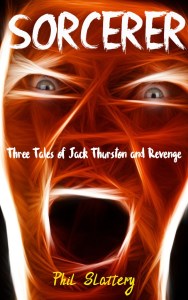


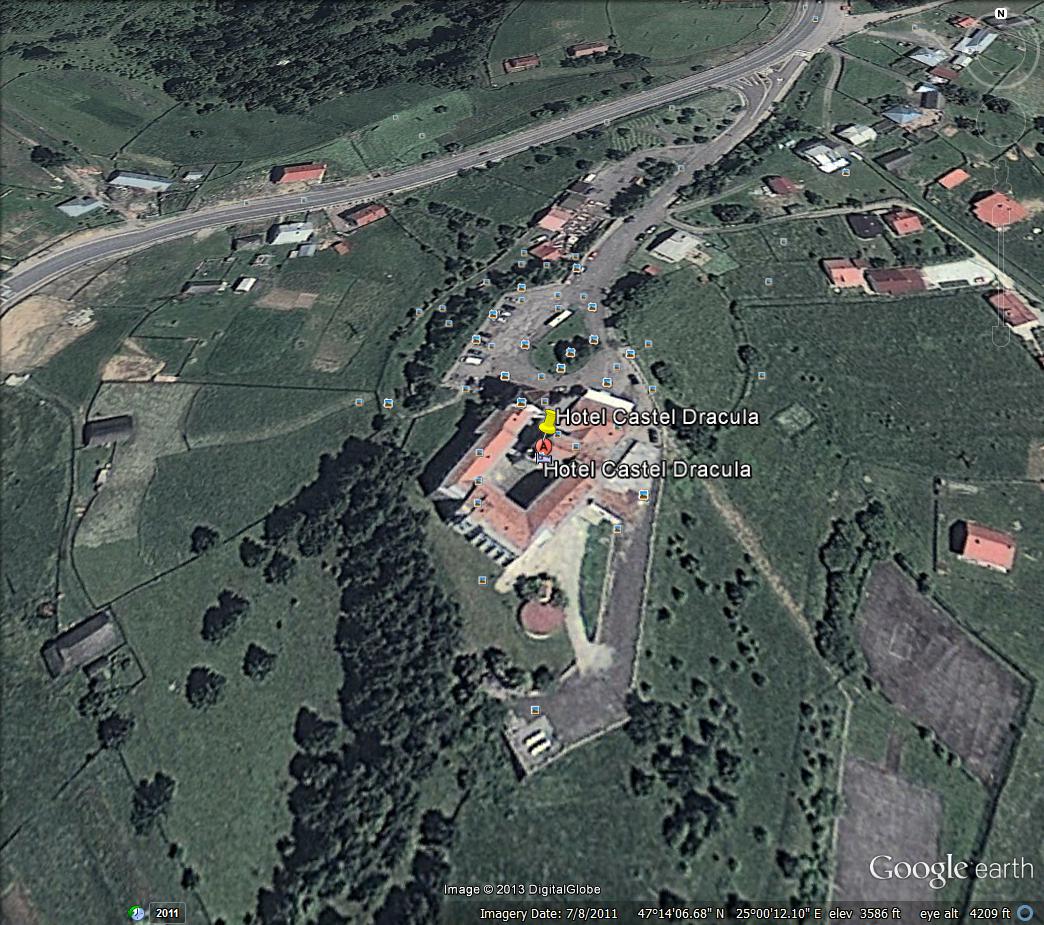
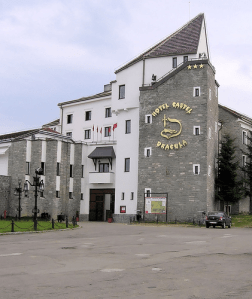



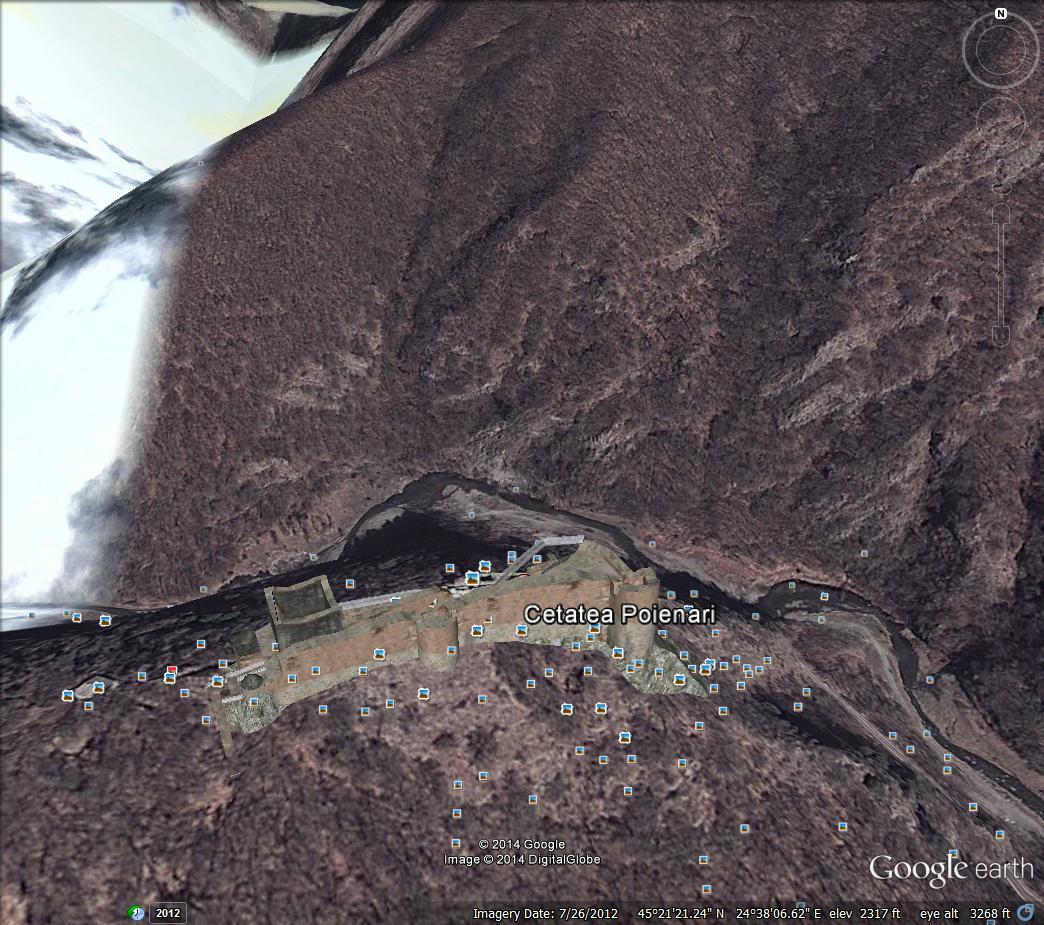
 To get to the top, one has to walk up almost 1500 steps. But the effort is certainly worth it. As you approach the magnificent ruin (last 50 steps or so) the scene is totally Gothic. There is the outline of the castle perched on the top of this rock, seeming to grow out of the very mountain itself. It covers the full space at the top, has a sheer drop on three sides, and is barely accessible by a small bridge near the top of the steps.



 Phil Slattery, Writer, Publisher