Notes from Farmington Writers Circle of December 10

imageOn Thursday, December 10, the Farmington Writers Circle had another productive meeting.  Attending were myself,  Linda Frederick, Yvonne Ravenwood, Vicki Holmsten, Cluff Eliott, Traci Hales-Vass (professor of creative writing at San Juan College), and Roberta Summers, who gave an informal talk on writing professional query letters.   The next meeting will be on January 7, at 7:00 p.m. at Hastings Hardback Café, when Traci Hales-Vass will give an informal talk on writing pitches and hooks for novels.   The date of the February meeting is yet to be determined, but at that one I will present a talk on establishing a blog.

Roberta, author of Pele’s Realm and judge in the Pike’s Peak Writers Conference, led an excellent discussion on writing a query letter, supported with two excellent examples of a query letter formatted for a letter and of one formatted for e-mail.  She also provided a list of informal notes on the basics of writing a query letter, which I have provided here:

Query Letter

Comment:  The query letter is a sales tool.  If you don’t capture the agent/editor’s attention with it, they will not request pages or your manuscript.  Make it the most professional and best writing you do.

  1. Business letter structure, proper salutation, opening and closing.  Different for snail mail and e-mail.
  2. Author contact information included.
  3. One page in length, single spaced with one inch margins.  About 250 words.
  4. Font, 12 points Time New Roman or Courier New.
  5. Proper grammar and mechanics (commas, etc.)
  6. No spelling errors.
  7. Proper agent/editor honorific (title of respect such as Mr. or Mrs. or Ms. if in doubt)
  8. Make sure your genre matches the agent you are querying.
  9. Title of work included.
  10. Word count included.
  11. Comparables.  Market knowledge in the form of comparisons to other authors and/or books or the target audience.
  12. How appropriate in your story to the genre?
  13. Can the agent/editor get a sense of time and place?
  14. Is/are the main character/s identified?
  15. Is the plot or central conflict clear?
  16. Is your voice strong in the query? [my note for clarity:  the voice should be strong.]
  17. Is the tone or mood of your story represented?
  18. Is your summary clean, not too much or too little information?
  19. Is there a hook in your summary that will make the agent/editor want to see more?

Identify the genre, title and word count in the first paragraph.

Spend the next two paragraphs introducing your character and the conflict.

Summarize with a hook.

 Next, say something about yourself.  Do you have a creative writing degree?  Are you published.  Be brief.

Last a call to action, such as “My manuscript is complete and available to send upon request.” Then thank them.

A few of my own notes from conversations during the meeting:

It is best to make submissions in January-February, when agents/editors are making plans for the upcoming year; it is worst to  submit in November and December.

The timing of your query must be good and you must establish some chemistry with the agent/editor.

A good quote from Roberta Summers that came out during the meeting was “You can write the most magnificent book on the planet, but if you can’t writer a query letter you’re dead in the water.”

Everyone is welcome to attend the next meeting of the Farmington Writers Circle on January 7 at 7:00 pm, which will once again be at the Farmington Hastings Hardback Café.  Traci Hales-Vass will lead the discussion on writing pitches and hooks.

Thoughts?  Comments?

Next Meeting of Farmington Writers Circle Set for December 10

imageThe Farmington Writers Circle will meet tonight, December 10, at 7:00 p.m. at Hastings Hardback Café on 20th Street.   The topic of the evening will be query letters and will be led by  Roberta Summers, author of Pele’s RealmThe meeting is open to the general public.  Feel free to read up on the topic before coming (though this is not required) and contribute to the discussion.
The Farmington Writers Circle is a nascent organization of authors and writers, who are interested in publishing and marketing their works.

Please contact Phil Slattery via this website with any questions or comments.

Next Meeting of Farmington Writers Circle Set for December 10

imageThe next meeting of the Farmington Writers Circle will be at 7:00 p.m. on December 10 at Hastings Hardback Café on 20th Street.   The topic of the evening will be query letters and will be led by  Roberta Summers, author of Pele’s RealmThe meeting is open to the general public.  Feel free to read up on the topic before coming (though this is not required) and contribute to the discussion.

The Farmington Writers Circle is a nascent organization of authors and writers, who are interested in publishing and marketing their works.

Please contact Phil Slattery via this website with any questions or comments.

Next Meeting of Farmington Writers Circle Set for December 10

imageThe next meeting of the Farmington Writers Circle will be at 7:00 p.m. on December 10 at Hastings Hardback Café on 20th Street.   The topic of the evening will be query letters and will be led by  Roberta Summers, author of Pele’s RealmThe meeting is open to the general public.  Feel free to read up on the topic before coming (though this is not required) and contribute to the discussion.

The Farmington Writers Circle is a nascent organization of authors and writers, who are interested in publishing and marketing their works.

Please contact Phil Slattery via this website with any questions or comments.

With your heart fixed on the Supreme Lord: Foreword, issue the 11th

Source: With your heart fixed on the Supreme Lord: Foreword, issue the 11th

Do not judge this article by its title; it’s not what you expect.  Check out this neat article from The Stockholm Review of Literature on publication, rejection, and J.D. Salinger (pictured).

Thoughts?  Comments?

At Flashes in the Dark: “The Jar” by Olivia Wilding

“The Jar”  Follow the link to the flash horror “The Jar” by Olivia Wilding.  This is an interesting tale, primarily for its point of view:  frominside the narrator’s head that describes his emotions to the events around him and to the actions he takes.  This is not unusual in itself, but here it is done very well and it manages to transmit what Henry James called “the atmosphere of the mind” to the reader.  The voice has a haunting quality.  I wish I had the time to write a thesis on what makes for a haunting narration such as this one, but I don’t.

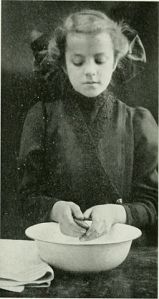
Girl Washing Hands, 1911

There is something in the combined sequence of actions and emotions that stirs certain dark emotions in the readers psyche, perhaps it’s something archetypal, Jungian.   For me, this has always been the most effective means of instilling horror into a readership.  If it didn’t start with Poe, it must have started in his era.

Second, it has an interesting twist at the end, which the author never gives away or hints at in the story.  This is hard to do  and it is done here well.

Lastly,  the story is a combination of two different types of horror:  the physical act of violence and the moral disgust it generates (when revealed) and the twisted relationship revealed at the end.  All in all, this story has a very good denouement.

Please take the time to read “The Jar”.  You won’t regret it.

Don’t read it, if you have something against well-chosen, strong language.

Thoughts? Comments?


Publication Announcement: “Murder by Plastic”

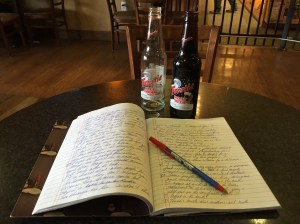
Writing at Hasting's Hardback Café in Farmington, NM, late evening of October 16, 2015 (self-portrait)
Writing at Hasting’s Hardback Café in Farmington, NM, late evening of October 16, 2015 (self-portrait)

My flash work of crime/thriller/horror “Murder by Plastic” appears today in www.fictionontheweb.co.uk.  “Murder by Plastic” has previously appeared in Every Day Fiction in 2013.  It is a work of taut suspense involving murder, gangsters, intrigue, and betrayal.  “Murder by Plastic” has been called “chilling and brilliantly economical” and “very well-paced and intriguing”.

Many thanks to Charlie Fish and his staff for reprinting this, one of my favorite stories.

Monica J. O’Rourke and Wrath James White ‘Poisoning Eros’ Review

Source: Monica J. O’Rourke and Wrath James White ‘Poisoning Eros’ Review

For Fans of extreme horror, this article from Horror Novel Reviews has something titillating for you.


Farmington Writers Circle in Development

Writing at Hasting's Hardback Café in Farmington, NM, late evening of October 16, 2015 (self-portrait)
Writing at Hasting’s Hardback Café in Farmington, NM, late evening of October 16, 2015 (self-portrait)

I would like to establish a writers’ circle for the Farmington, New Mexico area, including San Juan County, and anyone from the Four Corners area.  I will he hosting a meeting on November 19 at 7:00 p.m. at the Farmington Hastings’ Hardback Cafe to establish how many people are interested.  Everyone is welcome to attend.  The mission of the Writers Circle will be to promote Farmington area writers of any genre and skill level, to advise each other on being published, and to establish useful contacts within the regional and national literary communities.   If anyone in the Farmington/Four Corners has an interest, please contact me via this website by commenting below.

Thoughts?  Comments?

The Quick 10: 10 Unexpected Horror Writers

John Steinbeck (from the website Letters of Note)
John Steinbeck
(from the website
Letters of Note)

The Quick 10: 10 Unexpected Horror Writers.

In this article from mentalfloss.com Stacy Conradt tells us about ten renown figures from literature and history who had brief, quirky flings with the horror genre.  Some of these you would probably never suspect of even hearing about the horror genre.  One aspect that may be of interest to writers of horror is the minimal experience each author had with horror before dreaming up the concept for his/her foray into the genre.

Thoughts?  Comments?

6 Horror Books Based On Real Events

Source: 6 Horror Books Based On Real Events

Check out these six books on events forming the basis for some well-known fictional horror.   Good recommendations for reading over the holidays, particularly Halloween.

Publication Announcement: “Murder by Plastic”

9mm Computer Graphic by Phil Slattery
9mm
      Computer Graphic
        by Phil Slattery

Today I received word that my flash suspense/crime drama/horror/thriller story “Murder by Plastic” will be re-printed on Fiction on the Web on November 17.   Set in the modern day, “Murder by Plastic” is story about what happens when someone pisses off the wrong gangster.

Many thanks to Charlie Fish and his crew at Fiction on the Web for re-printing another of my personal favorites.

“Murder by Plastic” was first printed by Everyday Fiction on March 24, 2013.

Thoughts?  Comments?

“NOTED” Fiction by Steffany Willey

I am pleased to announce that I have accepted the first work of fiction submitted to Slattery’s Art of Horror Magazine.  Although some might not consider it “horror” per se, because it is not supernatural in nature and does not contain horrific gore, it does meet the stipulations I have set out for this magazine, in that it contains a horrific element and it pushes a nebulous boundary between horror and another genre, which in this case is mainstream literature.  I like the story and its understated element of suspense, its thoughtful wording, and its ability to draw the reader into it for a vicarious experience.  I hope you enjoy it as much as I did.

NOTED

by Steffany Willey

Asha was my spur-of-the-moment walking buddy. She lived five houses away, and if one of us suddenly needed a break from our mom lives we’d give the other a call. Winter and summer we’d plod the two-mile loop, often grumbling about what our kids did or didn’t do, sometimes bragging about the grandkids. We’d pick apart the neighbors’ landscaping, which often amounted to little more than plugging in a feeble row of Home Depot arborvitae, and made suggestions (to each other) like clipboard horticulturalists.

Our route passed a house I’d visited many times. It was a trim two-story colonial with a wing on one side that had once been a garage. The lawn was thick then, lush, the sidewalk edged, the shrubs mulched. Inside, the rooms lulled sweetly in this tidy castle.

Over the years it had changed hands a number of times but to progressively disinterested owners. Now it had deteriorated into such a mess it brought us to a halt. We scowled at a tree skeleton and overgrown shrubs that shrouded the windows. That same grass was choked with weeds that were well beyond a lawnmower and a gallon of Weed B Gon. Even the sidewalk fought to hold its own. It was a shame. It brought down the neighborhood.

photo by D Sharon Pruitt

It was during that scathing appraisal that we saw the girl. She was at a front window and seemed to be struggling to open it. She looked like a young teen. When she saw us she waved. We waved back. She kept on waving.

Suddenly a man emerged from the front door. He was fortyish and lean, a swimmer or runner possibly. In jeans and a pressed shirt and a stylish day-old beard, he couldn’t have been more at odds with this sorry house. Or that was our impression until he marched our way.

“Everything OK?” he demanded in a no-nonsense tone. His laser eyes pinned us down as if we’d been trespassing. The message was clear: Move on ladies. Were neighbors giving him heat about his property?

“Yeah,” I think I mumbled, and turned away to walk on. When I glanced back the girl was gone and a shade pulled. The man stood firm, watching.

It bothered me. Asha too. Had the girl been waving or beckoning, asking for help? We hemmed and hawed. Should we do something about this? Or was she just a kid sent to her room and trying to sneak out?

We made a point to check out the house the next day. This time I jotted down the address and name on the mailbox, but weeks passed before I contacted the community association and was told to share my concerns with the police; in turn, they took note, made a written report.

So it was. We did our bit, said what we saw.

Fall brought birthdays and holidays and deaths in the neighborhood. We squeezed in our walk when we could, offering up our critiques. A couple houses went on the market, polished it seemed overnight. Asha’s neighbor built a lopsided shed on a twenty-degree slope in his backyard that was supported on one edge by stilts; it and his new John Deere riding mower crashed to the bottom of their lot two months later. We might have told him so.

And sometimes I would drive by the house with the girl and see a light on, but usually it was dark, to itself.

The winter was harsh, the land hidden under a glaze of snow that leaked all day then morphed into black ice at night. Our walks were few, and we didn’t get back into the swing until March. By then neighbors were emerging like hibernated bears, poking into gardens and washing cars. One afternoon we slowed to admire a ’57 T-Bird, its owner in the driveway stroking it like a cat. I’d seen him before, similarly entranced, touching up flaws only he could see. His house, as it happened, was across the street from the house with the girl.

“Do you ever drive it?” I asked pleasantly as we came even with his driveway.

Snatched from his reverie, he offered, “Fourth of July parades. That’s about it.”

“I’ll have to look for you. I never miss the Catonsville parade.”

“‘I’ll be there.”

I glanced behind me. “I was wondering about that house. It looks abandoned.”

He wrung out a chamois that looked dry.

”Yeah. He … ah … isn’t there.”

“He moved?”

“I guess you could say that.” He honed in on the passenger-side door, buffing an area under the handle. Asha and I traded looks.

“Were there children living there?”

“No. Why?”

“We saw a girl  at a front window a while back. Something seemed … off … not right …”

He sighed and turned to us. “I figured they were relatives.” Then: “He was arrested a few days ago on child pornography charges. He’s … he was …. a teacher.” He didn’t meet our eyes.

“Oh no!” I said.

Asha touched my arm. “Sweet Lord,” she croaked.

We stood looking at each other, the three of us. There was more but he wasn’t saying. Guilt was written on his face as if in Magic Marker.

“I’ll look for the car at the parade,” I finally said, backing off and pulling Asha with me.

“I’m sorry,” he said as if he was to blame.

Later it made the news, and in a month a For Sale sign was stuck in the mud by the driveway. No one had bothered to tame the property, so someone was going to get a good fixer-upper deal. Families clamored for homes in this school district so it would sell easily.

Though we still walk, we never speak of the girl or remark on the house as we pass. In fact, it’s as if it isn’t even there