Here is a fascinating article about the founding father of modern horror: Edgar Allan Poe: Poet and Prophet | Interesting Literature. Interestingly, it states that the story about Edgar Allan Poe in his white belt and gloves at West Point, which I quoted in an earlier post from The Writer’s Home Companion, is urban legend. It goes on to state several fascinating bits of trivia about Poe including his involvement in the development of the detective story and the short story, the backgrounds of some of his most famous works, his passion for cryptography, his foreshadowing of the Big Bang Theory, criticisms of his work by William Butler Yeats and T.S. Eliot, and some insights on his personal and financial life.
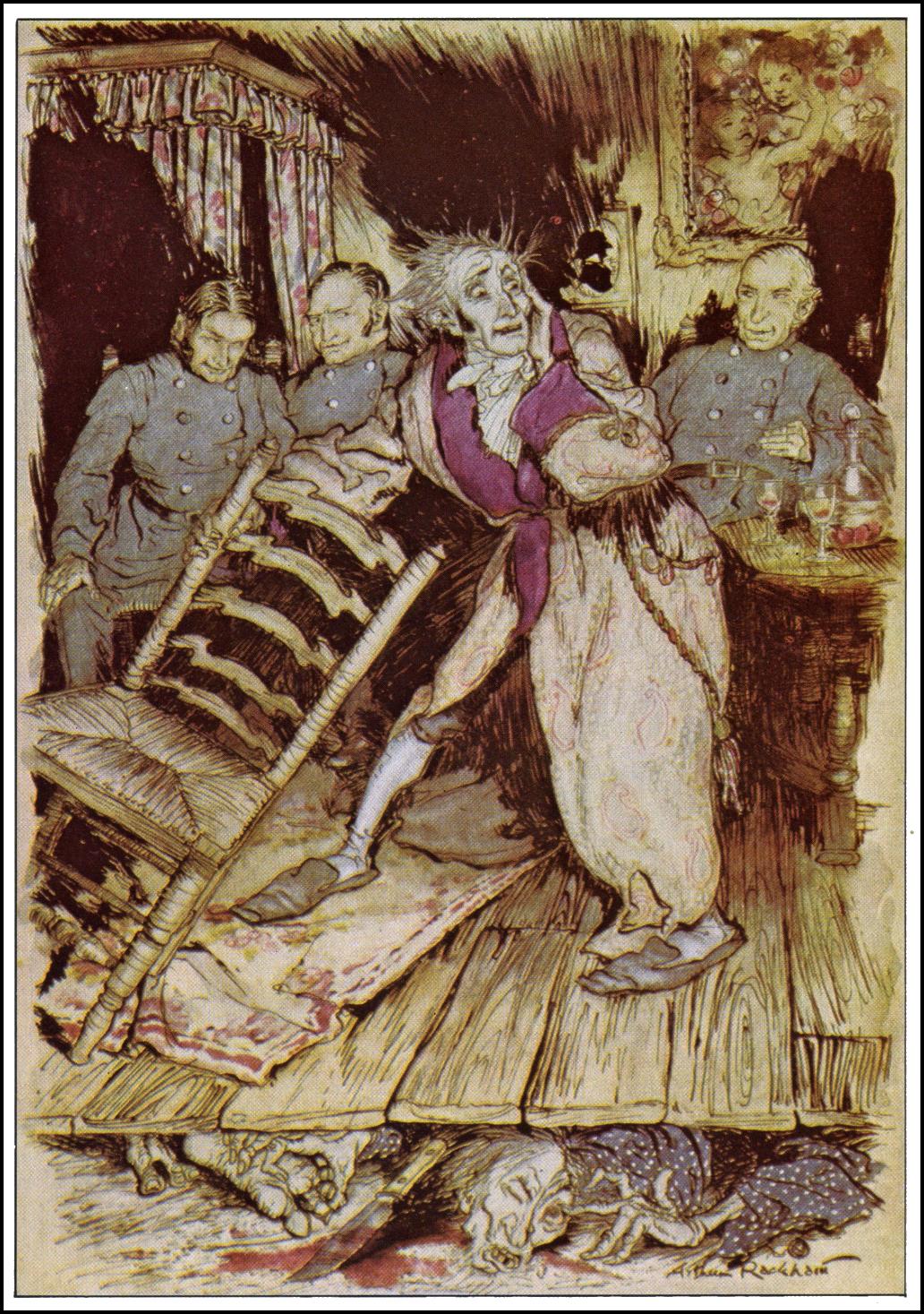
“The Tell-Tale Heart” Illustration by Arthur Rackham, 1935
I was just musing that if a canon of horror literature could be developed, what should it include? This would be a collection of say ten works that define horror literature and that everyone seriously interested in horror should read if he/she they wish to learn what horror is and should be. This would not be a collection of the most popular works (whether novel, short story, essay, screenplay, theater, etc.) of horror, which would change constantly, but ten works which would define horror now and forever as the Bible does Christianity, as the Koran does Islam, and as the Analects of Confucius do Confucianism. These should be eternal works that at the end of time, after the Zombie Apocalypse when no more books are written, the few remaining survivors of humanity can review all the literary works of all time and say, “These ten defined the horror genre.” Of course, this canon will be forever debated, but lively, engaged discussion is the fun of a list like this.
To start off this conversation, here are my initial ten recommendations (subject to change as my reading progresses). I will keep this list to one work from each of ten authors so that works by one author do not overwhelm the list. This is not in any order of priority or preference–just as they pop into my mind. Although these reflect my own reading (which tends to the past more than the present), I have added one or two authors I haven’t read, but from what I understand, have made significant contributions to the horror genre.
You know the “Nutcracker” ballet, the one that every local ballet troupe is obligated to perform at Christmas? This isn’t the guy — Tchaikovsky wrote that music in the 1890s, using the translation by Alexander Dumas (pere) rather than Hoffmann’s original. But Hoffmann wrote the short story that lies behind it, and it’s a short story that’s very unlike the charmingly sentimental puffery that little kids get dragged to every December. Very unlike… Hoffmann, a brilliant music critic and respectable composer as well as writer, is one of the major figures of German Romanticism, and a powerful and disturbing writer — and disturbed, according to many; Sir Walter Scott, in his extended discussion of Hoffmann and literary supernaturalism, concludes that Hoffmann needs medical attention more than he needs literary criticism, and no less a student of dysfunctional minds (which I guess is just about everyone’s) than Sigmund Freud made Hoffman’s “The Sandman” the center of his essay on “The Uncanny.” Hoffmann, although strongly influenced by Gothic literature, is probably best regarded as a fantasist rather than a “Gothic” or “horror” writer, although Freud’s term is perhaps the most apt.
This link leads to a rather lengthy article on Hoffmann and German Romanticism at theliterarylink.com. I haven’t read it yet, but to a fan of German literature like myself, it looks fascinating. I hope to find time to read it soon.
Here is a link to the text of “The Sandman“, one’s of Hoffmann’s most famous works. Litgothic.com says about it:
“The classic — and widely anthologized — tale of a boy and his automaton — and, according to Freud, who discusses this work in his essay “The Uncanny,” castration anxiety. Automata, by the way, were a happening phenomenon in the C19 — check out Edgar Allan Poe‘s “Maelzel’s Chess Player” and Hoffmann’s own “Automata” for other Gothic-tradition examples; for a general discussion of automata, check out The Automata Gallery or this History of Automata.”
“Why should not a writer be permitted to make use of the levers of fear, terror and horror because some feeble soul here and there finds it more than it can bear? Shall there be no strong meat at table because there happen to be some guests there whose stomachs are weak, or who have spoiled their own digestions?” ETA Hoffmann
“There are… otherwise quite decent people who are so dull of nature that they believe that they must attribute the swift flight of fancy to some illness of the psyche, and thus it happens that this or that writer is said to create not other than while imbibing intoxicating drink or that his fantasies are the result of overexcited nerves and resulting fever. But who can fail to know that, while a state of psychical excitement caused by the one or other stimulant may indeed generate some lucky and brilliant ideas, it can never produce a well-founded, substantial work of art that requires the utmost presence of mind.” ― E.T.A. Hoffmann, Die Serapions Brüder: Gesammelte Erzählungen Und Märchen In Vier Bänden
Another interesting summary of Hoffmann’s talent, this one from nndb.com:
“Hoffmann is one of the master novelists of the Romantic movement in Germany. He combined with a humor that reminds us of Jean Paul the warm sympathy for the artist’s standpoint towards life, which was enunciated by early Romantic leaders like Tieck and Wackenroder; but he was superior to all in the almost clairvoyant powers of his imagination. His works abound in grotesque and gruesome scenes — in this respect they mark a descent from the high ideals of the Romantic school; the gruesome was only one outlet for Hoffmann’s genius, and even here the secret of his power lay not in his choice of subjects, but in the wonderfully vivid and realistic presentation of them. Every line he wrote leaves the impression behind it that it expresses something felt or experienced; every scene, vision or character he described seems to have been real and living to him. It is this realism, in the best sense of the word, that made him the great artist he was, and gave him so extraordinary a power over his contemporaries.”
That’s it for tonight. I am off to the land of dreams.
I was checking my blog stats today and found out that two recent views came from Germany. I was a German major in college and therefore I begin to be curious about what is happening today in the horror genre for both German movies and literature, since I unfortunately know little about either.
I did a quick search on Google for “German horror” and found this interesting article on IMDb. I did another search for “German horror fiction” and “German horror literature” and found almost nothing of interest. I searched for “German horror writers” and found the German Horror Writers Circle on Facebook, which I might use as a starting point for further investigations. Later, I may search in German, but today I confined my inquiries to what is available in English due to a lack of time inflicted by other pressing matters.
I have to admit I have read very little modern German literature compared to German lit of the 19th century, that I am woefully unfamiliar with most modern German writers, and that I am completely unfamiliar with modern German horror writers. I know that in the distant past, Germany and other German-speaking lands have produced excellent writers of horror such as E.T.A. Hoffmann (see my post about Hoffmann) and Jeremias Gotthelf (“The Black Spider”, 1842). Given the dearth of information readily available on modern German horror (at least on Google), I think the IMDb article mentioned above may have a point that because of German history since 1933, Germany may have (understandably) lost its taste for horror. I find that unfortunate, because now that my curiosity about German horror has been aroused, I would love to read some first-rate German horror or at least see one or two first-rate German horror films from the last decade or two.
Therefore, my question for you in this blog is: if you are familiar with German horror, what films or books do you recommend as introductions to the world of German horror?
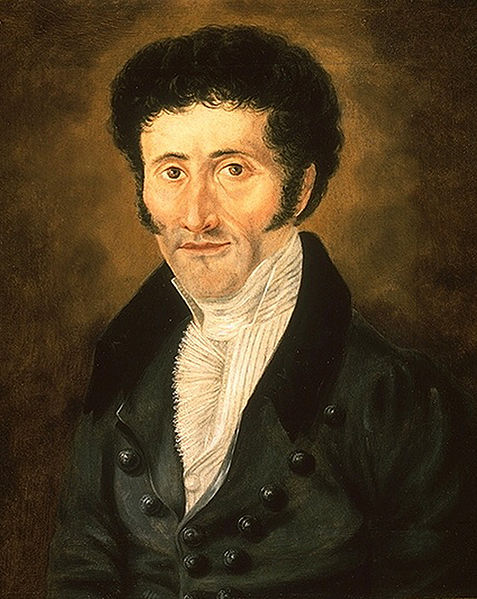
Unless you are a literature/horror aficinado, you may never have heard of Ernst Theodor Amadeus Hoffmann, a German writer from the late 18th century. He predated Poe by almost half a century and in his time was probably as well known then as Stephen King and Clive Barker are today. His stories were considered terrifying in his time. Several of his stories were the basis for the well-known opera by Jacques Offenbach “Tales of Hoffmann”. If you have never heard the music from this, it would be worthwhile to listen for it or to buy a CD of it. It is very impressive. As with the photo of Stoker, I obtained this image from Wikimedia Commons, where it is listed as being in the public domain.


 Phil Slattery, Writer, Publisher