Here’s something for comics aficionados: Dark Horse Comics is combining the tales of Prometheus, Alien, and Predator for what promises to be a mind-boggling thrill-ride. Follow the link above to Matt Molgaard’s rousing review of the project at Horror Novel Reviews.
After seeing this type of story published by Dark Horse, one has to wonder why they are still called “comics”.
If you have a more suitable name for this type of publication, especially in regards to the horror genre, please note it in a comment below.
Walking down the hall, Sarah shivered at the chill of winter as it brushed over her delicate skin like the bristles of a wet paintbrush. Looking ahead, she saw the darkness of the living room: a large table with six chairs set around it, with a hanging light.
She smirked; the home was supposedly haunted, at least that’s what the ad had told her. The real estate agent had been wary when she brought it up, only bringing it fully into light when Jessica revealed that it was a selling point. The papers had been signed, and by the beginning of the month she had her new loft overlooking the Riverwalk, which was brilliantly colored due to the holiday season, strung up lights flickering with the colors of the rainbow. Even now with her shades covering the window Sarah could see the flickering lights, their dim glow coming through the wooden slates to merrily dance in her darkened den.
Walking into the kitchen, she stepped on something thick and leathery, causing her to gasp. Flicking on the light, she looked down to see her wallet on the ground. Bending down to scoop it up, she checked it over to make sure nothing was missing and looked for her purse.
“This never leaves my purse unless I’m buying something…” Sarah muttered to herself, walking out of the kitchen and back into the den, only gasp in surprise.
Stacked up on the table, the high backed ends holding up the light fixture, the chairs had moved from their spots on the floor to the top of the large table. She saw her purse sitting in the center of the table.
“Hello?” She called out to her small loft, looking around wildly. She didn’t dare dream that this could be an actual haunting; such a thing would prove too good to be true! Looking around wildly, she tried her best to remain calm.
That is until she heard the giggles of a little girl.
Her heart beating a mile a minute, she moved forward into the hall leading to her bedroom. It was dark, and the light switch was on the other side of the hall… but in this dim lighting, she could just make out the shadowy form of someone small, with long unruly hair. Another giggle escaped from the entities direction, sending shivers down Sarah’s spine.
“Hello?” She said, hoping to keep the spirit calm. “Are you lost?”
The entity tilted its head to the side, a glint in the dim lighting reflecting from its dark eyes, which seemed to be analyzing Sarah, judging her. The entity slowly turned and walked into the total darkness of the bedroom, singing a wordless song softly.
First contact! Sarah thought frantically, standing still as the spirit moved deeper into the bedroom. It’s important to let them know you’re here to help them, not to do anything bad.
“Little girl? I’m coming in the bedroom… don’t be afraid, okay? I just want to talk,” Sarah called out, padding softly into her bedroom, shivering as a cold wind blew in from her balcony. The two doors that led to her view over the San Antonio River had been opened, the curtain billowing lazily. In the flickering glow from the holiday lights, Sarah could just make out the figure of the little girl standing in the shadows near the closet.
“Are you afraid?” The little girl asked her voice cold and detached, though still curious.
“No, of course not. I would never be afraid of you… what’s your name?” Sarah said, walking further into the room, taking each step slowly so as not to startle the ghost-child.
“Erin. I live here.” The child replied in a sing song manner, her eyes glinting happily in the darkness.
“Well I live here too. Maybe we can be friends?” Sarah said, walking around the bed until she was standing in front of the opened balcony, a few feet away from the girl.
The girl shook her head. “He said I can’t have friends. You need to leave before he gets to you.”
“Before who gets to me?” Sarah asked before being slammed from the side, her body flying out and landing on the balcony, her left side bruised from the sudden impact.
“Him.” The girls voice faded as a hunchbacked figure, arms dragging along the floor, came into sight. In his hands was a strand of Christmas lights, looped around like a lasso.
“No. I just want to be your friend!” Sarah cried.
“Friend…” The spirit groaned, waving a misshapen arm at Sarah, knocking her out onto the balcony. The cold air nipped at her flesh as the specter advanced, stooping in the doorway.
“Yes, friend. I want to help you, I want to understand you!” Sarah pleaded, doing her best to stand, leaning on the railing.
“Friend…” the ghost repeated, the lasso of Christmas lights lashing out and wrapping around Sarah’s hand before snaking up her wrist and forearm. “Friends play games.”
“Y-yes, friends play games! So let’s go inside and play a game!” Sarah said, growing more nervous by the second as her arm became numb wherever the strand of lights touched.
“Already playing a game,” the ghost replied, the strand of light slowly slithering from its hand to begin wrapping around Sarah’s neck.
She screamed, hoping someone would hear here from the streets below. The strand of lights, now flickering on, was wrapped tightly around her arm and neck.
Then they began to constrict.
Gasping for air, Sarah stumbled back as another wave of force slammed into her, pushing her over the edge of her balcony, leaving her dangling some ten feet above the sidewalk.
As she inhaled to scream, the cords constricted even tighter, choking her on her own fluids as she dangled lifelessly. Just as she felt the pressure of her lungs give way, Sarah gazed out over the Riverwalk at the people walking to and fro, some stopping to stare, screaming for an ambulance.
Check out these six books on events forming the basis for some well-known fictional horror. Good recommendations for reading over the holidays, particularly Halloween.
Check out this spooky, foreboding horror vignette from horroraddicts.net. It may give you the shivers the next time you drive past the beach. It is a good, clear narrative that draws you into the moment as if you were standing on the side watching the events unfold. Here are the author’s impressive credentials (quoted from the blog):
Chris Ringler was raised in Linden, Michigan, a where he lived and attended school. He fell in love with writing as a teenager when he started writing short stories and began working on fanzines with friends. In 1999 BACK FROM NOTHING, a short story collection was published by University Editions. Since that time Chris has been published in BARE BONE and CTHULHU SEX MAGAZINE, received Honorable Mention in THE YEAR’S BEST FANTASY AND HORROR twice, was voted Best in Blood on HORRORADDICTS.COM, and has been working on his writing and art.
Chris has written and published nine books which range from horror and dark fiction to fairy tales.
Chris is a writer, artist, weirdo, and was the creator of many events in the Flint area such as the Flint Horror Convention.
Forgive me for loving you, I didn’t mean to. It was your smile that made my heart skip a beat, and your eyes that made my back shiver. I held you in my arms, and you warmed my soul. I talked to you, and my mindset broadened. You entered my dreams, and freed me from the nightmares. Your touch made me smile, and your kiss froze time. You gave me hope, and I could give you nothing. I am sorry.Those were the words on the yellow note.
I observed the attached box curiously, it was small and plain. Suddenly, it trembled, once. I dropped it, I ran away. Blood dripped off of it. Now, it was constantly moving; beating. I approached it again, cowardly. I hadn’t heard from him in days; last time I saw him, I told him I couldn’t be with him. I still loved him, but I needed time to figure out myself. The box stood still. I took a few hesitant steps towards it. I had abandoned everything for him; then I abandoned him. The box trembled again, but only once. I opened it. I burst out in muffled tears. I was looking at his broken heart, and it was all my doing.
George Gad Economou, born in 1990 in Athens, Greece, is currently a Master’s student at Aarhus University, working on his thesis on social epistemology. His first novel, “The Elixir of Youth” was published in 2010 by Lefki Selida Publications, whilst his English short fiction has appeared in various horror magazines, such as Black Petals and Blood Moon Rising Magazine.
Today I received word that my flash suspense/crime drama/horror/thriller story “Murder by Plastic” will be re-printed on Fiction on the Web on November 17. Set in the modern day, “Murder by Plastic” is story about what happens when someone pisses off the wrong gangster.
Many thanks to Charlie Fish and his crew at Fiction on the Web for re-printing another of my personal favorites.
“Murder by Plastic” was first printed by Everyday Fiction on March 24, 2013.
Working on a play in Hasting’s Hardback Café, late evening, October 16, 2015.
Since I decided to publish submitted flash fiction on this website, I have had to explore its various subtypes, of which there seem to be an increasing number with definitions that often vary from editor to editor. Here is what I have discovered so far:
Flash fiction: generally accepted to be any prose work of 1,000 words or less. Some alternate terms include micro fiction, micro narrative, micro-story, postcard fiction, short short, short short story, and sudden fiction, although some editors define specific limits for these as well. In China, the genre is sometimes called a “smoke long”, because it should be finished before the reader can finish smoking a cigarette. The Wikipedia article on flash fiction notes that:
“Unlike a vignette, flash fiction often contains the classic story elements: protagonist, conflict, obstacles or complications, and resolution. However, unlike a traditional short story, the limited word length often forces some of these elements to remain unwritten – that is, hinted at or implied in the written storyline. Different readers thus may have different interpretations.”
Micro fiction: Can refer to works of 1,000 words or less or even of works 300 words or less or somewhere in between.
Nano fiction: 300 words or less. See http://www.nanofiction.org (which takes submissions of 300 words or less) for excellent examples and discussions of the genre. Some put it at 55 words or less.
Drabbles: 100 words or less. See The Drabble on WordPress for a discussion and examples.
Twitterature: Sized to fit in a Twitter “tweet” of 140 characters or less. Some equate this to about 23 words.
Now here is an interesting bit of trivia from the Wikipedia article on flash fiction that seems written for horror aficionados:
“Also notable are the 62 “short-shorts” which comprise Severance, the thematic collection by Robert Olen Butler in which each story describes the remaining 90 seconds of conscious awareness within human heads which have been decapitated.[12]“
I will probably add these and any others I find to my lexicon of horror.
I would be interested in knowing if you encounter other subcategories not listed here.
Go to 15 Creepy Two-Sentence Horror Stories for a few quick thrills. Some of these have been floating around the Internet in different forms for a while, but some are original. All demonstrate how to pack a lot of meaning in a very small amount of space. See my article on “Baby Shoes” for a lengthier discussion on the art of compressing meaning into as few words as possible. While you’re visiting “15 Creepy…Stories” compliment the editor for selecting some truly creepy photos to accompany the article.
I am pleased to announce that I have accepted the first work of fiction submitted to Slattery’s Art of Horror Magazine. Although some might not consider it “horror” per se, because it is not supernatural in nature and does not contain horrific gore, it does meet the stipulations I have set out for this magazine, in that it contains a horrific element and it pushes a nebulous boundary between horror and another genre, which in this case is mainstream literature. I like the story and its understated element of suspense, its thoughtful wording, and its ability to draw the reader into it for a vicarious experience. I hope you enjoy it as much as I did.
NOTED
by Steffany Willey
Asha was my spur-of-the-moment walking buddy. She lived five houses away, and if one of us suddenly needed a break from our mom lives we’d give the other a call. Winter and summer we’d plod the two-mile loop, often grumbling about what our kids did or didn’t do, sometimes bragging about the grandkids. We’d pick apart the neighbors’ landscaping, which often amounted to little more than plugging in a feeble row of Home Depot arborvitae, and made suggestions (to each other) like clipboard horticulturalists.
Our route passed a house I’d visited many times. It was a trim two-story colonial with a wing on one side that had once been a garage. The lawn was thick then, lush, the sidewalk edged, the shrubs mulched. Inside, the rooms lulled sweetly in this tidy castle.
Over the years it had changed hands a number of times but to progressively disinterested owners. Now it had deteriorated into such a mess it brought us to a halt. We scowled at a tree skeleton and overgrown shrubs that shrouded the windows. That same grass was choked with weeds that were well beyond a lawnmower and a gallon of Weed B Gon. Even the sidewalk fought to hold its own. It was a shame. It brought down the neighborhood.
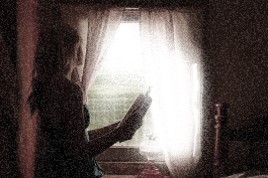
photo by D Sharon Pruitt
It was during that scathing appraisal that we saw the girl. She was at a front window and seemed to be struggling to open it. She looked like a young teen. When she saw us she waved. We waved back. She kept on waving.
Suddenly a man emerged from the front door. He was fortyish and lean, a swimmer or runner possibly. In jeans and a pressed shirt and a stylish day-old beard, he couldn’t have been more at odds with this sorry house. Or that was our impression until he marched our way.
“Everything OK?” he demanded in a no-nonsense tone. His laser eyes pinned us down as if we’d been trespassing. The message was clear: Move on ladies. Were neighbors giving him heat about his property?
“Yeah,” I think I mumbled, and turned away to walk on. When I glanced back the girl was gone and a shade pulled. The man stood firm, watching.
It bothered me. Asha too. Had the girl been waving or beckoning, asking for help? We hemmed and hawed. Should we do something about this? Or was she just a kid sent to her room and trying to sneak out?
We made a point to check out the house the next day. This time I jotted down the address and name on the mailbox, but weeks passed before I contacted the community association and was told to share my concerns with the police; in turn, they took note, made a written report.
So it was. We did our bit, said what we saw.
Fall brought birthdays and holidays and deaths in the neighborhood. We squeezed in our walk when we could, offering up our critiques. A couple houses went on the market, polished it seemed overnight. Asha’s neighbor built a lopsided shed on a twenty-degree slope in his backyard that was supported on one edge by stilts; it and his new John Deere riding mower crashed to the bottom of their lot two months later. We might have told him so.
And sometimes I would drive by the house with the girl and see a light on, but usually it was dark, to itself.
The winter was harsh, the land hidden under a glaze of snow that leaked all day then morphed into black ice at night. Our walks were few, and we didn’t get back into the swing until March. By then neighbors were emerging like hibernated bears, poking into gardens and washing cars. One afternoon we slowed to admire a ’57 T-Bird, its owner in the driveway stroking it like a cat. I’d seen him before, similarly entranced, touching up flaws only he could see. His house, as it happened, was across the street from the house with the girl.
“Do you ever drive it?” I asked pleasantly as we came even with his driveway.
Snatched from his reverie, he offered, “Fourth of July parades. That’s about it.”
“I’ll have to look for you. I never miss the Catonsville parade.”
“‘I’ll be there.”
I glanced behind me. “I was wondering about that house. It looks abandoned.”
He wrung out a chamois that looked dry.
”Yeah. He … ah … isn’t there.”
“He moved?”
“I guess you could say that.” He honed in on the passenger-side door, buffing an area under the handle. Asha and I traded looks.
“Were there children living there?”
“No. Why?”
“We saw a girl at a front window a while back. Something seemed … off … not right …”
He sighed and turned to us. “I figured they were relatives.” Then: “He was arrested a few days ago on child pornography charges. He’s … he was …. a teacher.” He didn’t meet our eyes.
“Oh no!” I said.
Asha touched my arm. “Sweet Lord,” she croaked.
We stood looking at each other, the three of us. There was more but he wasn’t saying. Guilt was written on his face as if in Magic Marker.
“I’ll look for the car at the parade,” I finally said, backing off and pulling Asha with me.
“I’m sorry,” he said as if he was to blame.
Later it made the news, and in a month a For Sale sign was stuck in the mud by the driveway. No one had bothered to tame the property, so someone was going to get a good fixer-upper deal. Families clamored for homes in this school district so it would sell easily.
Though we still walk, we never speak of the girl or remark on the house as we pass. In fact, it’s as if it isn’t even there
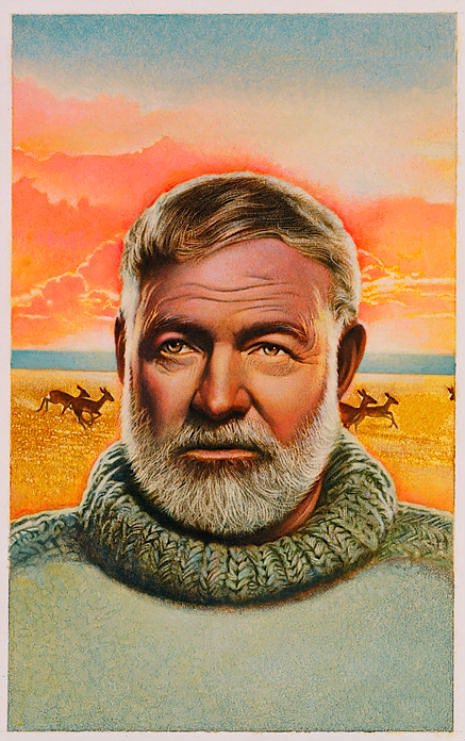
Ernest Hemingway Thought I do not know who the creator of this work is, I must ask that you respect their copyright.
The primary influences on my writing have always been Hemingway and Fitzgerald. Based on what I have read, neither was a fan of metaphors. Somewhere in the back of my mind I seem to recall Hemingway once calling metaphors “the weakest of animals” or “the “weakest of literary devices” or something like that (I have searched for this quote and haven’t found it yet). Ergo, I have always shied away from metaphors and I have found that it has helped my writing immensely by forcing me to be creative in my comparisons and analogies. While searching in vain for Hemingway’s quotation on metaphors tonight, I ran across this quotation from George Orwell which makes a few good points:
“By using stale metaphors, similes and idioms, you save much mental effort, at the cost of leaving your meaning vague, not only for your reader but for yourself. This is the significance of mixed metaphors. The sole aim of a metaphor is to call up a visual image. When these images dash [sic] … it can be taken as certain that the writer is not seeing a mental image of the objects he is naming; in other words he is not really thinking.”
Metaphors are a bridge to another idea; they take the reader onto a tangent. If I say, “The hunter stumbled through the woods like a wounded bear,” I am shifting the reader’s visual image from that of the hunter to that of a bear. Yes, I give the reader a concise description of how the hunter was stumbling, and the reader can probably visualize the stumbling rather accurately, but wouldn’t the reader become more involved with the hunter and be able to visualize the scene more precisely if the hunter is described as if he were a wounded bear stumbling. Wouldn’t it also be a bit more of an intriguing psychological puzzle for the reader to solve and come to his own sudden epiphany of something like “Oh, he’s moving like a wounded bear!” For example:
The hunter, half-dazed from a blow to the head, his dark eyes fixed on some point on the dim horizon, staggered back and forth, bumping into trees, sometimes leaning against them to keep from collapsing into the hard-packed snow, dropping to one knee then rising slowly, painfully catching his breath, limping, often groaning, sometimes bellowing out in a desperate hope that someone passing through the distant shadows might come to his aid.
Isn’t that more dramatic? Doesn’t that involve the reader more into the actions and situation of the main character? Yes, it’s considerably longer, but now the reader can visualize precisely the hunter’s agonizing movements. Now, instead of having to visualize a bear, all attention is focused entirely on visualizing the hunter. Now you are forced to be creative, to use something other than Orwell’s “stale metaphors, similes and idioms” and have to use something more dynamic. No one can accuse you of not really thinking or of being lazy in your descriptions.
In short, if I want to compare two objects, I describe one using the characteristics and attributes of the other. If I have done it well, the reader will see the likeness between the two, but will still remained focused, and maybe even more intensely, on the subject.
Painting of a Dog by Kim Duryang Sapsalgae, 1743
I have used this method for some time now, and I believe it has strengthened my works considerably.
Good story from The Drabble. If you are not familiar with them, they are dedicated to publishing fiction and non-fiction of 100 words or less. They occasionally post a story that breaks into horror, such as this one (reminiscent of the French conte cruel), but the site is definitely worth visiting just to see how writers handle the challenge of extreme brevity. The Drabble generally publishes one story per day, and you can be included in their feed to have it sent to you. You can find them at https://thedrabble.wordpress.com.
horror flash fiction isn’t quite short enough, these tweets seek to elicit a shudder, shock, or wicked laugh within the strict limit of 140 characters.” I look forward to @tweetsthecreeps submitting to this blog. Here are four samples:
The smell of death was something the neighbors got used to. When an arm came unearthed, everyone assumed it was a Halloween decoration.
I’m applying for a job at the blood bank but #MyResumeDoesntMention any of my early job history covering the period from 1837 until 1972.
I finally decided who I want to be for Halloween. Her skin will fit me beautifully if I get it off in one piece.
I always thought my bed’s warmth was just a matter of quality, ’til I turned in early & saw someone scramble out of it, into the crawlspace.
Writing at Hasting’s Hardback Café in Farmington, NM, late evening of October 16, 2015 (self-portrait)
After some consideration, I have decided to change the format of this blog from publishing only my own thoughts on the horror genre to that of a magazine printing submitted articles and works of fiction. I would like to explore the breadth and depth of horror as an art form, but that will never happen so long as I am showcasing only my own works, viewpoints, discoveries, and analyses, for which my other commitments allow little time. I am doing this for my own education and enlightenment as well as for that of my readership. Please visit my Submissions page to read the guidelines for what I would like to publish.
Working on a play in Hasting’s Hardback Café, late evening, October 16, 2015.
As I was preparing to go to the local theatre this evening, I was thinking about how I can improve my writing and what distinguishes the great writers of horror. Of course, the first two that came into my mind as being easily discernible from all others were Poe and Lovecraft. Obviously, what distinguishes them is their use of language. Both use very intense, muscular language with a distinctly archaic tone. Not knowing if there a precise term already exists for this style, I decided to call it “the dark language”, because of its tight connection with the horror genre and with the horrifying in general. For me, there seems to be something archetypal about this, arising out of the Jungian collective unconscious. Perhaps it is just that Poe bound the Dark Language so intimately with scenes of horror, terror, and suspense, which is also bound with genres such as the Gothic novel, that the sound of it automatically brings forth societal memories of dread.
I need to finish dressing if I am to dine at my favorite local sushi restaurant before heading to the play. Somehow, I just have the taste for something raw tonight.

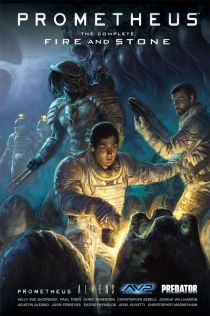 Source: ‘Prometheus: Fire and Stone’ Review





 Phil Slattery, Writer, Publisher