“Tell me again why we have to kill this guy and take his island,” said T.J., looking across the saltwater to a flat island a little over a hundred yards long and less than a hundred wide. Bushes and a few palms sheltered a small cabin and pier from the wind in all directions, except on the north side, where the shore was barren sand.
T.J. licked his lips and tasted the salt from the spray the small powerboat had kicked up on its trip down the Laguna Madre. He wanted to head back to Corpus Christi soon. He liked the taste of the salt, because it reminded him of the taste of a margarita, but that was all he liked about this day. He had no love for the Texas heat or for the oppressive humidity or for the roll of the boat in the slight chop or for the bright sunlight filtering through the haze. He hated these more than he hated killing, but he did what he had to to make a living.
So begins my novelette Click, the story of Frank Martinez and the two drugrunners that want the island where he is staying.
Frank Martinez, a policeman with the Corpus Christi Police Department, has unintentionally shot and killed an unarmed man when called to intercede in a domestic violence case. To recover from the guilt while the incident is under investigation by the CCPD, Frank’s fiancée arranges for him to stay on a secluded island owned by her father’s former law partner. While dozing one night on a lounge chair in the yard, he awakes to find two hitmen slipping onto the island and breaking into the cabin. Are they after him? Are they after the cabin’s owner? Most importantly, how is he going to reach his pistol in his luggage in the bedroom?
My action-adventure/crime novelette, Click, is available on Kindle and in paperback. For either version and to read a sample, go to my Amazon author’s page: Amazon.com/author/philslattery.
My concept of Frank Martinez as portrayed by a photo from the public domain.
Reader Charles Stacey gave “Click” five stars, calls it “A great suspenseful read and then a twist”, and comments: “Author has a wonderful ability to develop the characters using few words. Great foreshadowing to build suspense. And then a really outstanding twist at the end that left me smiling.”
An anonymous Amazon customer gave it five stars, called it “strong storytelling”, and commented, “This novelette is a quick and very entertaining read. It opened with a grabber (“Tell me again whey we have to kill this guy…”) and kept pulling me in from there. Frank Martinez is a cop trying to recover from a shooting incident in solitude on an island off the Texas gulf coast. T.J. and Benny are the bad guys. Their hunt and chase on the small island kept me in suspense. It ends with a surprise twist. Slattery proves here he is a good storyteller.”
While on my author’s page, check out my other works.
Cover of the original Kindle edition
Don’t forget to leave a review on Amazon, Goodreads, or other social media.
Check back frequently for updates or follow me (on the homepage).
My e-book collection of horror shorts A Tale of Hell and Other Works of Horror” is available on Amazon Kindle. For your copy, go to my Amazon author’s page (amazon.com/author/philslattery) where you can find links to my other works as well.
In this collection of published and previously unpublished stories of horror, I offer a look into the minds of people who perpetrate horrors, from acts of stupidity with unintended results to cold-hearted revenge to pure enjoyment to complete indifference. Settings range from 17th-century France in the heart of the werewolf trials to the resurrection of the Aztec black arts to a medicine man’s revenge in the Old West to the depths of Hell to mob vengeance and modern day necromancy to sociopathic serial killers and on to alien worlds in the distant future.
Don’t forget to show your appreciation for these tales by leaving a review on Amazon, Goodreads, or other social media.
P.S. Winn gave the collection four stars on Amazon, calling it “Great variety”, and commented: “The author has given readers a fantastic collection of varied horror stories. Short stories, flash fiction and even shorter micro fiction tales are included in a collection that might have readers keeping their lights on. I have read other books by this author and love the writing style and the way his words draw one into the tales.”
Comments on previously published stories (which are only a part of those in this collection) include:
Jay Manning, editor of Midnight Times commented in its Spring, 2006 issue: “Wolfsheim” is basically a traditional horror story that tells the tale of a small European village confronted by the threat of werewolves. If you like stories about lycans, you definitely need to check this one out. Great stuff.”
Publisher Charlie Fish of Fiction on the Web summarizes A “Tale of Hell” as a “… chilling vision of hell”. Other comments on “A Tale of Hell” from readers of Fiction on the Web:
“An intense and well paced story, cleverly leading the reader up a number of garden paths before Jack’s reality finally clarifies and appears in all its horror. The writing is focused and spare as Jack’s malevolent characteristics and idiosyncrasies manifest themselves…Overall a strong tale that lingers in the imagination…”
“brilliantly descriptive piece on man´s apparently unstoppable descent, literally into hell,…”
” Enjoyed this story. I thought it was nicely written. Started with a familiar vision of hell, but added several unique treatments; kept me interested in how it all would end. Thanks”
Publisher Charlie Fish of Fiction on the Web summarizes “Dream Warrior” as a “…powerful revenge epic about a man who visits his Mexican grandfather for spiritual guidance after a violent crime results in the death if his fiancée”. Fiction on the Web readers commented:
“quite literally a rite of passage, mystical and with an interesting payoff, one which Miguel may have to reckon with in time. some very good writing and characterisation. well done”
“…this is a rite of passage, complex and rich with significance. The cultural invocations are vivid and intense, the work of a writer in his/her full stride. The future for Miguel, who knows? The readers interest is fully engaged with what is to come…”
“Really enjoyed the story-kept me up past my bedtime reading it!”
“I loved the concept, was fascinated by the almost hallucinatory detail of legend with its fatal shadowlands.”
Reader comments on “Murder by Plastic” include:
“Chilling and brilliantly economical”
“Very well-paced and intriguing”
“Fabulous story! Five stars!”
Follow me using the link on the homepage or check back frequently for updates.
Don’t forget to leave a review on Amazon, Goodreads, or on other social media.
After some deliberation, I have decided to make a couple of major changes to this website.
I will be taking submissions of literary fiction of all genres and announcements for publication on this website. Please see my submissions and announcements page for more details and guidelines. There will be no pay in the foreseeable future. You will have, however, all the glory that comes with being published on this website. They will probably be published on Friday nights.
I am changing the name of the website to Slattery’s Magazine, so that the publication credit will look good on the resume of anyone published here.
I will be focusing less on horror on this website and will be leaning more toward mainstream and popular fiction. That does not mean that I will not publish horror. I love good horror. I will just be throwing other genres into the mix.
I have removed the pages focused on horror and migrated them to The Chamber Magazine, which is also accepting submissions. The guidelines are close to the same as these, but focused more on horror and on flash fiction.
I am restarting the Saturday Night Special feature that I ran for 43 installments a few years ago. It will run on Saturday nights, of course, at 6:00 p.m. eastern standard time (11:00 p.m. Greenwich Mean Time–i.e. in London, England). In accordance with the website changes, I will incorporate more mainstream literature into it, though I will initially re-run a lot of the original horror stories until I can find some good mainstream stories. Originally, I ran stories from prior to 1923, the year of institution of copyright laws in the US, in order to avoid copyright problems. I will probably continue to do so. I will focus on what are generally considered to be classic short stories, e.g. by Poe, Mark Twain, Ambrose Bierce, and others.
Stand by for more updates as they occur. Check back frequently.
Jack Thurston is a retired professor of medieval literature and history. He is also a widower and father and a retired sorcerer who has returned to the black arts to exact revenge for the death of his wife, daughter, and brother. He has an intriguing position in the universe at a focal point of life, the afterlife, logic and reason, anger and hatred, the ancient and the modern worlds, grief and his attempts to escape grief through self-destruction. Though he wants to have the peace he once found with his wife, Agatha, he is pulled in many directions by circumstance and by his powerful negative emotions.
I am a fan of the old school horror practiced by such authors as H.P. Lovecraft, Poe, Edward Lucas White, and Arthur Machen. I endeavor to make a story as terrifying and suspenseful for the reader as possible without resorting to gratuitous blood and gore for a simple shock or quick feeling of disgust.
This collection of three short tales is perfect for those who have only a few short breaks to escape into the hidden world of horror, black magic, sorcery, and anger-fueled revenge.
Currently, Jack has a Twitter account (@jthurston666), where he has attracted a small following and where it has only recently been revealed that he is fictional. Jack has his own blog at jackthurstonblog.wordpress.com (a work in progress) and his own e-mail at jackthurston666@gmail.com.
Information on more social media accounts and other characters (as they are developed) can be found at: philslattery.wordpress.com. Please interact with him at any of his social media accounts as you would with a real person.
Show your appreciation for these stories by leaving a review on Amazon, Goodreads, or other social media.
If you enjoy horror, check out my collection of horror short stories A Tale of Hell and Other Works of Horror: Stories of wizards, werewolves, serial killers, alien worlds, and the damned, which includes these stories.
After some deliberation, I have decided to make a couple of major changes to this website.
I will be taking submissions of literary fiction of all genres and announcements for publication on this website. Please see my submissions and announcements page for more details and guidelines. There will be no pay in the foreseeable future. You will have, however, all the glory that comes with being published on this website. They will probably be published on Friday nights.
I am changing the name of the website to Slattery’s Magazine, so that the publication credit will look good on the resume of anyone published here.
I will be focusing less on horror on this website and will be leaning more toward mainstream and popular fiction. That does not mean that I will not publish horror. I love good horror. I will just be throwing other genres into the mix.
I have removed the pages focused on horror and migrated them to The Chamber Magazine, which is also accepting submissions. The guidelines are close to the same as these, but focused more on horror and on flash fiction.
I am restarting the Saturday Night Special feature that I ran for 43 installments a few years ago. It will run on Saturday nights, of course, at 6:00 p.m. eastern standard time (11:00 p.m. Greenwich Mean Time–i.e. in London, England). In accordance with the website changes, I will incorporate more mainstream literature into it, though I will initially re-run a lot of the original horror stories until I can find some good mainstream stories. Originally, I ran stories from prior to 1923, the year of institution of copyright laws in the US, in order to avoid copyright problems. I will probably continue to do so. I will focus on what are generally considered to be classic short stories, e.g. by Poe, Mark Twain, Ambrose Bierce, and others.
Stand by for more updates as they occur. Check back frequently.
My e-book collection of horror shorts A Tale of Hell and Other Works of Horror” is available on Amazon Kindle. For your copy, go to my Amazon author’s page (amazon.com/author/philslattery) where you can find links to my other works as well.
In this collection of published and previously unpublished stories of horror, I offer a look into the minds of people who perpetrate horrors, from acts of stupidity with unintended results to cold-hearted revenge to pure enjoyment to complete indifference. Settings range from 17th-century France in the heart of the werewolf trials to the resurrection of the Aztec black arts to a medicine man’s revenge in the Old West to the depths of Hell to mob vengeance and modern day necromancy to sociopathic serial killers and on to alien worlds in the distant future.
Don’t forget to show your appreciation for these tales by leaving a review on Amazon, Goodreads, or other social media.
P.S. Winn gave the collection four stars on Amazon, calling it “Great variety”, and commented: “The author has given readers a fantastic collection of varied horror stories. Short stories, flash fiction and even shorter micro fiction tales are included in a collection that might have readers keeping their lights on. I have read other books by this author and love the writing style and the way his words draw one into the tales.”
Comments on previously published stories (which are only a part of those in this collection) include:
Jay Manning, editor of Midnight Times commented in its Spring, 2006 issue: “Wolfsheim” is basically a traditional horror story that tells the tale of a small European village confronted by the threat of werewolves. If you like stories about lycans, you definitely need to check this one out. Great stuff.”
Publisher Charlie Fish of Fiction on the Web summarizes A “Tale of Hell” as a “… chilling vision of hell”. Other comments on “A Tale of Hell” from readers of Fiction on the Web:
“An intense and well paced story, cleverly leading the reader up a number of garden paths before Jack’s reality finally clarifies and appears in all its horror. The writing is focused and spare as Jack’s malevolent characteristics and idiosyncrasies manifest themselves…Overall a strong tale that lingers in the imagination…”
“brilliantly descriptive piece on man´s apparently unstoppable descent, literally into hell,…”
” Enjoyed this story. I thought it was nicely written. Started with a familiar vision of hell, but added several unique treatments; kept me interested in how it all would end. Thanks”
Publisher Charlie Fish of Fiction on the Web summarizes “Dream Warrior” as a “…powerful revenge epic about a man who visits his Mexican grandfather for spiritual guidance after a violent crime results in the death if his fiancée”. Fiction on the Web readers commented:
“quite literally a rite of passage, mystical and with an interesting payoff, one which Miguel may have to reckon with in time. some very good writing and characterisation. well done”
“…this is a rite of passage, complex and rich with significance. The cultural invocations are vivid and intense, the work of a writer in his/her full stride. The future for Miguel, who knows? The readers interest is fully engaged with what is to come…”
“Really enjoyed the story-kept me up past my bedtime reading it!”
“I loved the concept, was fascinated by the almost hallucinatory detail of legend with its fatal shadowlands.”
Reader comments on “Murder by Plastic” include:
“Chilling and brilliantly economical”
“Very well-paced and intriguing”
“Fabulous story! Five stars!”
Follow me using the link on the homepage or check back frequently for updates.
Don’t forget to leave a review on Amazon, Goodreads, or on other social media.
After some deliberation, I have decided to make a couple of major changes to this website.
I will be taking submissions of literary fiction of all genres and announcements for publication on this website. Please see my submissions and announcements page for more details and guidelines. There will be no pay in the foreseeable future. You will have, however, all the glory that comes with being published on this website. They will probably be published on Friday nights.
I am changing the name of the website to Slattery’s Magazine, so that the publication credit will look good on the resume of anyone published here.
I will be focusing less on horror on this website and will be leaning more toward mainstream and popular fiction. That does not mean that I will not publish horror. I love good horror. I will just be throwing other genres into the mix.
I have removed the pages focused on horror and migrated them to The Chamber Magazine, which is also accepting submissions. The guidelines are close to the same as these, but focused more on horror and on flash fiction.
I am restarting the Saturday Night Special feature that I ran for 43 installments a few years ago. It will run on Saturday nights, of course, at 6:00 p.m. eastern standard time (11:00 p.m. Greenwich Mean Time–i.e. in London, England). In accordance with the website changes, I will incorporate more mainstream literature into it, though I will initially re-run a lot of the original horror stories until I can find some good mainstream stories. Originally, I ran stories from prior to 1923, the year of institution of copyright laws in the US, in order to avoid copyright problems. I will probably continue to do so. I will focus on what are generally considered to be classic short stories, e.g. by Poe, Mark Twain, Ambrose Bierce, and others.
Stand by for more updates as they occur. Check back frequently.
It was, as far as I can ascertain, in September of the year 1811 that a post-chaise drew up before the door of Aswarby Hall, in the heart of Lincolnshire. The little boy who was the only passenger in the chaise, and who jumped out as soon as it had stopped, looked about him with the keenest curiosity during the short interval that elapsed between the ringing of the bell and the opening of the hall door. He saw a tall, square, red-brick house, built in the reign of Anne; a stone-pillared porch had been added in the purer classical style of 1790; the windows of the house were many, tall and narrow, with small panes and thick white woodwork. A pediment, pierced with a round window, crowned the front. There were wings to right and left, connected by curious glazed galleries, supported by colonnades, with the central block. These wings plainly contained the stables and offices of the house. Each was surmounted by an ornamental cupola with a gilded vane.
An evening light shone on the building, making the window-panes glow like so many fires. Away from the Hall in front stretched a flat park studded with oaks and fringed with firs, which stood out against the sky. The clock in the church-tower, buried in trees on the edge of the park, only its golden weather-cock catching the light, was striking six, and the sound came gently beating down the wind. It was altogether a pleasant impression, though tinged with the sort of melancholy appropriate to an evening in early autumn, that was conveyed to the mind of the boy who was standing in the porch waiting for the door to open to him.
The post-chaise had brought him from Warwickshire, where, some six months before, he had been left an orphan. Now, owing to the generous offer of his elderly cousin, Mr Abney, he had come to live at Aswarby. The offer was unexpected, because all who knew anything of Mr Abney looked upon him as a somewhat austere recluse, into whose steady-going household the advent of a small boy would import a new and, it seemed, incongruous element. The truth is that very little was known of Mr Abney’s pursuits or temper. The Professor of Greek at Cambridge had been heard to say that no one knew more of the religious beliefs of the later pagans than did the owner of Aswarby. Certainly his library contained all the then available books bearing on the Mysteries, the Orphic poems, the worship of Mithras, and the Neo–Platonists. In the marble-paved hall stood a fine group of Mithras slaying a bull, which had been imported from the Levant at great expense by the owner. He had contributed a description of it to the Gentleman’s Magazine, and he had written a remarkable series of articles in the Critical Museum on the superstitions of the Romans of the Lower Empire. He was looked upon, in fine, as a man wrapped up in his books, and it was a matter of great surprise among his neighbours that he should ever have heard of his orphan cousin, Stephen Elliott, much more that he should have volunteered to make him an inmate of Aswarby Hall.
Whatever may have been expected by his neighbours, it is certain that Mr Abney — the tall, the thin, the austere — seemed inclined to give his young cousin a kindly reception. The moment the front-door was opened he darted out of his study, rubbing his hands with delight.
‘How are you, my boy? — how are you? How old are you?’ said he —‘that is, you are not too much tired, I hope, by your journey to eat your supper?’
‘No, thank you, sir,’ said Master Elliott; ‘I am pretty well.’
‘That’s a good lad,’ said Mr Abney. ‘And how old are you, my boy?’
It seemed a little odd that he should have asked the question twice in the first two minutes of their acquaintance.
‘I’m twelve years old next birthday, sir,’ said Stephen.
‘And when is your birthday, my dear boy? Eleventh of September, eh? That’s well — that’s very well. Nearly a year hence, isn’t it? I like — ha, ha! — I like to get these things down in my book. Sure it’s twelve? Certain?’
‘Yes, quite sure, sir.’
‘Well, well! Take him to Mrs Bunch’s room, Parkes, and let him have his tea — supper — whatever it is.’
‘Yes, sir,’ answered the staid Mr Parkes; and conducted Stephen to the lower regions.
Mrs Bunch was the most comfortable and human person whom Stephen had as yet met at Aswarby. She made him completely at home; they were great friends in a quarter of an hour: and great friends they remained. Mrs Bunch had been born in the neighbourhood some fifty-five years before the date of Stephen’s arrival, and her residence at the Hall was of twenty years’ standing. Consequently, if anyone knew the ins and outs of the house and the district, Mrs Bunch knew them; and she was by no means disinclined to communicate her information.
Certainly there were plenty of things about the Hall and the Hall gardens which Stephen, who was of an adventurous and inquiring turn, was anxious to have explained to him. ‘Who built the temple at the end of the laurel walk? Who was the old man whose picture hung on the staircase, sitting at a table, with a skull under his hand?’ These and many similar points were cleared up by the resources of Mrs Bunch’s powerful intellect. There were others, however, of which the explanations furnished were less satisfactory.
One November evening Stephen was sitting by the fire in the housekeeper’s room reflecting on his surroundings.
‘Is Mr Abney a good man, and will he go to heaven?’ he suddenly asked, with the peculiar confidence which children possess in the ability of their elders to settle these questions, the decision of which is believed to be reserved for other tribunals.
‘Good? — bless the child!’ said Mrs Bunch. ‘Master’s as kind a soul as ever I see! Didn’t I never tell you of the little boy as he took in out of the street, as you may say, this seven years back? and the little girl, two years after I first come here?’
‘No. Do tell me all about them, Mrs Bunch — now, this minute!’
‘Well,’ said Mrs Bunch, ‘the little girl I don’t seem to recollect so much about. I know master brought her back with him from his walk one day, and give orders to Mrs Ellis, as was housekeeper then, as she should be took every care with. And the pore child hadn’t no one belonging to her — she telled me so her own self — and here she lived with us a matter of three weeks it might be; and then, whether she were somethink of a gipsy in her blood or what not, but one morning she out of her bed afore any of us had opened a eye, and neither track nor yet trace of her have I set eyes on since. Master was wonderful put about, and had all the ponds dragged; but it’s my belief she was had away by them gipsies, for there was singing round the house for as much as an hour the night she went, and Parkes, he declare as he heard them a-calling in the woods all that afternoon. Dear, dear! a hodd child she was, so silent in her ways and all, but I was wonderful taken up with her, so domesticated she was — surprising.’
‘And what about the little boy?’ said Stephen.
‘Ah, that pore boy!’ sighed Mrs Bunch. ‘He were a foreigner — Jevanny he called hisself — and he come a-tweaking his ‘urdy-gurdy round and about the drive one winter day, and master ‘ad him in that minute, and ast all about where he came from, and how old he was, and how he made his way, and where was his relatives, and all as kind as heart could wish. But it went the same way with him. They’re a hunruly lot, them foreign nations, I do suppose, and he was off one fine morning just the same as the girl. Why he went and what he done was our question for as much as a year after; for he never took his ‘urdy-gurdy, and there it lays on the shelf.’
The remainder of the evening was spent by Stephen in miscellaneous cross-examination of Mrs Bunch and in efforts to extract a tune from the hurdy-gurdy.
That night he had a curious dream. At the end of the passage at the top of the house, in which his bedroom was situated, there was an old disused bathroom. It was kept locked, but the upper half of the door was glazed, and, since the muslin curtains which used to hang there had long been gone, you could look in and see the lead-lined bath affixed to the wall on the right hand, with its head towards the window.
On the night of which I am speaking, Stephen Elliott found himself, as he thought, looking through the glazed door. The moon was shining through the window, and he was gazing at a figure which lay in the bath.
His description of what he saw reminds me of what I once beheld myself in the famous vaults of St Michan’s Church in Dublin, which possesses the horrid property of preserving corpses from decay for centuries. A figure inexpressibly thin and pathetic, of a dusty leaden colour, enveloped in a shroud-like garment, the thin lips crooked into a faint and dreadful smile, the hands pressed tightly over the region of the heart.
As he looked upon it, a distant, almost inaudible moan seemed to issue from its lips, and the arms began to stir. The terror of the sight forced Stephen backwards and he awoke to the fact that he was indeed standing on the cold boarded floor of the passage in the full light of the moon. With a courage which I do not think can be common among boys of his age, he went to the door of the bathroom to ascertain if the figure of his dreams were really there. It was not, and he went back to bed.
Mrs Bunch was much impressed next morning by his story, and went so far as to replace the muslin curtain over the glazed door of the bathroom. Mr Abney, moreover, to whom he confided his experiences at breakfast, was greatly interested and made notes of the matter in what he called ‘his book’.
The spring equinox was approaching, as Mr Abney frequently reminded his cousin, adding that this had been always considered by the ancients to be a critical time for the young: that Stephen would do well to take care of himself, and to shut his bedroom window at night; and that Censorinus had some valuable remarks on the subject. Two incidents that occurred about this time made an impression upon Stephen’s mind.
The first was after an unusually uneasy and oppressed night that he had passed — though he could not recall any particular dream that he had had.
The following evening Mrs Bunch was occupying herself in mending his nightgown.
‘Gracious me, Master Stephen!’ she broke forth rather irritably, ‘how do you manage to tear your nightdress all to flinders this way? Look here, sir, what trouble you do give to poor servants that have to darn and mend after you!’
There was indeed a most destructive and apparently wanton series of slits or scorings in the garment, which would undoubtedly require a skilful needle to make good. They were confined to the left side of the chest — long, parallel slits about six inches in length, some of them not quite piercing the texture of the linen. Stephen could only express his entire ignorance of their origin: he was sure they were not there the night before.
‘But,’ he said, ‘Mrs Bunch, they are just the same as the scratches on the outside of my bedroom door: and I’m sure I never had anything to do with making them.’
Mrs Bunch gazed at him open-mouthed, then snatched up a candle, departed hastily from the room, and was heard making her way upstairs. In a few minutes she came down.
‘Well,’ she said, ‘Master Stephen, it’s a funny thing to me how them marks and scratches can ‘a’ come there — too high up for any cat or dog to ‘ave made ’em, much less a rat: for all the world like a Chinaman’s finger-nails, as my uncle in the tea-trade used to tell us of when we was girls together. I wouldn’t say nothing to master, not if I was you, Master Stephen, my dear; and just turn the key of the door when you go to your bed.’
‘I always do, Mrs Bunch, as soon as I’ve said my prayers.’
‘Ah, that’s a good child: always say your prayers, and then no one can’t hurt you.’
Herewith Mrs Bunch addressed herself to mending the injured nightgown, with intervals of meditation, until bed-time. This was on a Friday night in March, 1812.
On the following evening the usual duet of Stephen and Mrs Bunch was augmented by the sudden arrival of Mr Parkes, the butler, who as a rule kept himself rather to himself in his own pantry. He did not see that Stephen was there: he was, moreover, flustered and less slow of speech than was his wont.
‘Master may get up his own wine, if he likes, of an evening,’ was his first remark. ‘Either I do it in the daytime or not at all, Mrs Bunch. I don’t know what it may be: very like it’s the rats, or the wind got into the cellars; but I’m not so young as I was, and I can’t go through with it as I have done.’
‘Well, Mr Parkes, you know it is a surprising place for the rats, is the Hall.’
‘I’m not denying that, Mrs Bunch; and, to be sure, many a time I’ve heard the tale from the men in the shipyards about the rat that could speak. I never laid no confidence in that before; but tonight, if I’d demeaned myself to lay my ear to the door of the further bin, I could pretty much have heard what they was saying.’
‘Oh, there, Mr Parkes, I’ve no patience with your fancies! Rats talking in the wine-cellar indeed!’
‘Well, Mrs Bunch, I’ve no wish to argue with you: all I say is, if you choose to go to the far bin, and lay your ear to the door, you may prove my words this minute.’
‘What nonsense you do talk, Mr Parkes — not fit for children to listen to! Why, you’ll be frightening Master Stephen there out of his wits.’
‘What! Master Stephen?’ said Parkes, awaking to the consciousness of the boy’s presence. ‘Master Stephen knows well enough when I’m a-playing a joke with you, Mrs Bunch.’
In fact, Master Stephen knew much too well to suppose that Mr Parkes had in the first instance intended a joke. He was interested, not altogether pleasantly, in the situation; but all his questions were unsuccessful in inducing the butler to give any more detailed account of his experiences in the wine-cellar.
* * * * *
We have now arrived at March 24, 1812. It was a day of curious experiences for Stephen: a windy, noisy day, which filled the house and the gardens with a restless impression. As Stephen stood by the fence of the grounds, and looked out into the park, he felt as if an endless procession of unseen people were sweeping past him on the wind, borne on resistlessly and aimlessly, vainly striving to stop themselves, to catch at something that might arrest their flight and bring them once again into contact with the living world of which they had formed a part. After luncheon that day Mr Abney said:
‘Stephen, my boy, do you think you could manage to come to me tonight as late as eleven o’clock in my study? I shall be busy until that time, and I wish to show you something connected with your future life which it is most important that you should know. You are not to mention this matter to Mrs Bunch nor to anyone else in the house; and you had better go to your room at the usual time.’
Here was a new excitement added to life: Stephen eagerly grasped at the opportunity of sitting up till eleven o’clock. He looked in at the library door on his way upstairs that evening, and saw a brazier, which he had often noticed in the corner of the room, moved out before the fire; an old silver-gilt cup stood on the table, filled with red wine, and some written sheets of paper lay near it. Mr Abney was sprinkling some incense on the brazier from a round silver box as Stephen passed, but did not seem to notice his step.
The wind had fallen, and there was a still night and a full moon. At about ten o’clock Stephen was standing at the open window of his bedroom, looking out over the country. Still as the night was, the mysterious population of the distant moon-lit woods was not yet lulled to rest. From time to time strange cries as of lost and despairing wanderers sounded from across the mere. They might be the notes of owls or water-birds, yet they did not quite resemble either sound. Were not they coming nearer? Now they sounded from the nearer side of the water, and in a few moments they seemed to be floating about among the shrubberies. Then they ceased; but just as Stephen was thinking of shutting the window and resuming his reading of Robinson Crusoe, he caught sight of two figures standing on the gravelled terrace that ran along the garden side of the Hall — the figures of a boy and girl, as it seemed; they stood side by side, looking up at the windows. Something in the form of the girl recalled irresistibly his dream of the figure in the bath. The boy inspired him with more acute fear.
Whilst the girl stood still, half smiling, with her hands clasped over her heart, the boy, a thin shape, with black hair and ragged clothing, raised his arms in the air with an appearance of menace and of unappeasable hunger and longing. The moon shone upon his almost transparent hands, and Stephen saw that the nails were fearfully long and that the light shone through them. As he stood with his arms thus raised, he disclosed a terrifying spectacle. On the left side of his chest there opened a black and gaping rent; and there fell upon Stephen’s brain, rather than upon his ear, the impression of one of those hungry and desolate cries that he had heard resounding over the woods of Aswarby all that evening. In another moment this dreadful pair had moved swiftly and noiselessly over the dry gravel, and he saw them no more.
Inexpressibly frightened as he was, he determined to take his candle and go down to Mr Abney’s study, for the hour appointed for their meeting was near at hand. The study or library opened out of the front-hall on one side, and Stephen, urged on by his terrors, did not take long in getting there. To effect an entrance was not so easy. It was not locked, he felt sure, for the key was on the outside of the door as usual. His repeated knocks produced no answer. Mr Abney was engaged: he was speaking. What! why did he try to cry out? and why was the cry choked in his throat? Had he, too, seen the mysterious children? But now everything was quiet, and the door yielded to Stephen’s terrified and frantic pushing.
* * * * *
On the table in Mr Abney’s study certain papers were found which explained the situation to Stephen Elliott when he was of an age to understand them. The most important sentences were as follows:
‘It was a belief very strongly and generally held by the ancients — of whose wisdom in these matters I have had such experience as induces me to place confidence in their assertions — that by enacting certain processes, which to us moderns have something of a barbaric complexion, a very remarkable enlightenment of the spiritual faculties in man may be attained: that, for example, by absorbing the personalities of a certain number of his fellow-creatures, an individual may gain a complete ascendancy over those orders of spiritual beings which control the elemental forces of our universe.
‘It is recorded of Simon Magus that he was able to fly in the air, to become invisible, or to assume any form he pleased, by the agency of the soul of a boy whom, to use the libellous phrase employed by the author of the Clementine Recognitions, he had “murdered”. I find it set down, moreover, with considerable detail in the writings of Hermes Trismegistus, that similar happy results may be produced by the absorption of the hearts of not less than three human beings below the age of twenty-one years. To the testing of the truth of this receipt I have devoted the greater part of the last twenty years, selecting as the corpora vilia of my experiment such persons as could conveniently be removed without occasioning a sensible gap in society. The first step I effected by the removal of one Phoebe Stanley, a girl of gipsy extraction, on March 24, 1792. The second, by the removal of a wandering Italian lad, named Giovanni Paoli, on the night of March 23, 1805. The final “victim”— to employ a word repugnant in the highest degree to my feelings — must be my cousin, Stephen Elliott. His day must be this March 24, 1812.
‘The best means of effecting the required absorption is to remove the heart from the living subject, to reduce it to ashes, and to mingle them with about a pint of some red wine, preferably port. The remains of the first two subjects, at least, it will be well to conceal: a disused bathroom or wine-cellar will be found convenient for such a purpose. Some annoyance may be experienced from the psychic portion of the subjects, which popular language dignifies with the name of ghosts. But the man of philosophic temperament — to whom alone the experiment is appropriate — will be little prone to attach importance to the feeble efforts of these beings to wreak their vengeance on him. I contemplate with the liveliest satisfaction the enlarged and emancipated existence which the experiment, if successful, will confer on me; not only placing me beyond the reach of human justice (so-called), but eliminating to a great extent the prospect of death itself.’
* * * * *
Mr Abney was found in his chair, his head thrown back, his face stamped with an expression of rage, fright, and mortal pain. In his left side was a terrible lacerated wound, exposing the heart. There was no blood on his hands, and a long knife that lay on the table was perfectly clean. A savage wild-cat might have inflicted the injuries. The window of the study was open, and it was the opinion of the coroner that Mr Abney had met his death by the agency of some wild creature. But Stephen Elliott’s study of the papers I have quoted led him to a very different conclusion.
One of my concepts of cover art for The Man Who Escaped from Hell using an alternate title. The locket is a significant detail in the overall story. The graphic is from the public domain, but it dovetails nicely with the story and provided inspiration for the inclusion of a locket.
After reviewing the word counts on my three novels in progress, I realize that I should be focusing on The Man Who Escaped from Hell (working title), which is by far the furthest along at 84,000+ words. I want it between 80,000 and 100,000. Shadows and Stars…, however, is at 54,000+ with the same goal of 80,000-100,000. Another, The Long-Pig Inquiry, (working title, sci-fi/horror), is at around 34,000+ with the same goal. I worked most recently on The Man Who… over the Fall and Winter, but the ideas would not flow, but ideas for Shadows and Stars… were coming constantly and still are. Ideas for The Long-Pig Inquiry come occasionally.
But with The Man Who… being closest to a complete first draft, I will take some time to review its status and see if I can stimulate enough ideas to bring it to a well-crafted conclusion. I do not want this to be some (pardon my French) half-assed hack work. I want it to be a true work of art. I will have to continue with Shadows and Stars… simultaneously, because the good ideas keep coming. It would be foolish to let them slip away.
By the way, “long pig” is a term cannibals of New Guinea reportedly use to refer to the flesh of humans, much as we use “pork” to refer to the flesh of swine. The taste is said to be similar to that of pork.
Of course, the subject of The Man Who… is a man who literally escapes from Hell, but there is a twist revealing that escaping from Hell is not as simple as one would think, not that escaping from Hell would be ever be simple.
One thing I have learned in writing these posts, is that it is fun to tease the audience with the superficial details of a mystery and this helps me learn how to hold an audience in suspense.
After some deliberation, I have decided to make a couple of major changes to this website.
I will be taking submissions of literary fiction of all genres and announcements for publication on this website. Please see my submissions and announcements page for more details and guidelines. There will be no pay in the foreseeable future. You will have, however, all the glory that comes with being published on this website. They will probably be published on Friday nights.
I am changing the name of the website to Slattery’s Magazine, so that the publication credit will look good on the resume of anyone published here.
I will be focusing less on horror on this website and will be leaning more toward mainstream and popular fiction. That does not mean that I will not publish horror. I love good horror. I will just be throwing other genres into the mix.
I have removed the pages focused on horror and migrated them to The Chamber Magazine, which is also accepting submissions. The guidelines are close to the same as these, but focused more on horror and on flash fiction.
I am restarting the Saturday Night Special feature that I ran for 43 installments a few years ago. It will run on Saturday nights, of course, at 6:00 p.m. eastern standard time (11:00 p.m. Greenwich Mean Time–i.e. in London, England). In accordance with the website changes, I will incorporate more mainstream literature into it, though I will initially re-run a lot of the original horror stories until I can find some good mainstream stories. Originally, I ran stories from prior to 1923, the year of institution of copyright laws in the US, in order to avoid copyright problems. I will probably continue to do so. I will focus on what are generally considered to be classic short stories, e.g. by Poe, Mark Twain, Ambrose Bierce, and others.
Stand by for more updates as they occur. Check back frequently.
For my sci-fi novel, Shadows and Stars Lying Down, I am shooting for a word count of between 80,000 to 100,000. I currently have a little over 54,000 words. I am past the point of no return. I have to finish this.
When I research word count for a novel, short story, or novella, I find a lot of varying answers. The most recent general consensus seems to be that to be accepted as a first novel by most publishers these days, the word count should be around 80,000-100,000. That may vary considerably by publisher (I have seen one that accepts 50,000 words as a first novel and another as 40,000, a more traditional count).
Other figures I have found for other formats for fiction are:
6-300 for micro-fiction
Up to 1,000 for flash fiction
1,000-21,000 for a short story (sometimes longer)
Around 10,000 for a novelette (a debatable category)
Circa 20,000-50,000 for a novella
Of course, there are lots of subcategories and nuanced categories that one might find, particularly under the flash fiction category. There is even a Twitter novel/story of what can fit into a single tweet.
For what it’s worth, I did a quick search of Duotrope, which I use for submitting short stories. In general, Duotrope considers 40,000+ words to be a novel. Granted that this is very small slice of novel publishers, but I found out the following, which may give an indication of generally accepted lengths for a novel (there are a whole lot of possible caveats here). I won’t list the publishing company names. Note the range of differences. Note also that some of these companies overlap the different pay rates. For example, a company might pay pro rates and semi-pro rates (though I tried to separate those here). In any case, this gives an idea of the range of opinions of the length a novel should be.
I have surpassed the 40,000+ point with my novel, but to tell the story as I think it should be, I will need at least 80,000 words anyway.
For a market paying Duotrope’s “pro rates” for a novel on any topic there were six matches. Here are the lengths considered novels:
40,000-45,000
40,000-75,000
40,000-80,000
80,000+ (two companies)
100,000-130,000
For a market paying Duotrope’s “semi-pro rates” for a novel on any topic there were six matches. Here are the lengths considered novels:
40,000+ (four companies)
60,000+
80,000+
For a market paying Duotrope’s “token rates” for a novel on any topic there were six matches. Here are the lengths considered novels:
40,000+ (four companies)
40,000-90,000
80,000+
Let me know you opinion of these lengths and nuanced categories/formats you find interesting.
After some deliberation, I have decided to make a couple of major changes to this website.
I will be taking submissions of literary fiction of all genres and announcements for publication on this website. Please see my submissions and announcements page for more details and guidelines. There will be no pay in the foreseeable future. You will have, however, all the glory that comes with being published on this website. They will probably be published on Friday nights.
I am changing the name of the website to Slattery’s Magazine, so that the publication credit will look good on the resume of anyone published here.
I will be focusing less on horror on this website and will be leaning more toward mainstream and popular fiction. That does not mean that I will not publish horror. I love good horror. I will just be throwing other genres into the mix.
I have removed the pages focused on horror and migrated them to The Chamber Magazine, which is also accepting submissions. The guidelines are close to the same as these, but focused more on horror and on flash fiction.
I am restarting the Saturday Night Special feature that I ran for 43 installments a few years ago. It will run on Saturday nights, of course, at 6:00 p.m. eastern standard time (11:00 p.m. Greenwich Mean Time–i.e. in London, England). In accordance with the website changes, I will incorporate more mainstream literature into it, though I will initially re-run a lot of the original horror stories until I can find some good mainstream stories. Originally, I ran stories from prior to 1923, the year of institution of copyright laws in the US, in order to avoid copyright problems. I will probably continue to do so. I will focus on what are generally considered to be classic short stories, e.g. by Poe, Mark Twain, Ambrose Bierce, and others.
Stand by for more updates as they occur. Check back frequently.
In this collection of short stories, I explore the dark, sometimes violent, sometimes twisted, sometimes touching side of love, the side kept not only from public view, but sometimes from our mates. Set in the modern era, these stories range from regretting losing a lover to forbidden interracial love in the hills of 1970’s Kentucky to a mother’s deathbed confession in present-day New Mexico to debating pursuing a hateful man’s wife to the callous manipulation of a lover in Texas.
Praise for Stories Contained in “The Scent and Other Stories”:
The Scent
“This story has a lovely dreamy quality whilst being unsettling too. It lingers on half processed emotional experiences and leaves the reader asking ‘what if’ and ‘if only’ – feelings that are familiar for so many people.”
“You wrote about something we can all relate to – how, out of the blue, the scent of something evokes a memory of something long past; and the emotions we felt at the time! A clever story …”
“This descriptive piece about remembrance, the thought of what might have been, is a common sad thread that will resonate with those have experienced the pain of that one love lost. Slattery’s use of scent was exquisite as we feel Quinn’s pain and hope that he finds his peace, at last.”
Decision
“Fantastic writing – I held my breath for most of the story. The descriptions of the countryside and the people were beautiful and the tension compelling. This could possibly be the start of a novel or a suite of stories. Thank you very much and good luck with your writing in the future”
“Suspenseful and engaging. The dialogue and descriptions kept pace with the action. Well done.”
A Good Man
“Lots of detail examining an old question of how do you judge a person’s life. It left me wondering.”
“Great job capturing the social climate of the sixties. Good choice for how to present the story – deathbed “confession” by the mother. I enjoyed it.”
The Slightest of Indiscretions
“Excellent writing brings this poignant story to life and makes the reader work to understand more of what might be. Very many thanks for a satisfying, emotionally intelligent read…”
If you enjoy poems about love, check out my poetry collection Nocturne: Poems of Love, Distance, and the Night, a callous and disinterested lover.
“Tell me again why we have to kill this guy and take his island,” said T.J., looking across the saltwater to a flat island a little over a hundred yards long and less than a hundred wide. Bushes and a few palms sheltered a small cabin and pier from the wind in all directions, except on the north side, where the shore was barren sand.
T.J. licked his lips and tasted the salt from the spray the small powerboat had kicked up on its trip down the Laguna Madre. He wanted to head back to Corpus Christi soon. He liked the taste of the salt, because it reminded him of the taste of a margarita, but that was all he liked about this day. He had no love for the Texas heat or for the oppressive humidity or for the roll of the boat in the slight chop or for the bright sunlight filtering through the haze. He hated these more than he hated killing, but he did what he had to to make a living.
So begins my novelette Click, the story of Frank Martinez and the two drugrunners that want the island where he is staying.
Frank Martinez, a policeman with the Corpus Christi Police Department, has unintentionally shot and killed an unarmed man when called to intercede in a domestic violence case. To recover from the guilt while the incident is under investigation by the CCPD, Frank’s fiancée arranges for him to stay on a secluded island owned by her father’s former law partner. While dozing one night on a lounge chair in the yard, he awakes to find two hitmen slipping onto the island and breaking into the cabin. Are they after him? Are they after the cabin’s owner? Most importantly, how is he going to reach his pistol in his luggage in the bedroom?
My action-adventure/crime novelette, Click, is available on Kindle and in paperback. For either version and to read a sample, go to my Amazon author’s page: Amazon.com/author/philslattery.
My concept of Frank Martinez as portrayed by a photo from the public domain.
Reader Charles Stacey gave “Click” five stars, calls it “A great suspenseful read and then a twist”, and comments: “Author has a wonderful ability to develop the characters using few words. Great foreshadowing to build suspense. And then a really outstanding twist at the end that left me smiling.”
An anonymous Amazon customer gave it five stars, called it “strong storytelling”, and commented, “This novelette is a quick and very entertaining read. It opened with a grabber (“Tell me again whey we have to kill this guy…”) and kept pulling me in from there. Frank Martinez is a cop trying to recover from a shooting incident in solitude on an island off the Texas gulf coast. T.J. and Benny are the bad guys. Their hunt and chase on the small island kept me in suspense. It ends with a surprise twist. Slattery proves here he is a good storyteller.”
While on my author’s page, check out my other works.
Cover of the original Kindle edition
Don’t forget to leave a review on Amazon, Goodreads, or other social media.
Check back frequently for updates or follow me (on the homepage).
After some deliberation, I have decided to make a couple of major changes to this website.
I will be taking submissions of literary fiction of all genres and announcements for publication on this website. Please see my submissions and announcements page for more details and guidelines. There will be no pay in the foreseeable future. You will have, however, all the glory that comes with being published on this website. They will probably be published on Friday nights.
I am changing the name of the website to Slattery’s Magazine, so that the publication credit will look good on the resume of anyone published here.
I will be focusing less on horror on this website and will be leaning more toward mainstream and popular fiction. That does not mean that I will not publish horror. I love good horror. I will just be throwing other genres into the mix.
I have removed the pages focused on horror and migrated them to The Chamber Magazine, which is also accepting submissions. The guidelines are close to the same as these, but focused more on horror and on flash fiction.
I am restarting the Saturday Night Special feature that I ran for 43 installments a few years ago. It will run on Saturday nights, of course, at 6:00 p.m. eastern standard time (11:00 p.m. Greenwich Mean Time–i.e. in London, England). In accordance with the website changes, I will incorporate more mainstream literature into it, though I will initially re-run a lot of the original horror stories until I can find some good mainstream stories. Originally, I ran stories from prior to 1923, the year of institution of copyright laws in the US, in order to avoid copyright problems. I will probably continue to do so. I will focus on what are generally considered to be classic short stories, e.g. by Poe, Mark Twain, Ambrose Bierce, and others.
Stand by for more updates as they occur. Check back frequently.

 “Tell me again why we have to kill this guy and take his island,” said T.J., looking across the saltwater to a flat island a little over a hundred yards long and less than a hundred wide. Bushes and a few palms sheltered a small cabin and pier from the wind in all directions, except on the north side, where the shore was barren sand.

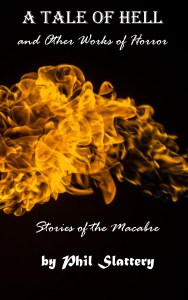 My e-book collection of horror shorts A Tale of Hell and Other Works of Horror” is available on Amazon Kindle. For your copy, go to
  After some deliberation, I have decided to make a couple of major changes to this website.


 For my sci-fi novel, Shadows and Stars Lying Down, I am shooting for a word count of between 80,000 to 100,000. I currently have a little over 54,000 words. I am past the point of no return. I have to finish this.
 In this collection of short stories, I explore the dark, sometimes violent, sometimes twisted, sometimes touching side of love, the side kept not only from public view, but sometimes from our mates. Set in the modern era, these stories range from regretting losing a lover to forbidden interracial love in the hills of 1970’s Kentucky to a mother’s deathbed confession in present-day New Mexico to debating pursuing a hateful man’s wife to the callous manipulation of a lover in Texas.
 Phil Slattery, Writer, Publisher