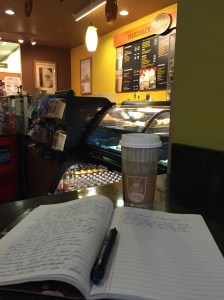
The Farmington Writers Circle meets tonight at 7:00 p.m. at Hastings Hardback Café on 20th Street. The topic of the evening will be writing pitches and hooks and will be led by Traci HalesVass, assistant professor of English at San Juan College.The meeting is open to the general public.
The Farmington Writers Circle is a nascent organization of authors and writers, who are interested in publishing and marketing their works.
Please contact Phil Slattery via this website with any questions or comments.
Tonight at 7:00 p.m, the Farmington Writers Circle will meet once at the Hastings Hardback Café on 20th Street in Farmington, NM. The topic for discussion will be writing pitches and hooks. With that in mind, I am posting the link above leading to an interesting contest from Anaspoke in which the contestant writing the best pitch for an actual or planned novel wins a free cover design. I hope that we will be able to use these pitch examples in our discussion. I believe the deadline for entries is past, but you can still vote.
Visit Anaspoke’s page via the link above for details and to see the contest entries.
The next meeting of the Farmington Writers Circle will be at 7:00 p.m. on January 7, 2016, at Hastings Hardback Café on 20th Street. The topic of the evening will be writing pitches and hooks and will be led by Traci HalesVass, assistant professor of English at San Juan College.The meeting is open to the general public.
The Farmington Writers Circle is a nascent organization of authors and writers, who are interested in publishing and marketing their works.
Please contact Phil Slattery via this website with any questions or comments.
The Farmington Writers Circle will meet tonight, December 10, at 7:00 p.m. at Hastings Hardback Café on 20th Street. The topic of the evening will be query letters and will be led by Roberta Summers, author of Pele’s Realm. The meeting is open to the general public. Feel free to read up on the topic before coming (though this is not required) and contribute to the discussion.
The Farmington Writers Circle is a nascent organization of authors and writers, who are interested in publishing and marketing their works.
Please contact Phil Slattery via this website with any questions or comments.
The next meeting of the Farmington Writers Circle will be at 7:00 p.m. on December 10 at Hastings Hardback Café on 20th Street. The topic of the evening will be query letters and will be led by Roberta Summers, author of Pele’s Realm. The meeting is open to the general public. Feel free to read up on the topic before coming (though this is not required) and contribute to the discussion.
The Farmington Writers Circle is a nascent organization of authors and writers, who are interested in publishing and marketing their works.
Please contact Phil Slattery via this website with any questions or comments.
The next meeting of the Farmington Writers Circle will be at 7:00 p.m. on December 10 at Hastings Hardback Café on 20th Street. The topic of the evening will be query letters and will be led by Roberta Summers, author of Pele’s Realm. The meeting is open to the general public. Feel free to read up on the topic before coming (though this is not required) and contribute to the discussion.
The Farmington Writers Circle is a nascent organization of authors and writers, who are interested in publishing and marketing their works.
Please contact Phil Slattery via this website with any questions or comments.
“The Jar” Follow the link to the flash horror “The Jar” by Olivia Wilding. This is an interesting tale, primarily for its point of view: frominside the narrator’s head that describes his emotions to the events around him and to the actions he takes. This is not unusual in itself, but here it is done very well and it manages to transmit what Henry James called “the atmosphere of the mind” to the reader. The voice has a haunting quality. I wish I had the time to write a thesis on what makes for a haunting narration such as this one, but I don’t.
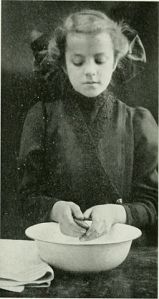
Girl Washing Hands, 1911
There is something in the combined sequence of actions and emotions that stirs certain dark emotions in the readers psyche, perhaps it’s something archetypal, Jungian. For me, this has always been the most effective means of instilling horror into a readership. If it didn’t start with Poe, it must have started in his era.
Second, it has an interesting twist at the end, which the author never gives away or hints at in the story. This is hard to do and it is done here well.
Lastly, the story is a combination of two different types of horror: the physical act of violence and the moral disgust it generates (when revealed) and the twisted relationship revealed at the end. All in all, this story has a very good denouement.
Please take the time to read “The Jar”. You won’t regret it.
Don’t read it, if you have something against well-chosen, strong language.
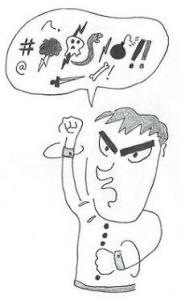
Here’s an interesting with an interesting perspective. It discusses all the non-verbal obscenities that appear in film, such as obscenities on t-shirts or in graffiti in the background. I am not a prude by any stretch of the imagination, but I believe that too much obscenity turns off a certain portion of a writer’s readership. On the other hand, sometimes a scene is of such intensity that it demands obscenities just to keep it plausible (e.g. some of the stories I am working on are set in hell, where obscenity-littered speech would be the norm). As is said in Ecclesiastes: “For everything there is a season.”
What this article inspires in me though, is not half-assed prudery or some type of literary caution or self-imposed censorship, but it opens up my mind to subtle places where I might place obscenities to express some subtlety of meaning or atmosphere.
I received this writing prompt from The Daily Post on November 8: “What’s the date today? Write it down, remove all dashes and slashes, and write a post that mentions that number.”
I started to write a glib response about numerology, but then a bell went off in the back of my mind.
While I don’t believe in numerology, I do like to toy with things like this in my writing for the enjoyment of people who do. Having been a graduate student at one time, I know how grad students and other literati like to analyze a text to the nth degree, searching for hidden but profound meaning in every nuanced word or misplaced comma. I seldom do this with the intent of relaying some arcane theme (people will interpret stories however best fits their worldview anyway), but just so the literati will have some fun analyzing and arguing about the story. For me, this is part of the fun of writing. But the more practical side of me also sees it as a way to build up a readership.
One way for a story to become known is via word of mouth. They will discuss the book if they find it interesting or they find something in it to argue about with their colleagues in the English Department or with friends at work or with like-minded enthusiasts at the local book club. So I give them something to debate.
Mostly, the understated connections I use are meaningless. For example, I have been working on a sci-fi short story in which I wanted to mention a sidearm astronauts 200 years from now might carry, but I did not want to use a type of space weapon that has become a cliché in the sci-fi world like a Star Trek phaser or a Star Wars blaster or a Flash Gordon ray gun. I named it the Hawking S-505 Black Particle sidearm. Hawking, obviously, for Stephen Hawking, who I am sure will have tons of scientific stuff named for him in the future including spaceports and starships. “Black Particle” as a form of dark energy relating to dark matter, which is cutting edge science these days, but will probably be trite in two centuries. S-550: the “S” is for sidearm; 550 is a US highway that runs through the town where I live currently. If I need a number, such as a serial number, I often use an old phone number or my birthdate or some other useless bit of trivia. As the original post from The Daily Post suggested, I might use a form of today’s date or some other date with meaning in my life. If the subject relates to magic(k), I might consult a book on numerology and choose/compose something appropriate. For example, in one horror story I have been writing for a long time, the protagonist walks through a tunnel under a dilapidated castle, where black magick was once practiced. The sides of the tunnel are covered in symbols and numbers including the number “4”, which symbolizes evil in some traditions.
For the names of characters, I frequently glance at the bookshelf to the right of my easy chair, where I write on my laptop, and combine the names of two authors to produce a name that has the right “sound” for the character or I might combine names from history or art or some other field. For example, I see I have one book by Bill Moyers and another by George Plimpton. I might name a character Bill Plimpton. In another sci-fi work (yet to be published) I needed the names for a nine man reconnaissance team to go aboard a derelict starship. I went to Google Translate and took the word for “warrior” from nine languages ranging from Gaelic to Swahili, so none would be immediately recognizable as a word for warrior (at least in the US), yet the names would express the cultural diversity of the crew.
Anyway, for me that is part of the fun of writing. How do you have fun with your writing?


 The next meeting of the Farmington Writers Circle will be at 7:00 p.m. on January 7, 2016, at Hastings Hardback Café on 20th Street. The topic of the evening will be writing pitches and hooks and will be led by
  Source:

 The Farmington Writers Circle will meet tonight, December 10, at 7:00 p.m. at Hastings Hardback Café on 20th Street. The topic of the evening will be query letters and will be led by
 Source:
 Phil Slattery, Writer, Publisher