The Saturday Night Special: “The Damned Thing” by Ambrose Bierce

As a new feature, I will endeavor each Saturday to post a work of horror from its long past.  Horror, as a recognized genre, has existed less than a century.  Before that, it was known by several names or vague references, such asv”weird fiction” or “ghost stories” or “gothic tales”.  Many tales from these earlier eras are forgotten, but many are still well-known, having withstood the test of time, because they contained some element(s) that made them worthy of being remembered.    It is to our advantage to study these memorable works and to discern what it is about them that speaks to the human psyche so intensely that they are remembered.  However, just because a work is not well-known today, does not mean it does not merit study.  There are many tales that were popular or highly acclaimed in their time, that should be remembered today, but sadly are not.  We can learn much from these as well.

My intent with this new, (hopefully) regular feature is to bring to the world’s attention once again, stories that warrant study and remembrance.  Too often in our modern world we become so lost among fads, trends, sound bytes, and the often ill-advised advice of pundits and critics, that we lose sight of the entirety of our lives and of our art.  As someone once said, “when you’re up to your ass in alligators, it’s hard to remember your mission was to drain the swamp.”  Maintaining a good, solid overview of one’s art is one means of maintaining a good, solid perspective, and probably the most basic overview is the historical perspective.

For these reasons, every Saturday I would like to bring you a story from horror’s long past, one that is worthy of study and remembrance.  I shall try to keep them brief, but I will have to balance that with each one’s own merits.  I hope you enjoy them all.  This Saturday’s selection is:


The Damned Thing

by Ambrose Bierce

1898

(The Project Gutenberg Text)

Ambrose Bierce October 7, 1892
Ambrose Bierce
October 7, 1892

By THE light of a tallow candle, which had been placed on one end of a rough table, a man was reading something written in a book. It was an old account book, greatly worn; and the writing was not, apparently, very legible, for the man sometimes held the page close to the flame of the candle to get a stronger light upon it. The shadow of the book would then throw into obscurity a half of the room, darkening a number of faces and figures; for besides the reader, eight other men were present. Seven of them sat against the rough log walls, silent and motionless, and, the room being small, not very far from the table. By extending an arm any one of them could have touched the eighth man, who lay on the table, face upward, partly covered by a sheet, his arms at his sides. He was dead.

The man with the book was not reading aloud, and no one spoke; all seemed to be waiting for something to occur; the dead man only was without expectation. From the blank darkness outside came in, through the aperture that served for a window, all the ever unfamiliar noises of night in the wilderness—the long, nameless note of a distant coyote; the stilly pulsing thrill of tireless insects in trees; strange cries of night birds, so different from those of the birds of day; the drone of great blundering beetles, and all that mysterious chorus of small sounds that seem always to have been but half heard when they have suddenly ceased, as if conscious of an indiscretion. But nothing of all this was noted in that company; its members were not overmuch addicted to idle interest in matters of no practical importance; that was obvious in every line of their rugged faces—obvious even in the dim light of the single candle. They were evidently men of the vicinity—farmers and woodmen.

The person reading was a trifle different; one would have said of him that he was of the world, worldly, albeit there was that in his attire which attested a certain fellowship with the organisms of his environment. His coat would hardly have passed muster in San Francisco: his footgear was not of urban origin, and the hat that lay by him on the floor (he was the only one uncovered) was such that if one had considered it as an article of mere personal adornment he would have missed its meaning. In countenance the man was rather prepossessing, with just a hint of sternness; though that he may have assumed or cultivated, as appropriate to one in authority. For he was a coroner. It was by virtue of his office that he had possession of the book in which he was reading; it had been found among the dead man’s effects—in his cabin, where the inquest was now taking place.

When the coroner had finished reading he put the book into his breast pocket. At that moment the door was pushed open and a young man entered. He, clearly, was not of mountain birth and breeding: he was clad as those who dwell in cities. His clothing was dusty, however, as from travel. He had, in fact, been riding hard to attend the inquest.

The coroner nodded; no one else greeted him.

“We have waited for you,” said the coroner. “It is necessary to have done with this business to-night.”

The young man smiled. “I am sorry to have kept you,” he said. “I went away, not to evade your summons, but to post to my newspaper an account of what I suppose I am called back to relate.”

The coroner smiled.

“The account that you posted to your newspaper,” he said, “differs probably from that which you will give here under oath.”

“That,” replied the other, rather hotly and with a visible flush, “is as you choose. I used manifold paper and have a copy of what I sent. It was not written as news, for it is incredible, but as fiction. It may go as a part of my testimony under oath.”

“But you say it is incredible.”

“That is nothing to you, sir, if I also swear that it is true.”

The coroner was apparently not greatly affected by the young man’s manifest resentment. He was silent for some moments, his eyes upon the floor. The men about the sides of the cabin talked in whispers, but seldom withdrew their gaze from the face of the corpse. Presently the coroner lifted his eyes and said: “We will resume the inquest.”

The men removed their hats. The witness was sworn.

“What is your name?” the coroner asked.

“William Harker.”

“Age?”

“Twenty-seven.”

“You knew the deceased, Hugh Morgan?”

“Yes.”

“You were with him when he died?”

“Near him.”

“How did that happen—your presence, I mean?”

“I was visiting him at this place to shoot and fish. A part of my purpose, however, was to study him, and his odd, solitary way of life. He seemed a good model for a character in fiction. I sometimes write stories.”

“I sometimes read them.”

“Thank you.”

“Stories in general—not yours.”

Some of the jurors laughed. Against a sombre background humor shows high lights. Soldiers in the intervals of battle laugh easily, and a jest in the death chamber conquers by surprise.

“Relate the circumstances of this man’s death,” said the coroner. “You may use any notes or memoranda that you please.”

The witness understood. Pulling a manuscript from his breast pocket he held it near the candle, and turning the leaves until he found the passage that he wanted, began to read.

II

“…The sun had hardly risen when we left the house. We were looking for quail, each with a shotgun, but we had only one dog. Morgan said that our best ground was beyond a certain ridge that he pointed out, and we crossed it by a trail through the chaparral. On the other side was comparatively level ground, thickly covered with wild oats. As we emerged from the chaparral, Morgan was but a few yards in advance. Suddenly, we heard, at a little distance to our right, and partly in front, a noise as of some animal thrashing about in the bushes, which we could see were violently agitated.

“‘We’ve started a deer,’ said. ‘I wish we had brought a rifle.’

“Morgan, who had stopped and was intently watching the agitated chaparral, said nothing, but had cocked both barrels of his gun, and was holding it in readiness to aim. I thought him a trifle excited, which surprised me, for he had a reputation for exceptional coolness, even in moments of sudden and imminent peril.

“‘O, come!’ I said. ‘You are not going to fill up a deer with quail-shot, are you?’

“Still he did not reply; but, catching a sight of his face as he turned it slightly toward me, I was struck by the pallor of it. Then I understood that we had serious business on hand, and my first conjecture was that we had ‘jumped’ a grizzly. I advanced to Morgan’s side, cocking my piece as I moved.

“The bushes were now quiet, and the sounds had ceased, but Morgan was as attentive to the place as before.

“‘What is it? What the devil is it?’ I asked.

“‘That Damned Thing!’ he replied, without turning his head. His voice was husky and unnatural. He trembled visibly.

“I was about to speak further, when I observed the wild oats near the place of the disturbance moving in the most inexplicable way. I can hardly describe it. It seemed as if stirred by a streak of wind, which not only bent it, but pressed it down—crushed it so that it did not rise, and this movement was slowly prolonging itself directly toward us.

“Nothing that I had ever seen had affected me so strangely as this unfamiliar and unaccountable phenomenon, yet I am unable to recall any sense of fear. I remember—and tell it here because, singularly enough, I recollected it then—that once, in looking carelessly out of an open window, I momentarily mistook a small tree close at hand for one of a group of larger trees at a little distance away. It looked the same size as the others, but, being more distinctly and sharply defined in mass and detail, seemed out of harmony with them. It was a mere falsification of the law of aerial perspective, but it startled, almost terrified me. We so rely upon the orderly operation of familiar natural laws that any seeming suspension of them is noted as a menace to our safety, a warning of unthinkable calamity. So now the apparently causeless movement of the herbage, and the slow, undeviating approach of the line of disturbance were distinctly disquieting. My companion appeared actually frightened, and I could hardly credit my senses when I saw him suddenly throw his gun to his shoulders and fire both barrels at the agitated grass! Before the smoke of the discharge had cleared away I heard a loud savage cry—a scream like that of a wild animal—and, flinging his gun upon the ground, Morgan sprang away and ran swiftly from the spot. At the same instant I was thrown violently to the ground by the impact of something unseen in the smoke—some soft, heavy substance that seemed thrown against me with great force.

“Before I could get upon my feet and recover my gun, which seemed to have been struck from my hands, I heard Morgan crying out as if in mortal agony, and mingling with his cries were such hoarse savage sounds as one hears from fighting dogs. Inexpressibly terrified, I struggled to my feet and looked in the direction of Morgan’s retreat; and may heaven in mercy spare me from another sight like that! At a distance of less than thirty yards was my friend, down upon one knee, his head thrown back at a frightful angle, hatless, his long hair in disorder and his whole body in violent movement from side to side, backward and forward. His right arm was lifted and seemed to lack the hand—at least, I could see none. The other arm was invisible. At times, as my memory now reports this extraordinary scene, I could discern but a part of his body; it was as if he had been partly blotted out—I can not otherwise express it—then a shifting of his position would bring it all into view again.

“All this must have occurred within a few seconds, yet in that time Morgan assumed all the postures of a determined wrestler vanquished by superior weight and strength. I saw nothing but him, and him not always distinctly. During the entire incident his shouts and curses were heard, as if through an enveloping uproar of such sounds of rage and fury as I had never heard from the throat of man or brute!

“For a moment only I stood irresolute, then, throwing down my gun, I ran forward to my friend’s assistance. I had a vague belief that he was suffering from a fit or some form of convulsion. Before I could reach his side he was down and quiet. All sounds had ceased, but, with a feeling of such terror as even these awful events had not inspired, I now saw the same mysterious movement of the wild oats prolonging itself from the trampled area about the prostrate man toward the edge of a wood. It was only when it had reached the wood that I was able to withdraw my eyes and look at my companion. He was dead.”

III

The coroner rose from his seat and stood beside the dead man. Lifting an edge of the sheet he pulled it away, exposing the entire body, altogether naked and showing in the candle light a clay-like yellow. It had, however, broad maculations of bluish-black, obviously caused by extravasated blood from contusions. The chest and sides looked as if they had been beaten with a bludgeon. There were dreadful lacerations; the skin was torn in strips and shreds.

The coroner moved round to the end of the table and undid a silk handkerchief, which had been passed under the chin and knotted on the top of the head. When the handkerchief was drawn away it exposed what had been the throat. Some of the jurors who had risen to get a better view repented their curiosity, and turned away their faces. Witness Harker went to the open window and leaned out across the sill, faint and sick. Dropping the handkerchief upon the dead man’s neck, the coroner stepped to an angle of the room, and from a pile of clothing produced one garment after another, each of which he held up a moment for inspection. All were torn, and stiff with blood. The jurors did not make a closer inspection. They seemed rather uninterested. They had, in truth, seen all this before; the only thing that was new to them being Harker’s testimony.

“Gentlemen,” the coroner said, “we have no more evidence, I think. Your duty has been already explained to you; if there is nothing you wish to ask you may go outside and consider your verdict.”

The foreman rose—a tall, bearded man of sixty, coarsely clad.

“I should like to ask one question, Mr. Coroner,” he said. “What asylum did this yer last witness escape from?”

“Mr. Harker,” said the coroner, gravely and tranquilly, “from what asylum did you last escape?”

Harker flushed crimson again, but said nothing, and the seven jurors rose and solemnly filed out of the cabin.

“If you have done insulting me, sir,” said Harker, as soon as he and the officer were left alone with the dead man, “I suppose I am at liberty to go?”

“Yes.”

Harker started to leave, but paused, with his hand on the door latch. The habit of his profession was strong in him—stronger than his sense of personal dignity. He turned about and said:

“The book that you have there—I recognize it as Morgan’s diary. You seemed greatly interested in it; you read in it while I was testifying. May I see it? The public would like—”

“The book will cut no figure in this matter,” replied the official, slipping it into his coat pocket; “all the entries in it were made before the writer’s death.”

As Harker passed out of the house the jury reentered and stood about the table on which the now covered corpse showed under the sheet with sharp definition. The foreman seated himself near the candle, produced from his breast pocket a pencil and scrap of paper, and wrote rather laboriously the following verdict, which with various degrees of effort all signed:

“We, the jury, do find that the remains come to their death at the hands of a mountain lion, but some of us thinks, all the same, they had fits.”

IV

In the diary of the late Hugh Morgan are certain interesting entries having, possibly, a scientific value as suggestions. At the inquest upon his body the book was not put in evidence; possibly the coroner thought it not worth while to confuse the jury. The date of the first of the entries mentioned can not be ascertained; the upper part of the leaf is torn away; the part of the entry remaining is as follows:

“… would run in a half circle, keeping his head turned always toward the centre and again he would stand still, barking furiously. At last he ran away into the brush as fast as he could go. I thought at first that he had gone mad, but on returning to the house found no other alteration in his manner than what was obviously due to fear of punishment.

“Can a dog see with his nose? Do odors impress some olfactory centre with images of the thing emitting them? . . .

“Sept 2.—Looking at the stars last night as they rose above the crest of the ridge east of the house, I observed them successively disappear—from left to right. Each was eclipsed but an instant, and only a few at the same time, but along the entire length of the ridge all that were within a degree or two of the crest were blotted out. It was as if something had passed along between me and them; but I could not see it, and the stars were not thick enough to define its outline. Ugh! I don’t like this. . . .”

Several weeks’ entries are missing, three leaves being torn from the book.

“Sept. 27.—It has been about here again—I find evidences of its presence every day. I watched again all of last night in the same cover, gun in hand, double-charged with buckshot. In the morning the fresh footprints were there, as before. Yet I would have sworn that I did not sleep—indeed, I hardly sleep at all. It is terrible, insupportable! If these amazing experiences are real I shall go mad; if they are fanciful I am mad already.

“Oct. 3.—I shall not go—it shall not drive me away. No, this is my house, my land. God hates a coward….

“Oct. 5.—I can stand it no longer; I have invited Harker to pass a few weeks with me—he has a level head. I can judge from his manner if he thinks me mad.

“Oct. 7.—I have the solution of the problem; it came to me last night—suddenly, as by revelation. How simple—how terribly simple!

“There are sounds that we can not hear. At either end of the scale are notes that stir no chord of that imperfect instrument, the human ear. They are too high or too grave. I have observed a flock of blackbirds occupying an entire treetop—the tops of several trees—and all in full song. Suddenly—in a moment—at absolutely the same instant—all spring into the air and fly away. How? They could not all see one another—whole treetops intervened. At no point could a leader have been visible to all. There must have been a signal of warning or command, high and shrill above the din, but by me unheard. I have observed, too, the same simultaneous flight when all were silent, among not only blackbirds, but other birds—quail, for example, widely separated by bushes—even on opposite sides of a hill.

“It is known to seamen that a school of whales basking or sporting on the surface of the ocean, miles apart, with the convexity of the earth between them, will sometimes dive at the same instant—all gone out of sight in a moment. The signal has been sounded—too grave for the ear of the sailor at the masthead and his comrades on the deck—who nevertheless feel its vibrations in the ship as the stones of a cathedral are stirred by the bass of the organ.

“As with sounds, so with colors. At each end of the solar spectrum the chemist can detect the presence of what are known as ‘actinic’ rays. They represent colors—integral colors in the composition of light—which we are unable to discern. The human eye is an imperfect instrument; its range is but a few octaves of the real ‘chromatic scale’ I am not mad; there are colors that we can not see.

“And, God help me! the Damned Thing is of such a color!”
“A Study in Emerald” by Neil Gaiman

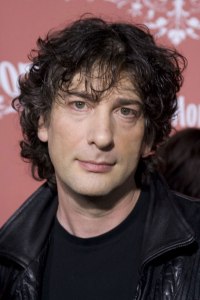
Neil Gaiman at the 2007 Scream Awards Photo by pinguino k
Neil Gaiman
at the 2007 Scream Awards
Photo by pinguino k

“A Study in Emerald”

I am not going to attempt to copy and paste this story here, because it is too beautifully formatted in it original form.  Follow the link to a short story by Neil Gaiman.  Scott Meslow in his article “9 contemporary horror stories you can read right now” (which I recommend reading) at The Week says about it:

Neil Gaiman won a Hugo Award for this clever pastiche, which blends together the best of both H.P. Lovecraft and Arthur Conan Doyle’s Sherlock Holmes for a case about a mysterious and disturbing death in London. As a bonus, the PDF copy of the story available online is a winking mockup of a 1914 newspaper story, with era-appropriate “ads” to match.

“It is the immensity, I believe. The hugeness of things below. The darkness of dreams.

“But I am woolgathering. Forgive me. I am not a literary man.

“I had been in need of lodgings. That was how I met him. I wanted someone to share the cost of rooms with me. We were introduced by a mutual acquaintance, in the chemical laboratories of St. Bart’s. “You have been in Afghanistan, I perceive,” that was what he said to me, and my mouth fell open and my eyes opened very wide…”

Follow the link above to read more.

Monica J. O’Rourke and Wrath James White ‘Poisoning Eros’ Review

Source: Monica J. O’Rourke and Wrath James White ‘Poisoning Eros’ Review

For Fans of extreme horror, this article from Horror Novel Reviews has something titillating for you.


Farmington Writers Circle in Development

Writing at Hasting's Hardback Café in Farmington, NM, late evening of October 16, 2015 (self-portrait)
Writing at Hasting’s Hardback Café in Farmington, NM, late evening of October 16, 2015 (self-portrait)

I would like to establish a writers’ circle for the Farmington, New Mexico area, including San Juan County, and anyone from the Four Corners area.  I will he hosting a meeting on November 19 at 7:00 p.m. at the Farmington Hastings’ Hardback Cafe to establish how many people are interested.  Everyone is welcome to attend.  The mission of the Writers Circle will be to promote Farmington area writers of any genre and skill level, to advise each other on being published, and to establish useful contacts within the regional and national literary communities.   If anyone in the Farmington/Four Corners has an interest, please contact me via this website by commenting below.

Thoughts?  Comments?

Ramsey Campbell’s ‘Thirteen Novels on the Edge of Horror’

Source: Ramsey Campbell’s ‘Thirteen Novels on the Edge of Horror’

In this fun, engaging article from Horror Novel Reviews, Ramsey Campbell lists thirteen thrilling novels from the last fifty years that should be on any horror enthusiast’s list of novels to read.

The Quick 10: 10 Unexpected Horror Writers

John Steinbeck (from the website Letters of Note)
John Steinbeck
(from the website
Letters of Note)

The Quick 10: 10 Unexpected Horror Writers.

In this article from mentalfloss.com Stacy Conradt tells us about ten renown figures from literature and history who had brief, quirky flings with the horror genre.  Some of these you would probably never suspect of even hearing about the horror genre.  One aspect that may be of interest to writers of horror is the minimal experience each author had with horror before dreaming up the concept for his/her foray into the genre.

Thoughts?  Comments?

6 Horror Books Based On Real Events

Source: 6 Horror Books Based On Real Events

Check out these six books on events forming the basis for some well-known fictional horror.   Good recommendations for reading over the holidays, particularly Halloween.

“NOTED” Fiction by Steffany Willey

I am pleased to announce that I have accepted the first work of fiction submitted to Slattery’s Art of Horror Magazine.  Although some might not consider it “horror” per se, because it is not supernatural in nature and does not contain horrific gore, it does meet the stipulations I have set out for this magazine, in that it contains a horrific element and it pushes a nebulous boundary between horror and another genre, which in this case is mainstream literature.  I like the story and its understated element of suspense, its thoughtful wording, and its ability to draw the reader into it for a vicarious experience.  I hope you enjoy it as much as I did.

NOTED

by Steffany Willey

Asha was my spur-of-the-moment walking buddy. She lived five houses away, and if one of us suddenly needed a break from our mom lives we’d give the other a call. Winter and summer we’d plod the two-mile loop, often grumbling about what our kids did or didn’t do, sometimes bragging about the grandkids. We’d pick apart the neighbors’ landscaping, which often amounted to little more than plugging in a feeble row of Home Depot arborvitae, and made suggestions (to each other) like clipboard horticulturalists.

Our route passed a house I’d visited many times. It was a trim two-story colonial with a wing on one side that had once been a garage. The lawn was thick then, lush, the sidewalk edged, the shrubs mulched. Inside, the rooms lulled sweetly in this tidy castle.

Over the years it had changed hands a number of times but to progressively disinterested owners. Now it had deteriorated into such a mess it brought us to a halt. We scowled at a tree skeleton and overgrown shrubs that shrouded the windows. That same grass was choked with weeds that were well beyond a lawnmower and a gallon of Weed B Gon. Even the sidewalk fought to hold its own. It was a shame. It brought down the neighborhood.

photo by D Sharon Pruitt

It was during that scathing appraisal that we saw the girl. She was at a front window and seemed to be struggling to open it. She looked like a young teen. When she saw us she waved. We waved back. She kept on waving.

Suddenly a man emerged from the front door. He was fortyish and lean, a swimmer or runner possibly. In jeans and a pressed shirt and a stylish day-old beard, he couldn’t have been more at odds with this sorry house. Or that was our impression until he marched our way.

“Everything OK?” he demanded in a no-nonsense tone. His laser eyes pinned us down as if we’d been trespassing. The message was clear: Move on ladies. Were neighbors giving him heat about his property?

“Yeah,” I think I mumbled, and turned away to walk on. When I glanced back the girl was gone and a shade pulled. The man stood firm, watching.

It bothered me. Asha too. Had the girl been waving or beckoning, asking for help? We hemmed and hawed. Should we do something about this? Or was she just a kid sent to her room and trying to sneak out?

We made a point to check out the house the next day. This time I jotted down the address and name on the mailbox, but weeks passed before I contacted the community association and was told to share my concerns with the police; in turn, they took note, made a written report.

So it was. We did our bit, said what we saw.

Fall brought birthdays and holidays and deaths in the neighborhood. We squeezed in our walk when we could, offering up our critiques. A couple houses went on the market, polished it seemed overnight. Asha’s neighbor built a lopsided shed on a twenty-degree slope in his backyard that was supported on one edge by stilts; it and his new John Deere riding mower crashed to the bottom of their lot two months later. We might have told him so.

And sometimes I would drive by the house with the girl and see a light on, but usually it was dark, to itself.

The winter was harsh, the land hidden under a glaze of snow that leaked all day then morphed into black ice at night. Our walks were few, and we didn’t get back into the swing until March. By then neighbors were emerging like hibernated bears, poking into gardens and washing cars. One afternoon we slowed to admire a ’57 T-Bird, its owner in the driveway stroking it like a cat. I’d seen him before, similarly entranced, touching up flaws only he could see. His house, as it happened, was across the street from the house with the girl.

“Do you ever drive it?” I asked pleasantly as we came even with his driveway.

Snatched from his reverie, he offered, “Fourth of July parades. That’s about it.”

“I’ll have to look for you. I never miss the Catonsville parade.”

“‘I’ll be there.”

I glanced behind me. “I was wondering about that house. It looks abandoned.”

He wrung out a chamois that looked dry.

”Yeah. He … ah … isn’t there.”

“He moved?”

“I guess you could say that.” He honed in on the passenger-side door, buffing an area under the handle. Asha and I traded looks.

“Were there children living there?”

“No. Why?”

“We saw a girl  at a front window a while back. Something seemed … off … not right …”

He sighed and turned to us. “I figured they were relatives.” Then: “He was arrested a few days ago on child pornography charges. He’s … he was …. a teacher.” He didn’t meet our eyes.

“Oh no!” I said.

Asha touched my arm. “Sweet Lord,” she croaked.

We stood looking at each other, the three of us. There was more but he wasn’t saying. Guilt was written on his face as if in Magic Marker.

“I’ll look for the car at the parade,” I finally said, backing off and pulling Asha with me.

“I’m sorry,” he said as if he was to blame.

Later it made the news, and in a month a For Sale sign was stuck in the mud by the driveway. No one had bothered to tame the property, so someone was going to get a good fixer-upper deal. Families clamored for homes in this school district so it would sell easily.

Though we still walk, we never speak of the girl or remark on the house as we pass. In fact, it’s as if it isn’t even there

The Dark Language

Working on a play in Hasting's Hardback Café, late evening, October 16, 2015.
Working on a play in Hasting’s Hardback Café, late evening, October 16, 2015.

As I was preparing to go to the local theatre this evening, I was thinking about how I can improve my writing and what distinguishes the great writers of horror.  Of course, the first two that came into my mind as being easily discernible from all others were Poe and Lovecraft.  Obviously, what distinguishes them is their use of language.  Both use very intense, muscular language with a distinctly archaic tone.   Not knowing if there a precise term already exists for this style, I decided to call it “the dark language”, because of its tight connection with the horror genre and with the horrifying in general.   For me, there seems to be something archetypal about this, arising out of the Jungian collective unconscious.   Perhaps it is just that Poe bound the Dark Language so intimately with scenes of horror, terror, and suspense, which is also bound with genres such as the Gothic novel, that the sound of it automatically brings forth societal memories of dread.

I need to finish dressing if I am to dine at my favorite local sushi restaurant before heading to the play.  Somehow, I just have the taste for something raw tonight.

Thoughts?  Comments?

Review of “The Vampyre” by John William Polidori

John William Polidori 1795-1821 (from Wikimedia)
John William Polidori
          1795-1821
    (from Wikimedia)

Today I finished reading “The Vampyre” by John William Polidori.  Polidori was a friend of Lord Byron and wrote this story during the famous writing contest between Byron, Polidori, Percy Bysshe Shelley, and Mary Shelley, in which Mary Shelley wrote the initial draft of “Frankenstein” (see my post on Polidori and “The Vampyre” dated July 12, 2013).  Tonight I wrote up a quick review for Goodreads, which I have pasted here for your enjoyment.  I gave the story three stars out of five.

“The action was somewhat fast moving and the ending unexpected, but the plot is rather simple and the narration is hampered by a lack of dialog. There are probably less than five lines of dialog in the entire story of 9,223 words (I copied and pasted the story from the Project Gutenberg version minus the “Extract of a Letter from Geneva” and the “Extract of a Letter Containing an Account of Lord Byron’s Residence in the Island of Mitylene” into Word then used their word count feature). One interesting aspect of Lord Ruthven’s (the vampire) character is that he cannot survive on just anyone’s blood; he has to feed only on the blood of those he loves. That would make an interesting twist to any vampire tale. As the Goodreads summary notes, this is also the start of the motif of the vampire as aristocratic seducer. While this story is probably of mediocre quality at best for today’s literary audiences, it is interesting from the perspective of literary history as the origin of today’s vampire stories and all the cultural offshoots that have sprung from those (such as the Goth movement). Bottom line: it’s worth taking the time to read, especially if one has an interest in the historical basis for today’s horror literature and the vampire subculture.”

Thoughts?  Comments?


Physical Descriptions and the Atmosphere of the Mind

Relaxing by the front yard firepit on a chilly New Mexico evening circa 2013.

I was sitting here writing a short story when it occurred to me that most characters in classic fiction seldom have detailed descriptions of their physical characteristics.  In fact, many have none at all.   If they are described, it is usually in a broad, general way, unless there is some detail the author wants to bring out that reveals something about the character.   While this is a good technique for lean, muscular writing, it also has the benefit of not limiting how the character appears in the reader’s mind.   For example, here is the initial description of Victor Frankenstein when the narrator’s ship rescues him in the arctic in letter 4 (which functions in essence as part of a preface):

“Upon hearing this he appeared satisfied and consented to come on board. Good God! Margaret, if you had seen the man who thus capitulated for his safety, your surprise would have been boundless. His limbs were nearly frozen, and his body dreadfully emaciated by fatigue and suffering. I never saw a man in so wretched a condition. We attempted to carry him into the cabin, but as soon as he had quitted the fresh air he fainted. We accordingly brought him back to the deck and restored him to animation by rubbing him with brandy and forcing him to swallow a small quantity. As soon as he showed signs of life we wrapped him up in blankets and placed him near the chimney of the kitchen stove. By slow degrees he recovered and ate a little soup, which restored him wonderfully.

“Two days passed in this manner before he was able to speak, and I often feared that his sufferings had deprived him of understanding. When he had in some measure recovered, I removed him to my own cabin and attended on him as much as my duty would permit. I never saw a more interesting creature: his eyes have generally an expression of wildness, and even madness, but there are moments when, if anyone performs an act of kindness towards him or does him any the most trifling service, his whole countenance is lighted up, as it were, with a beam of benevolence and sweetness that I never saw equalled. But he is generally melancholy and despairing, and sometimes he gnashes his teeth, as if impatient of the weight of woes that oppresses him.”

Very little is said about Frankenstein’s physical state except where it reveals something about his state of mind or gives an idea of the hardships he has suffered in pursuit of his creation.    Because the physical description is so minimal,  the reader may envision Frankenstein in any physical form that he wants or whatever is easiest for him to envision (there is a difference between what we may want to envision and what is easiest or most natural for us to envision).  Frankenstein could be short and dark-haired and dark-complected or tall and blonde and sunburned.  Later on, we learn his family is from Geneva, therefore the reader could envision him as whatever his stereotype of a Swiss man from Geneva happens to be.

Using minimal physical description is therefore an advantage to the author, because it allows the reader to more easily visualize and thus more easily experience the story vicariously, i.e., it allows the reader to more easily immerse himself in the story.  We have all experienced the feeling of being completely immersed in the world of a novel, what Henry James called “the atmosphere of the mind” (see the definition in the Lexicon of Horror) and that is a feeling I want my readers to experience.

Thoughts?  Comments?

The Annotated Lovecraft

Farmington, New Mexico, March 20, 2015

While over at Hastings tonight (not much to do in Farmington on a Monday night), I saw a new book entitled “The Annotated Lovecraft” (I hope I have the title right).  It’s about 8″ x 10″ x 2-3″ thick.  It contains a lot, if not all, of Lovecraft’s works with copious notes and illustrations, including photos of his home area.  It sells for about $25 and would a terrific gift for any Lovecraft aficionado.  I looked at it only briefly, but it did not occur to me until I arrived at home that I should write up a few notes on it for those who may not have encountered it.

Thoughts?  Comments?

Quote of the Day from Goodreads

With Iced Tea, Farmington, New Mexico, March 20, 2015

As you may already know, I am on Goodreads quote of the day mailing list.  Today’s I found particularly interesting on a couple of levels:

“Atticus told me to delete the adjectives and I’d have the facts.”  Harper Lee

First, there is the literary perspective.  Eliminating the adjectives and other modifiers from a story leaves you with the simple, cold hard facts, the bones, of the story.  I have read several bits of writing advice that advocate keeping modifiers to a minimum and using nouns and verbs to their fullest by using them precisely, trying to match the exact word to its underlying concept.   To my mind, that leaves one with the essence of the story.

Second, there is the deeper, philosophical perspective.   Like with the literary perspective above, if you observe or learn of an event, if you cut away all the extraneous opinions and descriptors and other crap, you will have the cold, hard facts of the matter.   This is echoed in Hannibal Lecter’s famous quote from Marcus Aurelius (though this is actually a paraphrase…at least in my copy of Meditations of Marcus Aurelius): “Read Marcus Aurelius. Of each particular thing ask: what is it in itself? What is its nature?”.  It is also echoed in Hemingway’s remark made during an interview in The Paris Review:  “The most essential gift for a good writer is a built-in, shockproof, shit detector.”

Thoughts?  Comments?

Goodreads Quote of the Day from H.P. Lovecraft

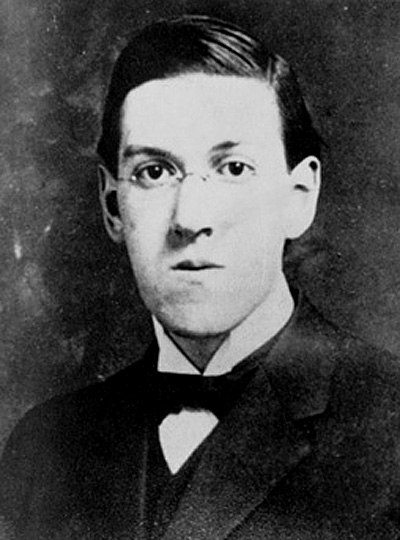
H.P. Lovecraft, 1915

Here’s another tidbit from those wonderful folks over at Goodreads:

The world is indeed comic, but the joke is on mankind.

H.P. Lovecraft

April 17, 1926: On this day, H.P Lovecraft returned to his home in Providence, Rhode Island after suffering a few years in the “hateful chaos” of Brooklyn. He never moved away again

Recommendations from “The Ray Bradbury Theatre”

Relaxing by the front yard firepit on a chilly New Mexico evening circa 2013.

I was in the Navy for the entire time “The Ray Bradbury Theatre” ran in syndication (1985-1992).   I happened to pick up a collection of 65 of its episodes yesterday while at the Hastings bookstore in Farmington.  I have watched less than a dozen of its first episodes (circa 1986) so far, but two I recommend highly for their suspense and general spookiness:  “The Banshee” starring Charles Martin Smith and Peter O’Toole and “The Town Where No One Got Off” starring Jeff Goldblum.  I particularly enjoyed the latter where Jeff Goldblum disembarks a train in a town where the train normally does not stop and finds himself in a sticky situation, which he manages to resolve quite cleverly.   Check them out if you get the chance.

Thoughts?  Comments?