
Several years ago, I wrote a seven-part series on my own Tao of the art of writing and published it on my then nascent version of this website. Over the next several days I will be republishing it. I will probably end up adding at least a part 8. In addition, I intend to convert this series into a series of YouTube videos, once I work out some production details, to play on the website’s YouTube channel. Please let me know what you think of this series and how I can improve it for YouTube.
A quick Google search reveals there are a lot of web articles entitled “The Tao of Writing”. This is mine. Let me begin by explaining what I perceive to be the Tao (others may view it differently and have equally valid perceptions).
The Chinese character above translates as Tao, the way, and is pronounced as “dow”, as in “The Dow-Jones Industrial Average”. Taoism is an ancient Chinese religion rooted in the teachings of the legenday Chinese philosopher Lao Tzu (sometimes transliterated as “Lao Tze” or in a number of other ways) as expressed in his book, the Tao Teh Ching (The Book of the Way). The Taoist religion, as I understand it, is far removed from Lao Tzu’s original philosophy, because the religion incorporates demons, gods, demigods, spirits, and other things that are not mentioned in the Tao Teh Ching or in the teachings of the original masters such as Lao Tzu, Chuang Tzu, or the Huainan Masters (at least in the translations I have read).
What the Tao is, is hard to express. “The Way”, as I understand it, refers to the the way of the universe, basically how the universe works in a general sense. In the American vernacular, we would probably express it as “the way things are”. Some reader might respond to that as, “Sure. I understand. You’re saying the Tao is why toast always falls buttered side down. Gotcha.”
No, I am talking about something a bit more profound. It’s more like this:
You work hard at trying to find a publisher for a story and are consistently rejected by what you perceived to be all the most suitable choices. So, one night when you are battling insomnia and have just started the first glass of your second bottle of wine, out of frustration you send it off as a shot in the dark to some big name magazine who will never accept it, and lo and behold it is accepted. So, sometimes it seems that you work your butt off for something and get nowhere, but you give up trying and you succeed. Basically, the Tao is then like learning the way the universe works, then learning to succeed by adapting to that way. Confused yet? Have I oversimplified my point or have I made it overly complex?
Understanding how the Tao works is not something anyone can express in words; it is something one can understand only subjectively, i.e., one must have a feel for it. In fact, the first sentence of the Tao Teh Ching is “The Way that can be spoken is not the true Way.” For most people, reading the Tao Teh Ching will probably be an exercise in confusion and frustration and contradiction. In the Tao Teh Ching, nothing is exact; everything is metaphor and allusion, about how water flows into a valley and then the sea, how wood is shaped, the balance of the universe, and so on.
To complicate matters even more, because the Tao Teh Ching was written in Chinese about 2,500 years ago, and the translation of the original Chinese characters may have changed significantly since then, translation of the Tao Teh Ching into modern languages is frustratingly imprecise, often relying on traditional or customary translations as opposed to knowing exactly what Lao Tzu was saying. For today’s modern, exact, Socratic-tradition-based society, this is maddening. Our scholars argue about the meanings of works written in modern English, how are they going to agree on something as nebulous as the Tao Teh Ching?
So, what are the important ponts of the Tao that everyone should remember?
As I perceive the Tao, one critical aspect of existence is balance; the universe consists of opposites that must balance out or problems arise. At the same time, all existence arises from the conflict of opposites. An example of this is the old Zen Buddhist rhetorical question of “what is the sound of one hand clapping?” I do not know the official or traditional answer to this, but from my Taoist perception, the answer is that there is no sound. The sound of clapping is produced only when the opposing forces of the hands meet. Thus it is with everything in the universe. Two opposites have to come together to produce anything: light and dark, man and woman, left and right, up and down, hot and cold, etc.
Another critical aspect of existence is that emptiness can be as important as substance and non-action can be as important as action. There are other aspects, of course, but I will stick to these for now and address those at a later date.
Take a look at your hand for an example of the first principle. If there were no spaces between your fingers, you would not have a hand, you would have something else, maybe a flipper. Likewise, a sculptor can create a sculpture only by cutting away pieces of material so that the now-empty spaces create a form. So a sculpture, or any object for that matter, comprises both substance and emptiness.
For an example of the non-action versus action principle, think about problems you faced in the past. Could you have solved any of them by simply doing nothing? Not every problem can be solved by doing nothing, but some can.
These principles are symbolized by what is know in our society as the Yin-Yang as shown here:
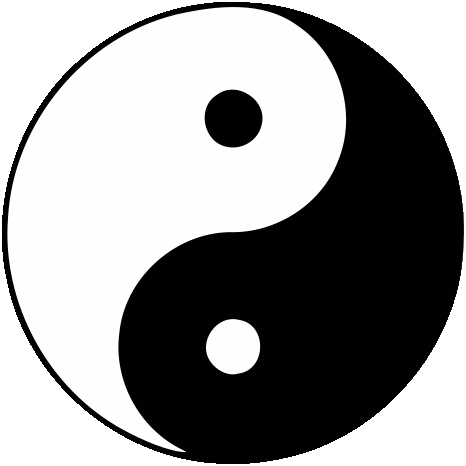
In the yin-yang, as I perceive it, the eternal circle of the universe is formed by the interaction of opposites, here symbolized by light and dark, but while they are opposites, a little of each exists in the other.
For a very short book, the Tao Teh Ching is filled with incredible depth and meaning. For me, in the few translations I have read, the Tao makes perfect sense, and I understand the world a little better each time I read it. However, others may read it and just be confused or frustrated. The Tao Teh Ching is something that will either speak to you personally and enlighten your world, or it will not.
But what has all this to do with writing?
I see the Tao at work whenever I write anything. I see it in what I consider to be some of the basic principles of writing: less is more, what is not said is often more important than what is said, and so forth. For me, this makes writing almost a form of magic, not in the sense of illusion, but true magic where one creates something out of nothing by using as few components as possible, by making something complex by keeping everything as simple as possible.
I will give one example and then I will close this article for the day and pick it up when I can sometime in the hopefully near future.
One of the first principles of writing I learned was to use as few words as possible. Strunk and White, in The Elements of Style, say to “Omit unnecessary words”, which in itself is a perfect example of omitting unnecessary words. How much more concise can that one sentence be? It contains absolutely no unnecessary words. If one word is omitted, the sentence ceases to have meaning. The virtue of this is that, if done properly, the work becomes much more powerful because each word carries more weight.
To do this, a writer needs to use words precisely. Try to find a word that captures the exact meaning of the idea you are trying to express–and the shorter the word the better. After all, you are trying to communicate an idea to the largest possible audience. Why use big words that will send readers scurrying to the nearest dictionary, thus interrupting their chain of thought and perhaps tainting their reading experience, when you can use words that everyone understands and keep their experience free from interruptions?
An example of using words precisely would be revising the sentence “A man went quickly to the store.”
Now, shorten it by replacing “went quickly” with “ran”. While you are at it, replace the other general terms with more precise ones. The sentence becomes “John ran to Walmart.” Now, if you have had any background information on John, you know who he is, what he is like, his possible motivations, and that he is in a hurry for some reason to get something from Walmart, knowing the kind of products Walmart has, you may have an idea of why he is going there. If we changed the sentence to “John ran to the Red Dot Liquor Store” we have an even better idea of his motivation. If we said, “John sped to Red Dot Liquors in his brand-new corvette”, we know even more about John: we know he can afford a brand-new corvette. If you have ever been in Red Dot Liquors, you know something of the products they carry and that may say something to you about John’s decision to purchase them.
So, how much more excitement and power does the sentence “John sped to Red Dot Liquors in his brand-new corvette” have versus “a man went quickly to the store”. The final version packs a lot more information in almost the same space.
So that is part of the magic of writing for me: using as few words as possible to create a work. On the surface, it seem to go against logic. How can you build something by using as few components as possible and deleting the ones you do have whenever possible?
Try an experiment, take the first page of any run of the mill romance novel and draw a line through every word you consider unnecessary while keeping the meaning of the sentence. Then take your final product and do it again. Do it a third time if you like. How much were you able to reduce without changing its meaning?
Now take the first page of a novel by Hemingway, someone known for his lean, muscular writing. How far were you able to reduce it before changing the meaning?
Someone once said, “draw a line through every third word and you will be surprised at how much it improves your writing.” I have tried that and it works wonderfully. Of course, you can’t arbitrarily omit every third word, or the work may become nonsense, but it does cause one to question whether that word is necessary.
I have always marveled at the idea that one can write something by omitting words. It goes against my standard, American, public school education, where teachers give a mininum number of words to an assignment and one is forced to insert as many words as possible just to meet the requirement. But can you blame them? If you told the average American high school student to tell what he did over the summer in as few words as possible, he would say, “I had fun” or “I worked.” Good luck teaching him to write.
Anyway, I am rambling once again. I will close for now and pick this up at some later date.
Thoughts? Comments?


 For those of you who have not heard it, here is a link to
 Phil Slattery, Writer, Publisher