Idiolects

Calvin and Hobbles--Tumblr

According to the Wikipedia definition (as of April 21, 2013), an idiolect is “…a variety of language that is unique to a person, as manifested by the patterns of vocabulary, grammar, and pronunciation that he or she uses.”  This accords to the definition I learned in graduate school many years ago.

In my writing, I try to make as much use of idiolects and personal speech patterns as possible in order to distinguish speakers in sometimes lengthy conversations so that I can omit boring, repetitious attributions such as  “he said”.  I feel this also adds a sort of flavor to the story, because the way a person speaks tells something about the speaker in terms of emotions, psychology, and background among other things.   Using idiolects adds a layer of subtle complexity to a story.

An example of this from my past is that of a college friend named Mike.  One of Mike’s pet expressions was “Whatever!”, which he used often in a sort of sympathetic exasperation when someone persisted in doing something Mike thought stupid in spite of his advice to the contrary.  On those occasions, he would chuckle and say “Whatever!” and walk away with a grin that said he would have fun seeing the outcome.  If I were to write down a conversation between myself, Mike, and several of our friends, you could tell when Mike was speaking by his frequent use of the “Whatever!”, which the rest of us seldom used.

Used carefully and sparingly, an idiolect can be a subtle motif about each character that the author can use to remind the reader of some facet of the character at critical moments.

Thoughts?  Comments?

Conflict or Struggle?

Higuchi Jiro Kanemitsu on a wooded mountainside struggling with a giant Monkey which grips his sword-blade between its teeth. Painting by Utagawa Kuniyoshi, 1798 - 1861
Higuchi Jiro Kanemitsu on a wooded mountainside struggling with a giant Monkey which grips his sword-blade between its teeth. Painting by Utagawa Kuniyoshi, 1798 – 1861


If a work of fiction is to succeed in entertaining its audience, there must be conflict.  As this conflict pertains to the horror genre, it may be best to think of it as a struggle.

I think of a conflict as something that can happen over a very short to a very long period of time and may or may not contain any substantial action.  Conflict is a very broad term and can apply to any work of literature or film.   Conflict can apply to Tracy Chevalier’s mind-numbingly boring novel Girl with Pearl Earring as it can to Clive Barker’s The Hellbound Heart.   Struggle connotates not only a protracted conflict, which is necessary if the work (or anything involving conflict for that matter) is to have any subtantial length.  A boxing match that goes the full fifteen rounds is much more entertaining than one in which one contender is suddenly floored in the first half of the first round.

Struggle connotates action as well, which is as essential for any work of the horror genre as it is to boxing.  In the most entertaining works of horror that come to my mind, the struggle usually begins on or close to the first page and continues on to or close to the last page.  Usually the struggle is between two or more characters, though it can be against inanimate forces (such as surviving a storm) or it can be against inner drives or forces in which the protagonist struggles against himself.

What are your thoughts?  Which term is more suitable for the horror genre:  struggle or conflict?

Thoughts on Speculative Fiction

Lovecraft in the Agony of ContemplationIllustration by MirrorCradle
Lovecraft in the Agony of Contemplation
Illustration by MirrorCradle

As I was driving about town today, I started reflecting on the difference between mainstream, so-to-speak literary fiction and speculative fiction (usually defined as consisting of the science-fiction, fantasy, and horror genres).  I recall reading somewhere, years ago, in the submissions guidelines for a mainstream fiction magazine, that mainstream fiction consisted of whatever did not fit into a genre.  Then, I considered that accurate and reasonable;  now I consider it somewhat snobbish.  In fact, the more I think about it, the more short-sighted and narrow-minded that statement becomes.

Speculative fiction, including the horror genre, deals with fantastic, often surreal, situations.  Mainstream fiction, if you go by the definition above, deals with anything not fantastic, not surreal, i.e. the real, events that could happen in the real world.  It would seem to me that the truly gifted writer would be the one with the greater imagination, the one who can conjure entire civilizations and fantastic creatures out of his mind alone.  My favorite authors for many years have been, and continue to be, Hemingway and Fitzgerald, based on their styles and how their stories can touch me.  However, if had to state who had the greatest imagination out of the history of writers, Tolkien would be at the top, simply because he was able to create an entire world out of his imagination (granted most of the ideas were based in Nordic mythology) and make it and his characters believeable.  Lovecraft and his Cthulhu mythos would be a close second.

Reading the guidelines of horror publications, I find that many of them do not want werewolf/vampire/zombie (w/v/z)stories.  They want something different, original.   That is a difficult challenge.   I could dream up w/v/z stories all day long, but creating something out of thin air, like Stephen King or Clive Barker does,  and to do it consistenly, is truly admirable. I have written one or two stories along the w/v/z line, but now I am taking up the challenge of writing something truly imaginative.    I have no good ideas just yet, but I am examining how horror authors of the past came up with ideas and what were their inspirations.

So now here is a question of the night:  if you are trying to write material outside the w/v/z tradition, how are you coming up with ideas?  Have you put any new slant on horror?  Do your inspirations come from dreams or from looking at real-world object and then allowing yourself to explore the possibities if something about that scene was just a little bit different?

Thoughts?  Comments?


Slattery’s Tao of Writing, Part 6: Profanity

Profanity

“There is a time for everything,  and a season for every activity under the heavens:..”  Ecclesiastes 3:1 (New International Version)

So when is the right time for profanity in literature?  I have my beliefs, but I thought it would be interesting in finding some quotations from more respected writers (and entertainers) other than myself, so I went quote-shopping through BrainyQuotes.com and Goodreads.com.

“Under certain circumstances, profanity provides a relief denied even to prayer.”   –Mark Twain

“I’ve tried to reduce profanity but I reduced so much profanity when writing the book that I’m afraid not much could come out. Perhaps we will have to consider it simply as a profane book and hope that the next book will be less profane or perhaps more sacred.”  –Ernest Hemingway

“There was certainly less profanity in the Godfather than in the Sopranos. There was a kind of respect. It’s not that I totally agreed with it, but it was a great piece of art.”  –Danny Aiello

“profanity and obscenity entitle people who don’t want unpleasant information to close their ears and eyes to you.”  ― Kurt Vonnegut, Hocus Pocus

“Never use a big word when a little filthy one will do.” ― Johnny Carson

“What I’m saying might be profane, but it’s also profound.” ― Richard Pryor, Pryor Convictions: and Other Life Sentences

All make excellent points.

My personal belief is best summarized by Ecclesiastes 3:1 above, with the following addenda:

  1. A  word is either the expression of an idea or of an emotion and should be used accordingly.  Profanity is therefore the expression of profane ideas or of intense emotions and should be used accordingly.
  2. Profanity is by nature shocking to most of the general public.  If used too frequently, it loses its effect and becomes tiresome.  I have known people who have used profanity to excess and although they shock and offend on first meeting, they quickly become tiresome and annoying and their limited vocabulary quickly shows their narrow intellect (with few exceptions–I have heard some respected authors have had colorful vocabularies).    Thus profanity is useful as a literary device only if it is used to show a person of that low character or to indicate irony.   An example of the latter would be a person who is superficially of low character, but on closer examination is more profound and intelligent than expected–there are a few people like that.   If profanity is to retain its shock value within a story, its use must be limited (the more limited the better), otherwise the story becomes tiresome and annoying.
  3. Vonnegut makes an excellent point above.   The more profanity one uses in a story, the less readers one will have–for whatever reason.  This parallels Stephen Hawking’s experience as a writer.  In the introduction of A Brief History of Time, Hawking says that someone told him that for every number used in a book, he would lose one reader.  Therefore, in A Brief History of Time Hawking uses only one number in describing one of the most profound and complex scientific theories of history.   An example from cinema would be the single profanity used in Gone with the Wind.  That profanity was used at a critical moment and because it expressed so much at the right time, it was memorable and powerful.  That moment would have lost much of its impact, if the movie had been as laced with profanity as Pulp Fiction (admittedly, I am a big fan of Pulp Fiction).  For those reasons, I believe profanity in literature should be kept to an absolute minimum.  
  4. When used, profanity should have a definite purpose:  to say something about a character, their emotional state, their state of mind, or their environment (e.g. in my story “A Tale of Hell”, the main character has problems with intense anger and actually ends up in hell.  Profanity is part of his character on earth and part of his surroundings in hell, where, understandably, it would be constant and ubiquitous.  
  5. Profanity has only been commonly accepted in literature since the early Twentieth Century at best.  Probably the foremost example of this would be Henry Miller’s Tropic of Cancer, which was first published in France in 1934, but which was banned in the U.S.   Its publication by Grove Press in 1961 led to a series of obscenity trials ending in the Supreme Court finally declaring it non-obscene in 1964.   Many, if not most, of the recognized masters of the horror genre wrote around or prior to 1934 and never used a single profanity, e.g. Lovecraft, Poe, Machen, Lord Dunsany, M.R. James, Sheridan Le Fanu, Blackwood, Ambrose Bierce, et cetera.  Profanity is not necessary to achieve a horrifying effect.  In fact, it becomes more of an artistic challenge to write something horrifying without profanity.  Shock may be part of horror, but horror is much more than shock.

The upshot of all this for the contemporary writer is that, like everything else, profanity has its place, but its use must be balanced against what the author wishes to achieve while bearing in mind that its careless overuse can severely damage the reader’s experience and taint that reader’s perception of the author.

Thoughts?  Comments?

Notes on “I am Legend”

Cover of First Edition, 1954(Please note that this cover is protected by copyright; please refer to Wikipedia for details on permissible use)
Cover of First Edition, 1954
(Please note that this cover is protected by copyright; please refer to Wikipedia for details on permissible use)

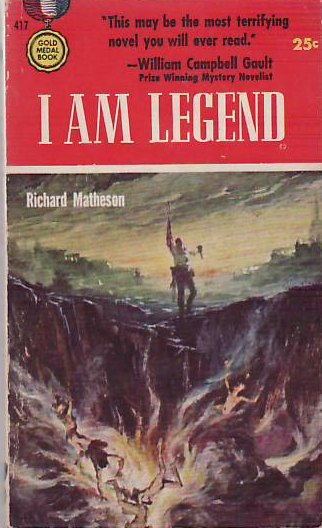
I have been reading Richard Matheson’s I am Legend recently whenever I have the opportunity.  I would not say it is a fascinating book, but it is interesting.   One particularly interesting aspect is that the book is not just about one man’s fight against zombies (which he terms “vampires”, but which fit better into the modern concept of zombies) , but that it also deals extensively with his fight against depression and loneliness in a post-apocalyptic future.   Today, I happened to look up the work on Wikipedia and found the following interesting review written by Dan Schneider of International Writers Magazine:  Book Review n 2005:

“…despite having vampires in it, [the novel] is not a novel on vampires, nor even a horror nor sci-fi novel at all, in the deepest sense. Instead, it is perhaps the greatest novel written on human loneliness. It far surpasses Daniel Defoe’s Robinson Crusoe in that regard. Its insights into what it is to be human go far beyond genre, and is all the more surprising because, having read his short stories – which range from competent but simplistic, to having classic Twilight Zone twists (he was a major contributor to the original TV series) there is nothing within those short stories that suggests the supreme majesty of the existential masterpiece I Am Legend was aborning.”

Mr. Schneider may very well be right that it may be the greatest novel written on human loneliness.  If it is not, it is very close to the top.  I have read Robinson Crusoe and my impression is that I am Legend surpasses that in describing the mental and emotional anguish of loneliness and bringing that inner struggle home to the modern reader.

In my view, one reason I am Legend is important to the horror genre, is because it shows another aspect of horror: personal, inner anguish and turmoil, which probably should be classified as a form of horror, if no one has done so yet.  Anyone who has suffered extreme inner turmoil would probably agree that it is worthy of being termed horror.  It may even be the most common form of real-life horror.  I do not know the statistics for how many people are tortured at the hands of serial killers or executioners or other true-to-life monsters, but I would guess that it is far less than the number of people experiencing extreme negative emotions without actually having been physically tormented.

This aspect of inner horror can add another dimension to the otherwise average horror novel or movie, which, based on what I have seen, tends to emphasize physical violence or the threat of physical violence.   In those works, the inner horror of the protagonists is usually assumed, but not examined in detail.   Examining the inner emotions of protagonists and antagonists will help form empathy and sympathy for the characters within readers, particularly in those who have experienced a similar emotion, and will help form a tighter emotional connection between work and audience.  

I recommend reading the Wikipedia article on I am Legend.  It is quite fascinating.  However, do not do as I have done and read it before completing the book.  You will only spoil the ending for yourself.

Thoughts?  Comments?

Slattery’s Tao of Writing, Part 5: Illumination of the Particular

ScorpionPhoto by Phil Slattery
Scorpion
Photo by Phil Slattery

Someone once said that poetry is the “illumination of the particular”.

In 1992, when I was enamored of poetry and was striving to become a serious poet, I took that advice to heart and wrote the poem “Faust“, which describes the thoughts of the infamous Dr. Faust immediately after signing over his soul to Mephistopholes  in exchange for all knowledge.  What I describe there is everything that is going through Faust’s mind in a few seconds, the amount of time it takes to actually read the poem.   The hardest part for me was to choose the right moment to illuminate.  I could have chosen the moment before signing or a moment a year later or the moment when he first met Mephistopholes or an infinite amount of others. But that second seemed the most pregnant with meaning, because it is the moment realizes that what he has done can never be undone and that he has lost everything meaningful as a result.   After that I just had to work out the details of what he had lost, the sensations he was experiencing, the future consequences, and the wording, all of  which took about a solid eight hours.   Choosing the particular moment to illuminate was the critical decision in construction of the poem.

Good prose is often compared to poetry.  When Ray Bradbury was introduced to Aldous Huxley at tea after publication of The Martian Chronicles in 1950, Huxley leaned forward and asked Bradbury, “do you know what you are?  You are a poet.”  “I’ll be damned,” responded Bradbury.

I believe that good writing (both prose and poetry) is like good photography: it illuminates the particulars in the subject so that the viewer sees them in their abundant wonder for the first time, though he may have seen that scene a thousand times before.  Take the photo at the top of the page for example.  I happened to see a scorpion crawling across a floor one day (when I was heavy into nature and wildlife photography), grabbed the nearest camera, lined up the shot as best I could, and snapped it.   To my surprise, the focus and lighting came off better than I had planned, and thousands of details popped out in the photo that I had never anticipated.   I had walked across that floor tile I do not know how many thousands of times previously and I had never noticed the texture in its surface.   I had never been as close to a scorpion before either and I was amazed at the details that popped out in it.

Great writers seem to have an innate sense for the proper amount of details and how to use them.   Among writers of horror, Poe springs to mind immediately as a master of detail with “The Tell-Tale Heart” as a prime example of how he used details.  Poe seems to string together a series of moments (describing the old man’s eye, creeping through the door to the old man’s bed, killing him, listening to the heart as it beats beneath his floorboards) and illuminates the details in each to produce a story of tremendous power.  But among all these, is there a single, superfluous detail that does not heighten the drama?  No.  Poe knew which details to illuminate and how to illuminate the details in each of those.

Several years ago, I saw a biography of Napoleon Bonaparte on A&E.  One of the speakers was an instructor at the U.S. Military Academy at West Point.  He said that one thing Bonaparte recognized was that “while details are important, not all details are important.”  I found this a fascinating point as the speaker went on to point out that Bonaparte had a incredible memory for details.   For example, every two weeks he had the roster of the entire French army (about 200,000 troops) read out to him.  He could remember from sitting to sitting who was sick, dead, missing, and so forth.  He could ask detailed questions about the state of repair of equipment such as “last time the second gun of the third battery at Cherbourg had broken spokes in its left wheel, has that been fixed yet?”

I try to remember that these days as I write, so that I weed out the important details from the unimportant ones.

“But which details are important?” you ask.  I wish I could give a quick and easy answer on that.  At this point in my development as a writer (I may give a completely different answer years from now when my learning has progressed further), I would say:  (1) details that help the reader live the story vicariously, such as sensations, (2) details that help the reader understand the current situation and its implications, and (3) details to help the reader understand the characters, their thoughts, their perspectives, and their reactions, (4) details that tie the parts of the story together, such as a motif, and create unity, and (5) details that point toward a denouement.

Details can be critical in writing, but as with all other things, there must be a balance.    Drown the reader in details and the story becomes tedious.  Provide too few details, and the story becomes monotonous.   Choose the wrong details, and the story is boring.  Choose the right details and the reader can step into another world.

Thoughts?  Comments?

Slattery’s Tao of Writing, Part 4: “Warehouses and All”

Lovecraft in the Agony of ContemplationIllustration by MirrorCradle
Lovecraft in the Depths of Contemplation
Illustration by MirrorCradle

 A problem I have encountered over the last few months is that most of the short stories on which I am working are too long for most publications, but too short to publish as novels.

Most magazines accept short stories of about 2,000 words.  Above that, there seems to be a law of inverse proportions :  the more words your short story has, the fewer publishers who will take it.  Unfortunately,  lately I find it difficult to write a story in less than 10,000 words.   

Usually, I start with a simple concept for a story, but as I write, I see more and more details coming to light, details I think are important to understand what is happening in the story.  I keep whittling down the words, contracting here, expanding there, omitting this and that, keeping the story as lean and muscular as possible while fleshing out the story enough so that the reader can live the story vicariously, but somehow the story keeps growing.

There is a school of thought that stories are out there in the literary ether, just waiting for the right author to come along and give them birth.   That is certainly the way it seems at times.  We could expand that comparison even further and say that stories are also like babies after birth and each will eventually grow to a certain size–whether we want it to or not.   But we have much more control over the size of a short story than we do the size of a baby. 

Here is a link to one of my earliest stories, “Sudan“, which was published by Ascent Aspirations several years ago.  It has 2,095 words.  It is not a work of horror.  It is by my current standards rather amateurish.   I based the story on a rather poignant story told to me by a former US assistant agricultural attache to Sudan, whom I met in Luxor, Egypt in 1989.   That story lingered in the back of my mind for some time, almost haunting me, as if it had always been waiting to be told to the world and it refused to pass up this chance, before I finally wrote it down.   It was published by Ascent Aspirations in August, 2002. 

In 2009, I came across www.sixsentences.blogspot.com, which challenges writers to tell a story in six sentences or less.   The assistant attache’s story still touched me after twenty years, so I decided to see if I could tell it in six sentences.  I did.  I changed the title and location and submitted it as “Warehouses and All“. 

While the original Ascent Aspirations version was good, I believe the Six Sentences version is much better, more powerful, more poignant, perhaps because it is more compact. 

Both these stories have exactly the same meaning.   Which length suits it best?    It is hard to say.  Ultimately, deciding the length of a story depends upon the effect the writer wishes to instill in the reader.   I do not think there is any way to concoct a rule of thumb about how to determine the length of short story.   The writer must simply have a subjective feel for what length is appropriate.   That is part of the art of writing.

There are probably many wonderful stories out there that cannot find a publisher because they do not fit the space constraints of most publications.   The reality of the literary world is that publishers do have space constraints and if a writer wishes to be published, he will have to conform to those constraints.  But this should not be seen as a brutal, demeaning demand for an author to butcher one of his stories as if he were a literary Abraham about to sacrifice Isaac on a stone altar.  It should be seen as a challenge, an opportunity for personal growth as a writer, because then one is forced to look seriously, impartially, critically, and clincally at the work, and to ask oneself, “What is it that I really want to say?  What do I want the reader to experience?  How can I make this more powerful, more meaningful?  What is the essence of this story?” 

You may find that while it is challenging, it is not impossible to pack the meaning of 2,095 words into six sentences and still achieve the effect you wish to impart.

Now, if you will pardon me, I have to go listen to my own advice.

Thoughts?  Comments?

Slattery’s Tao of Writing, Part 3: Talking About Dogs

Painting of a Dog by Kim Duryang Sapsalgae, 1743
Painting of a Dog
by Kim Duryang Sapsalgae, 1743

Some time back I was writing a story, thinking about how to be more mysterious in my writing, how to be less direct, yet provide more details in my narrative, when it occurred to me that (probably because I am a “dog person”) writing is often like talking about a dog without saying that you are talking about a dog.

Often, I have an idea or a feeling that I want to express, but if I try to express it directly and concisely, the reader will probably not apprehend the nuances I see in the idea.  At the same time, much of the enjoyment in reading is trying to perceive the meaning behind the author’s words while experiencing the world of the work’s narrator vicariously.   Therefore, as a writer, I want to get my ideas across without being so direct that the reader loses much of the fun of reading.   For example, look at the first chapter of Hemingway’s A Farewell to Arms.  Hemingway was known for his lean, muscular style, so you know he isn’t going to use any more words than necessary to express his ideas. 

In the first chapter, he describes soldiers marching off to the front over the course of several months as he views them from a nearby house.   As he watches the soldiers, the leaves fall from the trees, the vineyards dry up, the mountains turn brown and bare, and the dust the soldiers kick up turn everything bare and white–the color of bone.  All these hint at death.   Hemingway could have said simply, “Frederic Henry [the main character] watched the soldiers march off to their deaths”, but the reader would have lost the experience of living that time with  Frederic and he would have lost sharing Frederic’s experience of witnessing an event and puzzling out its greater meaning for himself.    All the artistic beauty of that chapter would have been lost.

I recall reading somewhere several years ago this idea described as the principle of contraction and expansion.  That is no doubt true.  Yet, to describe it so unemotionally as “contraction and expansion”  seems aesthetically too clinical, too sterile, too confining a term for an idea concerning the breadth and depth of literary intellectual and emotional perception.

I think I prefer to think of this idea in terms of a dog, a living, breathing being full of warmth, love, loyalty, joy, anger, fear, tenderness, intelligence, stupidity, pain, and all the other abstract qualities sentient creatures have.  Yes, I can simply say “dog” and hope my readers see all the nuances of a dog’s existence that I do, but they might not and I would be depriving them of the experience of sharing my perception and all the intimated nuances and emotions that come with it.  So sometimes it is best just to describe the nuances of a dog’s life and let my readers enjoy drawing their own conclusions and along with these conclusions enjoy the subsequent discussions and debates among them as to who was right, who was wrong, who knew what he was talking about, who did not, and so on.

There are times when it is necessary to be concise, to pick a single word you hope is as pregnant with meaning for the reader as it is for you, but those times must be balanced against the times when the reader needs to experience an event and all its nuances. The writer, as artist, must decide how to balance out those moments.  The writer strives to achieve a balance of ideas and perceptions. Balance is part of the art of writing.  Balance is part of the Tao of writing. 

Sometimes it is best to simply say “dog.”  At other times it is best to talk about a dog without actually saying that you are talking about a dog.

Thoughts?  Comments?

Slattery’s Tao of Writing, Part 2: the Allegory of the Stream

Thalia Muse of Comedy and Bucolic Poetry Illustration by Arash
Thalia
Muse of Comedy and Bucolic Poetry
Illustration by Arash

Once in a while, I come across some gem of the writer’s art that almost strikes me breathless with its beauty.  The poems of John Donne are one example.  The poignant first chapter of A Farewell to Arms is another.   Recently, I began reading Ray Bradbury’s The Martian Chronicles  and every time I pick it up, I am nearly struck breathless with his simple, understated eloquence that touches one’s very core.   Today I read a post at winebbler.wordpress.com and her simple, fun voice and flowing, relaxed style combined with playful use of the English language made for very entertaining and enjoyable reading beneath which I thought I could sense an undercurrent of growing artistic beauty.

That article made me start to think about what makes a work of writing aesthetically beautiful.  After some thought, I reached the conclusion that every work of literary beauty has the same qualities as a powerful but smoothly flowing mountain stream:  clarity, power, and an uninterrupted flow.  But unlike a stream, a work of literary beauty must also be reasonably brief.

In every literary work I consider beautiful,  the first universal characteristic that comes to mind is that the author uses a simple voice comprising simple, everyday words that anyone can understand.  Writing is communication.  Communication is one person disseminating ideas to others by using words, which are collections of sounds representing ideas.  By using simple words everyone understands easily, the writer makes his ideas easier to disseminate.  Why use a word that few can understand, when you can use a simpler word with the same meaning that everyone can understand?  Therefore, our stream must be crystal clear and free of mud or anything that would hinder insight and perception.

If ideas equate to the water in our allegorical mountain stream, the precision of the component ideas, the words, give the stream its force.  As I mentioned in my post “Slattery’s Tao of Writing, Part I”, words chosen for their precise meanings have power.   As I said earlier in this article, words are ideas.  Precise words are precise ideas.   Precise ideas are powerful ideas, powerful emotionally and intellectually.  Like all other forces in the universe, powerful ideas become more powerful if combined and organized with one idea leading logically, flowingly to the next.  This facilitates understanding and the reading experience.

When my stream of thought is uninterrupted and powerful, I become immersed in the work.  I can be swept away and can lose track of time and of everything happening around me.   To my mind, every writer should aspire to instill this experience into his readers.  When this happens, the writer has made an emotional and intellectual connection with his reader and the reader is grasping the writer’s ideas.

If organization is lacking, ideas are scattered like boulders in the stream and on the banks, creating rapids and breaking up the smooth flow. A powerful, disorganized stream is a torrent, destructive of everything along its banks, stiking out at random, benefiting no one.  In communication, disorganization is the source of misunderstanding, the antithesis of understanding.  The stream becomes destructive. 

If a writer uses words his readers do not understand and they have to turn to a dictionary to find out what the writer intends, the clarity of the ideas is lost and the reading experience is muddied.  Furthermore, the reading experience flows even less smoothly.   Even if the reader can reason out the meanings of the words from the context, the stream of thought is still disrupted and muddied, even if to a lesser degree.  The words will also lose much of their power, because the reader cannot appreciate the nuances of what he or she does not fully understand.

Lastly, every beautiful work has been reasonably brief.  Reading anything exasperatingly long becomes tiresome for everyone.   When readers become weary (word-weary so to speak), they can lose focus on what the writer is trying to communicate.  This detracts from the reading experience just as if someone who enjoys swimming in a mountain stream can no longer enjoy their swim if they become overly fatigued with exertion.

That said, I will now close tonight’s blog before I wear you out with my ramblings.

Thoughts?  Comments?

Slattery’s Tao of Writing, Part 1

tao3

A quick Google search reveals there are a lot of web articles entitled “The Tao of Writing”.   This is mine.  Let me begin by explaining what I perceive to be the Tao (others may view it differently and have equally valid perceptions).

The Chinese character above translates as Tao, the way, and is pronounced as “dow”, as in “The Dow-Jones Industrial Average”.  Taoism is an ancient Chinese religion rooted in the teachings of the legenday Chinese philosopher Lao Tzu (sometimes transliterated as “Lao Tze” or in a number of other ways) as expressed in his book, the Tao Teh Ching (The Book of the Way).   The Taoist religion, as I understand it, is far removed from Lao Tzu’s original philosophy, because the religion incorporates demons, gods, demigods, spirits, and other things that are not mentioned in the Tao Teh Ching or in the teachings of the original masters such as Lao Tzu, Chuang Tzu, or the Huainan Masters (at least in the translations I have read).

What the Tao is, is hard to express.  “The Way”, as I understand it, refers to the the way of the universe, basically how the universe works in a general sense.  In the American vernacular, we would probably express it as “the way things are”.    Some reader might respond to that as, “Sure.  I understand.  You’re saying the Tao is why toast always falls buttered side down.  Gotcha.” 

No, I am talking about something a bit more profound.  It’s more like this:

You work hard at trying to find a publisher for a story and are consistently rejected by what you perceived to be all the most suitable choices.  So, one night when you are battling insomnia and have just started the first glass of your second bottle of wine, out of frustration you send it off as a shot in the dark to some big name magazine who will never accept it, and lo and behold it is accepted.  So, sometimes it seems that you work your butt off for something and get nowhere, but you give up trying and you succeed.  Basically, the Tao is then like learning the way the universe works, then learning to succeed by adapting to that way.  Confused yet?  Have I oversimplified my point or have I made it overly complex? 

Understanding how the Tao works is not something anyone can express in words;  it is something one can understand only subjectively,  i.e., one must have a feel for it.  In fact, the first sentence of the Tao Teh Ching is “The Way that can be spoken is not the true Way.”  For most people, reading the Tao Teh Ching will probably be an exercise in confusion and frustration and contradiction.  In the Tao Teh Ching, nothing is exact; everything is metaphor and allusion, about how water flows into a valley and then the sea, how wood is shaped, the balance of the universe, and so on.  

To complicate matters even more, because the Tao Teh Ching was written in Chinese about 2,500 years ago, and the translation of the original Chinese characters may have changed significantly since then, translation of the Tao Teh Ching into modern languages is frustratingly imprecise, often relying on traditional or customary translations as opposed to knowing exactly what Lao Tzu was saying.  For today’s modern, exact, Socratic-tradition-based society, this is maddening.  Our scholars argue about the meanings of works written in modern English, how are they going to agree on something as nebulous as the Tao Teh Ching?

So, what are the important ponts of the Tao that everyone should remember?

As I perceive the Tao, one critical aspect of existence is balance;  the universe consists of opposites that must balance out or problems arise.  At the same time, all existence arises from the conflict of opposites.  An example of this is the old Zen Buddhist rhetorical question of “what is the sound of one hand clapping?”  I do not know the official or traditional answer to this, but from my Taoist perception, the answer is that there is no sound.   The sound of  clapping is produced only when the opposing forces of the hands meet.  Thus it is with everything in the universe.  Two opposites have to come together to produce anything:  light and dark, man and woman, left and right, up and down,  hot and cold, etc.

Another critical aspect of existence is that emptiness can be as important as substance and non-action can be as important as action.  There are other aspects, of course, but I will stick to these for now and address those at a later date.

Take a look at your hand for an example of the first principle.  If there were no spaces between your fingers, you would not have a hand, you would have something else, maybe a flipper.    Likewise, a sculptor can create a sculpture only by cutting away pieces of material so that the now-empty spaces create a form.  So a sculpture, or any object for that matter, comprises both substance and emptiness.

For an example of the non-action versus action principle, think about problems you faced in the past.  Could you have solved any of them by simply doing nothing?  Not every problem can be solved by doing nothing, but some can.

These principles are symbolized by what is know in our society as the Yin-Yang as shown here:
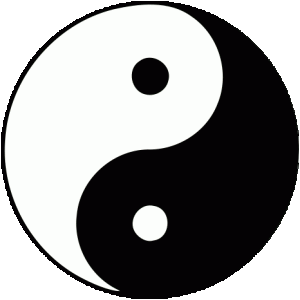
yinYang

In the yin-yang, as I perceive it, the eternal circle of the universe is formed by the interaction of opposites, here symbolized by light and dark, but while they are opposites, a little of each exists in the other.

For a very short book, the Tao Teh Ching is filled with incredible depth and meaning.  For me, in the few translations I have read, the Tao makes perfect sense, and I understand the world a little better each time I read it.    However, others may read it and just be confused or frustrated.   The Tao Teh Ching is something that will either speak to you personally and enlighten your world, or it will not.

But what has all this to do with writing?

I see the Tao at work whenever I write anything.  I see it in what I consider to be some of the basic principles of writing: less is more, what is not said is often more important than what is said, and so forth.  For me, this makes writing almost a form of magic, not in the sense of illusion, but true magic where one creates something  out of nothing by using as few components as possible, by making something complex by keeping everything as simple as possible.  

I will give one example and then I will close this article for the day and pick it up when I can sometime in the hopefully near future.

One of the first principles of writing I learned was to use as few words as possible.  Strunk and White, in The Elements of Style, say to “Omit unnecessary words”, which in itself is a perfect example of omitting unnecessary words.  How much more concise can that one sentence be?  It contains absolutely no unnecessary words.  If one word is omitted, the sentence ceases to have meaning.   The virtue of this is that, if done properly, the work becomes much more powerful because each word carries more weight.  

To do this, a writer needs to use words precisely.  Try to find a word that captures the exact meaning of the idea you are trying to express–and the shorter the word the better.  After all, you are trying to communicate an idea to the largest possible audience.  Why use big words that will send readers scurrying to the nearest dictionary, thus interrupting their chain of thought and perhaps tainting their reading experience, when you can use words that everyone understands and keep their experience free from interruptions?

An example of using words precisely would be revising the sentence “A man went quickly to the store.”

Now, shorten it by replacing “went quickly” with “ran”.  While you are at it, replace the other general terms with more precise ones.   The sentence becomes “John ran to Walmart.” Now, if you have had any background information on John, you know who he is, what he is like, his possible motivations, and that he is in a hurry for some reason to get something from Walmart, knowing the kind of products Walmart has, you may have an idea of why he is going there.   If we changed the sentence to “John ran to the Red Dot Liquor Store” we have an even better idea of his motivation.   If we said, “John sped to Red Dot Liquors in his brand-new corvette”, we know even more about John:  we know he can afford a brand-new corvette.   If you have ever been in Red Dot Liquors, you know something of the products they carry and that may say something to you about John’s decision to purchase them. 

So, how much more excitement and power does the sentence “John sped to Red Dot Liquors in his brand-new corvette” have versus “a man went quickly to the store”.   The final version packs a lot more information in almost the same space. 

So that is part of the magic of writing for me:  using as few words as possible to create a work.  On the surface, it seem to go against logic.  How can you build something by using as few components as possible and deleting the ones you do have whenever possible?

Try an experiment, take the first page of any run of the mill romance novel and draw a line through every word you consider unnecessary while keeping the meaning of the sentence.   Then take your final product and do it again.  Do it a third time if you like.  How much were you able to reduce without changing its meaning?

Now take the first page of a novel by Hemingway, someone known for his lean, muscular writing.  How far were you able to reduce it before changing the meaning?

Someone once said, “draw a line through every third word and you will be surprised at how much it improves your writing.”  I have tried that and it works wonderfully.  Of course, you can’t arbitrarily omit every third word, or the work may become nonsense, but it does cause one to question whether that word is necessary.

I have always marveled at the idea that one can write something by omitting words. It goes against my standard, American, public school education, where teachers give a mininum number of words to an assignment and one is forced to insert as many words as possible just to meet the requirement. But can you blame them? If you told the average American high school student to tell what he did over the summer in as few words as possible, he would say, “I had fun” or “I worked.” Good luck teaching him to write.

Anyway, I am rambling once again.  I will close for now and pick this up at some later date.

Thoughts?  Comments?

Fascinating Habits of Writers of Horror

GRACIN~2

Some writers have interesting habits.

I have always found one of the most interesting aspects of studying the lives of famous writers to be the personal habits they have while writing.   The habits show the writer’s personal side and perhaps give an insight into how their creativity is ingrained in their natures. Following are some examples of the better known habits of mainstream authors (the few examples I have collected of “horror habits” follow these).

Hemingway said that he, at least in his Paris years, wrote for four hours each day before going to work at the Kansas City Star office, he wrote using pencils and a spiral bound notebook, and he started each days writing by sharpening twenty pencis.

F. Scott Fitzgerald never rewrote anything less than nine times.

Thomas Mann was very disciplined and rose and dressed in a suit each day as if he were going to work at a bank (even though he was going only so far as his living room), started each day at the same time (I think 8:00 a.m.), wrote for four hours, broke for lunch for an hour, wrote for another four hours, and then ended his day, by going back to his bedroom and taking off his suit.

Hunter Thompson and Henry Miller were at the opposite end of the discipline scale and might write for days, then not write again for days or weeks, before going on another binge of writing.  Thompson might write some lines on a napkin while having lunch at a restaurant, then take the napkin and force it through a fax to get the work to his editors at Rolling Stone.

 Here are the tidbits on writing habits by authors of horror.

Thomas Cotterill, another WordPress member, wrote this interesting article on the habits of Stephen King.  I have read elsewhere that Stephen King normally writes a first draft, which he runs past his wife, Tabitha, makes some changes and then sends it out to friends for their inputs, and then writes a final draft, which he sends to the publisher.

I have yet to find anything detailed about Poe’s habits, but I did find this general description on the website of the Edgar Allan Poe Society of Baltimore.

“Edgar A. Poe, one of the Editors of the Broadway Journal. He never rests. There is a small steam-engine in his brain, which not only sets the cerebral mass in motion, but keeps the owner in hot water. His face is a fine one, and well gifted with intellectual beauty. Ideality, with the power of analysis, is shown in his very broad, high and massive forehead — a forehead which would have delighted Gall beyond measure. He would have have [[sic]] made a capital lawyer — not a very good advocate, perhaps, but a famous unraveller of all subtleties. He can thread his way through a labyrinth of absurdities, and pick out the sound thread of sense from the tangled skein with which it is connected. He means to be candid, and labours under the strange hallucination that he is so;  but he has strong prejudices, and, without the least intention of irreverence, would wage war with the Deity, if the divine canons militated against his notions. His sarcasm is subtle and searching. He can do nothing in the common way; and buttons his coat after a fashion peculiarly his own. If we ever caught him doing a thing like any body else, or found him reading a book any other way than upside down, we should implore his friends to send for a straitjacket, and a Bedlam doctor. He were mad, then, to a certtainty.”               — (Thomas Dunn English, “Notes About Men of Note,” The Aristidean, April 1845, p. 153. At this time, Poe and English were still friends, and the tone of this item is happy and jocular. In reviewing this issue of the Aristidean in his own Broadway Journal, for May 3, 1845, Poe comments “. . . the ‘Notes about Men of Note’ are amusing” (BJ, 1845, p. 285, col. 1).)

Dean Koontz says this about his own writing habits on his website:

“I work 10- and 11-hour days because in long sessions I fall away more completely into story and characters than I would in, say, a six-hour day. On good days, I might wind up with five or six pages of finished work; on bad days, a third of a page. Even five or six is not a high rate of production for a 10- or 11-hour day, but there are more good days than bad. And the secret is doing it day after day, committing to it and avoiding distractions. A month–perhaps 22 to 25 work days–goes by and, as a slow drip of water can fill a huge cauldron in a month, so you discover that you have 75 polished pages. The process is slow, but that’s a good thing. Because I don’t do a quick first draft and then revise it, I have plenty of time to let the subconscious work; therefore, I am led to surprise after surprise that enriches story and deepens character. I have a low boredom threshold, and in part I suspect I fell into this method of working in order to keep myself mystified about the direction of the piece–and therefore entertained. A very long novel, like FROM THE CORNER OF HIS EYE can take a year. A book like THE GOOD GUY, six months.”

Here is an interesting interview by M.R. Hunter with Richard Matheson in Lastheplace.com.  Apparently, Mr. Matheson does not have a computer, but writes everything in longhand and then has it typed up.

I have yet to find anything on Lovecraft’s writing habits, but here is a link to HPLovecraft.com that details his personal interests including his unusual dietary habits.

Lord Dunsany had the most eccentric habits of which I have heard.  The Wikipedia article on Lord Dunsany states:

“Dunsany’s writing habits were considered peculiar by some. Lady Beatrice said that “He always sat on a crumpled old hat while composing his tales.” (The hat was eventually stolen by a visitor to Dunsany Castle.) Dunsany almost never rewrote anything; everything he ever published was a first draft.[7] Much of his work was penned with quill pens, which he made himself; Lady Beatrice was usually the first to see the writings, and would help type them. It has been said that Lord Dunsany would sometimes conceive stories while hunting, and would return to the Castle and draw in his family and servants to re-enact his visions before he set them on paper.[citation needed]”

If you know of a source for information on the work habits of one or more horror writers, please share it.   If you are searching for a topic of an article to write, I would like to suggest writing on the work habits (or interests) of horror writers.  It would be fascinating to see if there is a common thread among them or if they vary from the habits of mainstream authors.  For example, I have found out that Algernon Blackwood, Arthur Machen, and Bram Stoker were members of the Hermetic Order of the Golden Dawn.

Anyway, I am now officially rambling.

If you have any thoughts or comments on this article, please share them.

Ginsberg’s Breath Units

Allen_Ginsberg_1978 by Ludwig Urning

Allen Ginsberg, 1978

Photo by Ludwig Urning

I saw the best minds of my generation destroyed by madness, starving hysterical naked,

dragging themselves through the negro streets at dawn looking for an angry fix,

Angel-headed hipsters burning for the ancient heavenly connection

to the starry dynamo in the machinery of night…

So run the opening lines of Allen Ginsberg’s “Howl, considered by many to be one greatest works of American literature.   One aspect of the poem that has always fascinated me is that Ginsberg wrote it in what are often called “breath units”, i.e. each line comprises the amount of words that should be spoken with one breath.   I have experimented with breath units or something similar in both prose and poetry.   One example is my poem “Faust“, which was published by the Hollins Critic in 1992.

I have found that when used in prose, breath units can be effective in breaking up rhythm in order to emphasize a point.   For example,  imagine a sentence as equivalent to a breath unit.  Write a very long sentence and try saying it in one breath.  It is as if you are trying to say something in a hurry.  Use that long sentence to describe fast-moving but extended action, such as a martial arts masters exchanging blows in a match.  To me, it seems as if I am in the fight while trying to describe it.  Now use three to four of these sentences to describe the entire match.  Then use a very short, indicative sentence to describe the final blow dropping the defeated master to the mat.

Here is an example of the use of my use of breath units in my story “A Tale of Hell” (published by Midnighttimes.com in 2006).  Note that here I start with two short sentences, then follow them with three long sentences, and then conclude with one short one for emphasis.

He wanted to make love. He did not want just sex. He was not interested in his own orgasm as much as he felt an overpowering desire for the smooth texture of Theresa’s skin; the velvety brush of her nipples across his face; the sight of the light playing upon the delicate, minute hair covering the back of her neck; the tickle of her breath as it flowed around the contours of his ear. Above all else, he wanted to hear her voice, that voice that sometimes changed into a shrill nag when he wasn’t paying attention to what she said, or when he forgot to pick up something at the store, or when he neglected to call and tell her he would be late for supper.  Now it dawned on him: over the years she had put up with a lot more crap than she should have. He wanted to apologize.

I have no doubt there are other technical names for this technique when used in prose, but I do not know them.   It is a technique  use occasionally.   To my mind, prose breath units should be used sparingly or they lose their impact.   I think they have a great potential in horror literature if used properly, because they can lead a reader very fast to a point that is suddenly emphasized by an unexpectedly abrupt hall–sort of like sprinting around a corner only to run face first into a brick wall.

So, I guess the question for tonight is:  are you familiar with this technique and do you know it by another name?

By the way, I had never thought of it before, but isn’t that first line of “Howl” very much in the horror vein?  I am wondering if “Howl” couldn’t be used as an example of horror in many ways, though it was almost certainly never intended to be viewed as a work of horror.


Baltasar Gracian on Expressing Yourself

GRACIN~2

Baltasar Gracian y Morales (1601-1658)

I have a small book entitled The Art of Worldly Wisdom:  A collection of Aphorisms from the Works of Baltasar Gracian (translated by Martin Fischer, published by Barnes and Noble, 1993).  Baltasar Gracian y Morales (1601-1658) was a Spanish Jesuit scholar and writer of Baroque prose.  The Art of Worldly Wisdom is perhaps his most famous work.   It is a collection of three hundred paragraphs from his works on how to live in what we would consider the practical world of human relations as these first lines from five randomly-chosen paragraphs show:

  • Because an ass once, not twice.
  • Watch him who works by indirection.
  • Know how to put fire into your subordinates.
  • Know how to pretend ignorance.
  • Discover each man’s thumbscrew.
  • Choose an occupation that brings distinction.

Clearly, the drift of the works is more towards the earthly than the spritual, more towards Machivelli and Marcus Aurelius than Solomon and Lao Tzu.   With that in mind, I have quoted paragraph 216, the one that seems to bear the most relation to the art of writing.   Please let me know your thoughts on the value of Gracian’s advice.

“Be able to express yourself, not only clearly, but with charm.  Some conceive easily, but have a hard delivery; yet without pains, these children of the spirit, our thoughts and our judgments, are not rightly born; others are like those vessels that hold much but yield little;  while conversely others pour forth more than was anticipated;  what resolution is to the will, exposition is to the mind, and both are great attributes;  clear heads are much praised, but those balmy may be venerated because not understood;  wherefore at times be not too clear, in order not to seem too ordinary;  yet how can a world get a concept of what it hears, if the speaker himself has no clear notion of what he is talking about?”

“The Terror” from the Wen Fu

Here is an interesting section/stanza from the ancient Chinese work Wen Fu (The Art of Writing).  It is entitled “The Terror”.

I worry that my ink well will run dry, that right words cannot be found ; I want to respond to the moment’s inspiration.

I work with what is given ; that which passes cannot be detained.

Things move into shadows & they vanish ; things return in the shape of an echo.

When Spring arrives, we understand that Nature has its own reason.

Thoughts are lifted from the heart on breezes, and language finds its speaker.

Yesterday’s buds are this morning’s blossoms which we draw with a brush on silk.

Every eye knows a pattern, every ear hears a distant music.

Wen Fu was written by Lu Chi (261 AD – 300 AD), who was a scholar, a military leader, and the the Literary Secretary in the the Emperor’s court.  It is very short and may take an average reader 15-20 minutes to complete.  The hardcopy  translation I have was written by Sam Hamill and published by Breitenbush Books in 1987.   A far more poetic version can be found at http://web.mnstate.edu/gracyk/courses/web%20publishing/LuChi.htm.

I like to peruse Wen Fu occasionally, because the language is simple yet mystical while the ideas are straightforward yet metaphorical.   What fascinates me most about the work is that the principles it expresses are eternal and universal.   The underlying principles that guided Lu Chi’s art are the same ones that underlie ours nearly two thousand years later and in a society (and language!) that would have been completely alien to Lu Chi.  What’s more, Lu Chi describes the experience of writing from a very intimate standpoint to which any author who is passionate about his art could relate.

What are your thoughts?  What principles of writing are eternal and universal?  What do you see in the stanza above?