
The Value of Discussing Catcher in the Rye Beyond the Classroom

I believe it [Catcher in the Rye] should be taught in high school because these are the issues teens face or will face once they go to college, just as Holden did. Once in college, students will learn how phony the world is, if they haven’t already.

[The following is a comment I made today to a post on Catcher in the Rye made by Colorless Wonderland published four years ago.]

Excellent presentation and discussion! I am going to play the age card here and say that I recently turned 68 (born in 1957, 6 years after Catcher in the Rye was first published). The culture I grew up in was only a few years after the culture shown in Catcher, ergo, not much difference. I disagree with your opinion that Catcher should not be taught in high school. It definitely should be taught in high school, but not for the usual reasons that communities have for banning this book or for the reasons you state.

I believe it [Catcher in the Rye] should be taught in high school because these are the issues teens face or will face once they go to college, just as Holden did. Once in college, students will learn how phony the world is, if they haven’t already.

This is a coming-of-age novel, at a point in which many teens START discovering the phoniness of the world. However (somewhat in agreement with you), high school teachers should not be the ones discussing Catcher with students. Teachers will only teach what the local school board says they should teach or they put their jobs on the line, and a lot of communities still, even in 2025, want to teach the idealized American Dream, which is a textbook example of phoniness.

The people with which students should be discussing Catcher are a) other students or b) their parents (ideally). High school students need to prepare themselves for encountering the phoniness that lies ahead for them and which they will be encountering for the rest of their lives, as I have for 68 years. Of course, many parents will just try to teach the ideal American Dream or sugar-coat the future, but the honest ones, the good parents (or friends) will honestly prepare their children for what lies ahead. So, while the “teachers” may present the local school board’s view of what teens should learn, the student’s friends and family will teach the down-to-earth, worthwhile lessons.

The great thing about literature which is most valuable for the reader is not reading something and then discussing it with the teacher the community hired to teach its values, but discussing the material with classmates, family, and others, i.e. getting a lot of opinions and then having to decide, based on experience, which are the opinions worth considering, which are the most valuable, which are the most truthful and accurate, and deciding what one should take from them to help oneself prepare for the coming future.

A Few Notes on Lady Caroline Lamb, Lord Byron, and Dr. Polidori

I was up late (i.e in the early morning of December 18) working on a future post to be entitled “A Few Thoughts on Vampires”. At one point in it, I mention John William Polidori, who wrote the original vampire story The Vampyre, whose main character is the vampire Lord Ruthven, a character which was used in subsequent vampire stories by a variety of authors. The name Ruthven was taken from Lady Caroline Lamb’s novel Glenarvon.

A little research in Wikipedia alone on Lady Caroline Lamb reveals what must be the tip of the iceberg of Byron’s complex interpersonal relationships. At this point, I wish I was a romance novelist. The tale of Byron’s (the author of the epic poem “Don Juan”) love life, or at least his affair with Lady Caroline Lamb, would make for a fascinating novel.

Polidori was Lord Byron’s personal physician and traveled with him. I have read that he and Bryon were quite likely lovers. Lord Ruthven is based in part on Byron. As I mentioned, Byron’s relationships were complex.

The Vampyre is about Lord Ruthven, a vampire who kills only lovers and who is based on Byron. Polidori’s eventual suicide was probably rooted in his relationship with Byron. The name Ruthven was taken from Glenarvon by Lady Caroline Lamb, who had a “well publicized” affair with Byron in 1812. After Byron broke off the affair, Lady Lamb became obsessed with Byron. They continued corresponding, often bitterly, for sometime nevertheless. Glenarvon, published in 1816, was a “thinly disguised” portrait of her affair with Byron.

As an example of their later relationship, here is a quote for the Wikipedia article.

Lady Caroline’s obsession with Byron would define much of her later life, as well as influencing both her and Byron’s works. They would write poems in the style of each other, about each other, and even embed overt messages to one another in their verse. After a thwarted visit to Byron’s home, Lady Caroline wrote “Remember Me!” into the flyleaf of one of Byron’s books. He responded with the hate poem; “Remember thee! Remember thee!; Till Lethe quench life’s burning stream; Remorse and shame shall cling to thee, And haunt thee like a feverish dream! Remember thee! Ay, doubt it not. Thy husband too shall think of thee! By neither shalt thou be forgot, Thou false to him, thou fiend to me!

from https://en.wikipedia.org/wiki/Lady_Caroline_Lamb. Accessed December 18, 2020.

What stimulated me into this minute bit of admittedly superficial research was reading Lady Lamb’s description of Byron as “mad, bad, and dangerous to know”. What a terrific description of anyone! This, if nothing else, shows the stereotype of a woman falling for a “bad boy” goes back at least 200 years. Here is a bit more on it from the Wikipedia article:

From March to August 1812, Lady Caroline embarked on a well-publicized affair with Lord Byron. He was 24, she 26. She spurned his attention on their first meeting, which was at a society event at Holland House. According to the memoirs of her friend Sydney, Lady Morgan, Lady Caroline claimed she coined the phrase “mad, bad, and dangerous to know” soon after meeting the poet. It became his lasting epitaph, but there is no contemporary evidence to prove that she coined the famous phrase at the time. She wrote him a fan letter; his response was to visit her because of her high social status, and then to pursue her passionately.

from https://en.wikipedia.org/wiki/Lady_Caroline_Lamb. Accessed December 18, 2020.

Yeah, their story would make a helluva romance novel.

I have been intending to read Don Juan for over thirty years now. Maybe I will get to it soon.

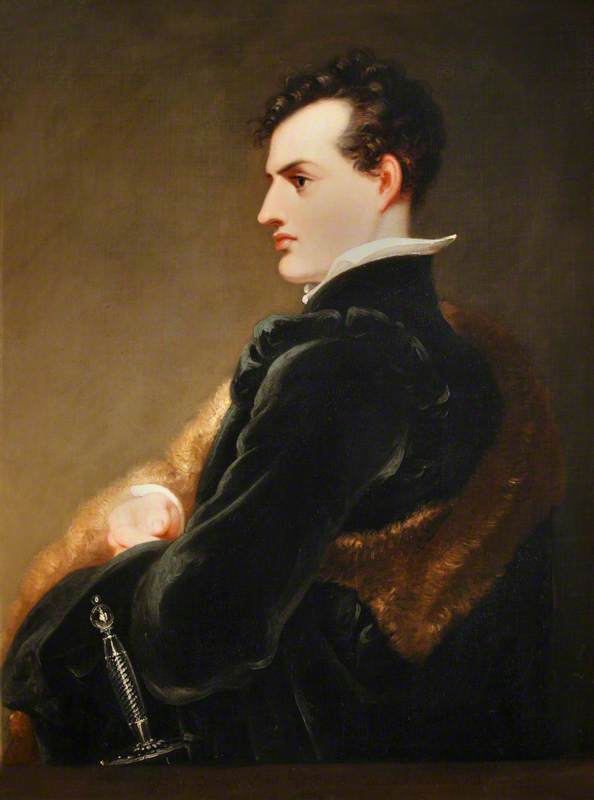
Below are portraits of Lady Lamb, Lord Byron, and Dr. Polidori. Check the dates of their births and deaths. Do the math. They all led intense lives and died young.

Thought? Comments?

George Gordon, Lord Byron (1788-1824) portrait dated 1813.
Carolinelamb
Lady Caroline Lamb (1785-1828). Date of portrait unknown.
John William Polidori (1795-1821) Date of portrait unknown.