Publication Announcement: “Sudan” and “Decision”

100_1736I am very pleased to announce that two more of my stories will be published very soon, albeit as re-prints:  “Sudan” and “Decision”.  Both will be published by “Through the Gaps” (http://throughthegaps.com/).   On their About page, they describe themselves as follows:

“Benjamin Choi founded Through the Gaps in 2014 with the help of his associate Raghav Mathur. From there, the site expanded to include over twenty original contributors releasing content in several unique categories on a daily basis. Here at TTG, we are dedicated to expressing opinions and starting discussions in a nurturing environment.”

In their submissions guidelines for fiction, they also note:

“We accept fictional stories of all genres. However, above all, we are looking for stories with a powerful message. More specifically, we are looking for stories with powerful comments on the state of our society and/or the human experience. Stories with a political or social message are the best examples of such a story. We are even willing to overlook subpar storytelling or weaker character development if we feel the story’s message is powerful enough.”

As noted, these two stories are re-prints of stories I wrote and had published long ago.

“Sudan” was first published in 2002 by Canadian on-line magazine “Ascent Aspirations, where you can still find it (www.ascentaspirations.com).  It was based on a story I heard from a former US assistant agricultural attaché to Sudan, whom I happened to meet when I was touring Luxor, Egypt in 1989.  If I recall correctly, we were splitting a horse-drawn carriage ride from the Hotel Jolie Ville, where we both happened to be staying, to the Temple of Luxor.   As strangers do when they meet while traveling, we fell into a conversation starting with a basic introduction of ourselves, our professions, and how we happened to be in that locale.   From there the conversation deepened and she told me this story that she had heard from two English nurses she happened to meet (I think) in Khartoum.  The story was so poignant, that I remembered it for several years and when I started to write fiction.  It was one of the first I developed into a short story.  I have always loved the story and recently decided to resurrect it along with several others of my first works to see what I could get re-printed.  “Sudan” will be published in about a week on the “Through the Gaps” website.

“Decision” is a very poignant tale as well.  It was first published in 2004 by “Spoiled Ink”, an English hard-copy magazine based in Denmark.  It is not based on any actual event.  Instead it was an idea I developed while thinking about racism and how feelings about race have changed since I was a boy.   I based it in Kentucky simply because that is the culture I knew as a boy, although the story is set in eastern Kentucky and I grew up in central Kentucky (for those not familiar with the state).  I wanted to write a story, in a sense, like Hemingway did in his early short stories using the culture and background with which he was familiar.  He could bring out the crunch of leaves as one went hunting or almost make the aromas of the forest almost come alive.  So I endeavored to do the same.   I don’t know exactly how I came up with the idea for the hunt that takes place.  I may have been inspired by “The Most Dangerous Game” or a similar tale.   I don’t think you can find “Spoiled Ink” any more.  It may be defunct.  If so, this will be the only place you will be able to read this story.  It will appear in two weeks.

If you get a chance, check out “Through the Gaps” even before my stories appear.  It seems to be a very eclectic, nurturing site with a lot of positive energy to it.

Considering the description of what they want as stated on their submissions page, I feel very honored to have my works published on their site.

Thoughts?  Comments?


Clive Barker ‘The Scarlet Gospels’ Advance Review

100_1736Good review:  Clive Barker ‘The Scarlet Gospels’ Advance Review.   As you can see in my comments, the review sounds fair, honest, and straightforward.  Also,  I enjoyed his comments on Barker’s other works.  Unfortunately, I have read only The Hellbound Heart and Books of Blood, but I want to read the others as soon as I can dedicate the time to each.  However, I already have a couple of dozen works on my “to read” list including those on my Goodreads “to read” list.  It is unfortunate that Mr. Barker may be going through a down period, but many, if not most, authors and artists of all types do.  What is important is how long the down turn lasts.

Publication Announcement: My Short Story “Ivan” will appear in “Infernal Ink”

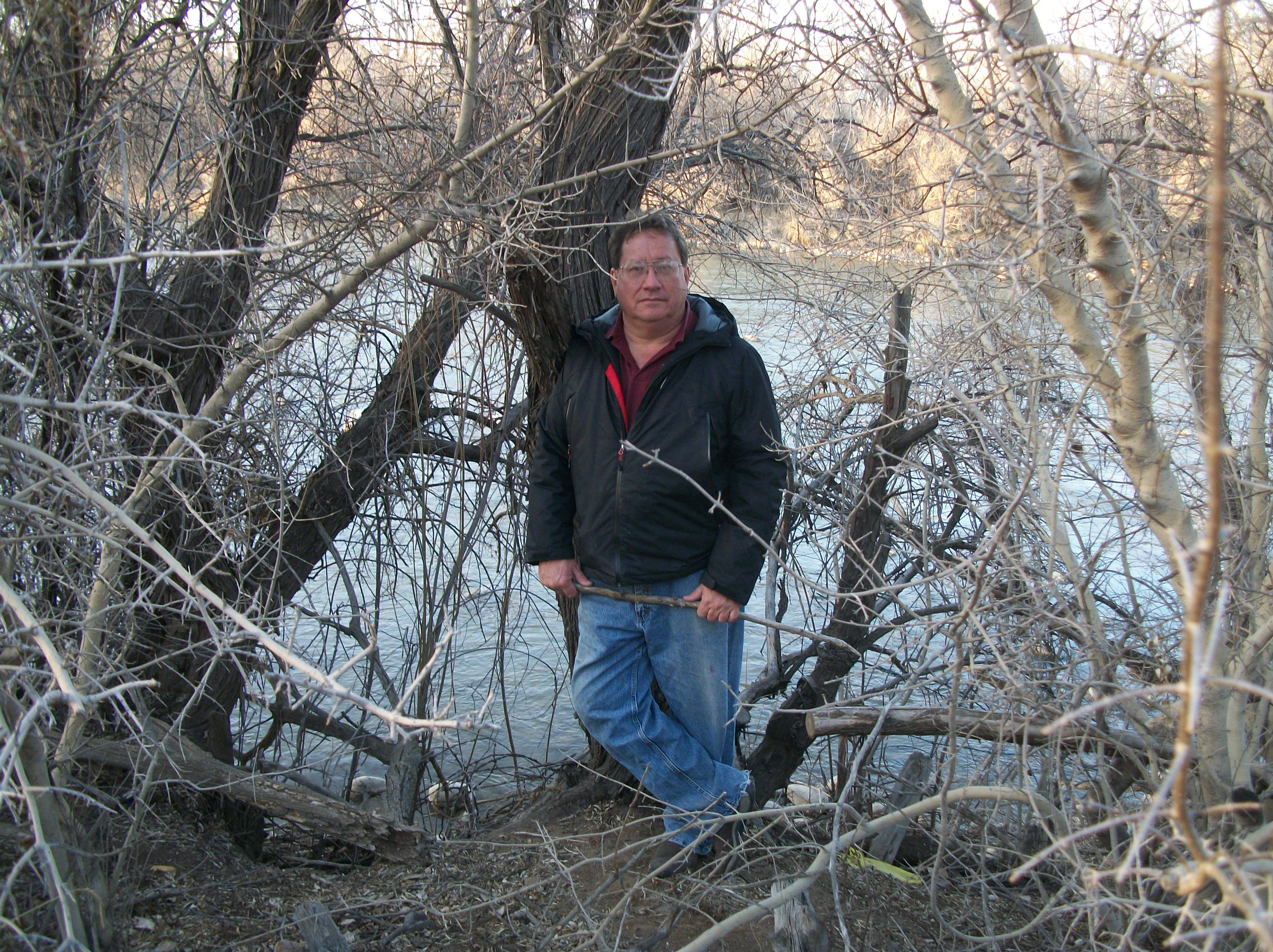
The blogger hiking in the Bisti Wilderness near Farmington, NM.

I just signed and returned the contract for my short horror story “Ivan” to appear in the April, 2016 edition of “Infernal Ink”.   “Ivan” is about a young serial killer in the making.   I would like to thank the “Infernal Ink” staff for publishing my work.  This is the first time I have had a new work published in over a year or more.

The idea for “Ivan” came to me while returning from Navajo Lake through an isolated stretch of road in a large canyon at sunset.  It was a very spooky setting and I thought about what would happen if a family became stranded in country like that and, while looking for help, wandered onto the estate of a serial killer.  The upshot of that story was that the serial killer trapped them in his basement only to discover he was trapped in his own basement with a family of werewolves.  I submitted it to several publications, but was consistently turned down.  One staff critqued the manuscript by saying that it was such a common story line, they were taking bets on whether the family would turn out to be werewolves or vampires at the end.   I took my cue from that and gave my work an honest review and decided that they were right.  So I changed the ending to one I thought would be completely unexpected, sent out the new manuscript to a publisher to which I had not previously submitted any work, and the story has been accepted.

Please note that the story will appear in 2016 vs. 2015.   It will be worth the wait.

Again, many heartfelt thanks to the “Infernal Ink” staff, Hydra M. Star and Dave Lipscomb, for publishing my work.

Thoughts?  Comments?

Writing between the Lines

mod 130419_0008A thought occurred to me tonight as I was watching another episode of the X-Files.  I was “reading between the lines”  of a dialog between Scully and Mulder, when it dawned on me that part of the art of writing is to write between the lines, i.e. to construct a dialog so that the reader will be able to read between the lines what you want him/her to read.   I always think of Hemingway’s short story “Hills Like White Elephants” when I think about talking around something or reading between the lines, because is the classic example.   One of my earlier posts, “Talking about Dogs” is on this same subject, when I say that part of the art of writing is like talking about a dog, without using the word “dog”.    Anyway, that’s my thought for the night.

Thoughts?  Comments?

Observations on the X-Files: Redrum, Season Eight, Episode 6

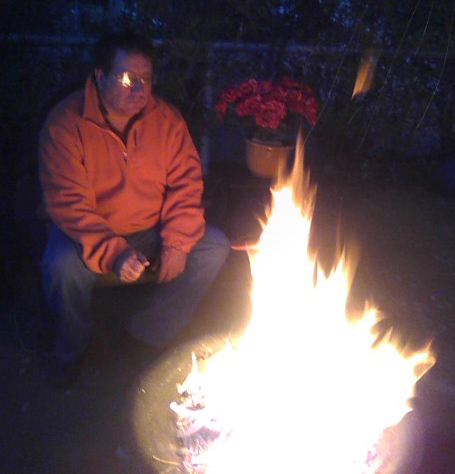
Relaxing by the front yard firepit on a chilly New Mexico evening circa 2013.

I recently purchased seasons  8 and 9 of the X-Files to complete my collection of the entire series.  As you can note above, I am up to episode 6 of season 8: Redrum.  No, it’s not based on The Shining or the famous line that sprang from there.   This is a completely original script and I think one of the best X-Files.   Why am I mentioning a Sci-Fi series in an article that should be about horror?  This article is about good writing, whatever the genre.

I will endeavor to avoid spoiling the story for you.

As we all know, “redrum” is murder spelled backwards.  This story is about a murder, but the alleged murderer finds himself traveling back in time to the day of the murder with the knowledge of how to prevent it.

I find the plot’s basic concept fascinating.  A prosecutor (and friend of Agent Doggett) wakes up one morning to find himself in prison for the murder of his wife, about which he remembers nothing.  As he is transferred to another facility for his safekeeping, he is assassinated.  However, at that point time starts to flow backwards for him.  Each morning he wakes up another day in the past (first he wakes up on Saturday, then on Friday, then on Thursday, etc.).  With each day he learns a bit more about his predicament until finally he wakes up on the day of the murder and he has an opportunity to prevent it.

Unexpectedly traveling back in time is not a common theme, but it’s not rare either.   I have to ask myself how Maeda and Arkin came up with the idea for this episode.  Maybe it was based on amnesia;  someone can’t recall his crime or immediate past and has to learn about it bit by bit, day by day, as the prosecutor does here.  Maybe it arose out of a philosophical question such as “if we could travel back in time, we could change our future but would the ultimate destination be the same and all we change is the route we take to get there?”   Maybe it was a thought that most stories show a protagonist going back in time to a certain point in time and then returning to the present; what if going back in time was not one big step, but several little steps.  How could we change our lives in that case?   What if as we traveled back in time, we knew as little about the past as we do about the future?  We wouldn’t be able to convince those around us that we are traveling back in time, because we wouldn’t know any history to prove our story.   They would believe us to be insane.

The whole scenario intrigues me.  One man goes back in time for unknown reasons while the rest of the world around him proceeds as normal.

I have to ask myself what their creative process was.

This scenario opens up so many questions and possibilities.   I love its originality.    If you haven’t seen it, I recommend renting it as soon as possible.

We never find out what causes the protagonist to travel back in time.  Like in a Stephen King novel, paranormal events happen out of the blue and at random.   But according to Lovecraft’s theories of weird fiction, not knowing the cause/origin of a horrible event, makes the event more horrifying, because the event could happen to any one of us at any time.

A common principle of writing is “to suspend belief” (some say “to suspend disbelief”).   In stories like this though, it is the natural laws of the universe that are suspended.    Everything else, all the world/universe surrounding the event. is quite believable, which emphasizes just how weird the event is.

The story was written by Steven Maeda and Daniel Arkin. A quick search in Imdb shows that Steven Maeda has an extensive list of credits as either a writer or producer for such television series as X-Files, Lost, CSI:Miami, Helix, Lie to Me, and many others.   Likewise Daniel Arkin has an extensive list of credits as a writer or producer for such shows as X-Files, Suits, Las Vegas, Alias, Medical Investigation, and others.  I will have to watch for more shows with which either one is involved.

Thoughts?  Comments?

“Summer Thunder” and the Horror of Tragedy

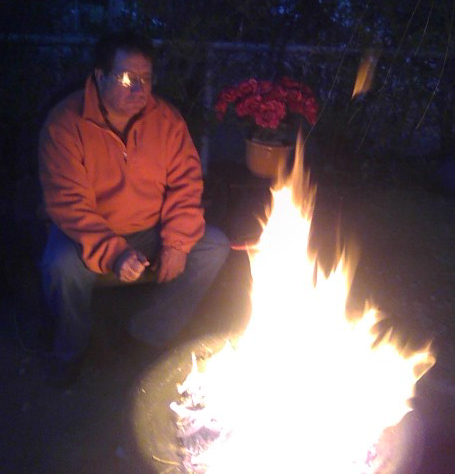
Relaxing by the front yard firepit on a chilly New Mexico evening circa 2013.

I picked up a copy of the latest issue of “Cemetery Dance” this evening and read the Stephen King short story “Summer Thunder”. This is a very interesting piece. I won’t spoil the ending for you, but the story is about a man, his dog, and his neighbor, who have survived a nuclear holocaust and are slowly succumbing to radiation poisoning.

This story was quite different from the other Stephen King stories I have read (which have been quite a few, though not all by any means). There is no supernatural factor in the story. There are also no twists or surprises. The story maintains the same pace throughout, just as the protagonists face the same things day in and day out until they die.

I would classify this story as horror-tragedy, because, even though it has very little of the blood and gore normally associated with the horror genre, it definitely has a horror “feel” to it, but that horror is subtle and understated. “Summer Thunder” sets up a tragic scenario and the horror finds its basis in watching these people suffer through no fault of their own. They were not involved in starting the war in any way; that was done by world leaders thousands of miles away. These are the common citizens, the “Everymen” that normally populate King’s works as protagonists, and who must pay the horrific price for their government’s actions. That is the tragedy and that is a large part of the horror.

What is also horrifying about the story is not the action described in it, but the scenario it describes, because this scenario is definitely one that could literally happen to each of us, should our government and/or other governments decide for whatever reason, to push the proverbial button. Each of us can (or perhaps should) see ourselves as the main character, who will be forced to watch his or her world disintegrate after a nuclear apocalypse.

That concept alone should be enough to bring the true horror of this story:  that this scenario is, and has been for a long time, a real possibility for each of us.

Thoughts?  Comments?

Art & Soul: Victorians and the Gothic | RAMM, Exeter’s Royal Albert Memorial Museum & Art Gallery

Here’s a brief, but interesting article for aficianados of the Gothic:

Art & Soul: Victorians and the Gothic | RAMM, Exeter's Royal Albert Memorial Museum & Art Gallery.

The Final Re-Post from Open Culture: John Steinbeck’s Writing Tips

John Steinbeck  (from the website  Letters of Note)
John Steinbeck
(from the website
Letters of Note)

Here is my final re-post from Open Culture: http://www.openculture.com/2012/02/john_steinbecks_nobel_prize_speech_and_his_six_tips_for_the_aspiring_writer.html.

The article is brief, but I won’t copy it here, because everyone with an interest in the art of writing should watch the accompanying five minute video of Steinbeck’s profound acceptance speech of the 1962 Nobel Prize.  I will, however, copy below a short paragraph immediately preceding his six tips (I also highly recommend following the link to an entertaining and insightful Paris Review article on his observations on the art of fiction):

And for insights into how Steinbeck reached that pinnacle, you can read a collection of his observations on the art of fiction from the Fall, 1975 edition of The Paris Review, including six writing tips jotted down in a letter to a friend the same year he won the Nobel Prize. “The following,” Steinbeck writes, “are some of the things I have had to do to keep from going nuts.”

Enjoy.


More from Open Culture: Twelve Writing Tips from Ray Bradbury

Ray Bradbury  by Lou Romano
Ray Bradbury
by Lou Romano

Ray Bradbury Gives 12 Pieces of Writing Advice to Young Authors (2001)

In earlier posts I mentioned that if one is to learn the art of writing, one must study the masters–regardless of genre.  Writing well is writing well whether in mainstream literature, horror, romance, mystery, or whatever.  After the basics of writing are mastered, then one can tailor stories to the accepted practices and traditions of his/her chosen genre.  That is why I have been posting these articles with advice from horror and non-horror writers.  Most of what they say is as applicable to horror as it is to mainstream literature or any other genre.

Tonight’s post is from Ray Bradbury.  If you have not read The Martian Chronicles, run out and buy a copy or download one before you finish reading this article.  You will find that it contains some of the most beautiful, poignant writing that you will ever encounter.  I wish I could develop the skill that Bradbury shows and apply it to anything I write, whether it be a horror novel or a shopping list.   Although this article will not help you do that, it will show you some of the important lessons that Mr. Bradbury learned in the school of literary hard knocks.  The focus of the Open Culture article is a fifty-four minute video.  The author of the article, Colin Marshall, summarizes the video into twelve points immediately below the video.  I recommend watching the entire video before reading the twelve points, because you may or may not agree with Mr. Marshall’s summary.

Enjoy.

More from Open Culture: Humor and Writing Advice From Kurt Vonnegut

Kurt Vonnegut, 1972
Kurt Vonnegut, 1972

Here’s a brief video with Kurt Vonnegut giving a fun presentation on the shape of a story:  http://www.openculture.com/2011/04/the_shape_of_a_story_writing_tips_from_kurt_vonnegut.html    Be sure to read the short article below the video.  It contains a link to Vonnegut’s eight rules for writers.

From Open Culture: Writing Tips from Neil Gaiman, Henry Miller, and others

Neil Gaiman at the 2007 Scream Awards Photo by pinguino k
Neil Gaiman
at the 2007 Scream Awards
Photo by pinguino k

Here’s the second batch of writing tips from Open Culture.  They include tidbits from Neil Gaiman, Henry Miller, Elmore Leonard, George Orwell, and Margaret Atwood.  Enjoy.

From Open Culture: Stephen King’s Top 20 Rules for Writers

Stephen King at Comicon, 2007 Photo by Penguino
Stephen King
at Comicon, 2007
Photo by Penguino

Stephen King’s Top 20 Rules for Writers

Great article.  Over the next week I hope to post more writing tips from great authors as they appeared in Open Culture.  They have a wealth of good advice that I would like to share.