
Just a gentle reminder…

Comments about writing horror in general.

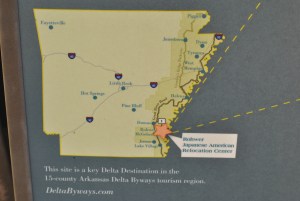
On July 5, my family and I drove 28 miles to visit the Rohwer Relocation Center, the site of an internment camp where 8,275 Japanese-Americans lived from 1942 to 1945.
To stand now in the middle of the immense expanses of heat-soaked cotton fields surrounding the site and to imagine what life must have been like can be heart-rending.
The wayside exhibits give a poignant portrayal of the harsh existence for these people, who happened to be of the wrong race when war came upon the US. Many, if not most or maybe even all, of these people came from California, a much milder climate than that of southeast Arkansas (I now live in Arkansas but I have lived in Alameda and San Diego). Most of the waysides have a recording describing some aspect of camp life narrated by perhaps the most famous former resident of Rohwer Relocation Center, George Takei, a.k.a. Mr. Sulu of Star Trek fame. Born in 1937, Mr. Takei lived here from the time he was about five years old to when he was about eight.
The inhabitants of Rohwer Relocation Center lived in military-style barracks, modified somewhat to accommodate families, but still exceptionally Spartan for any family. In one
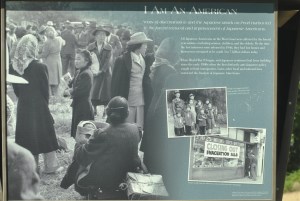
instance, Mr. Takei talks about his family’s arrival to find their new home a single room containing only a pot-bellied stove and five cots, one for each member of the family. Having been forced to leave their jobs behind, inhabitants struggled to find new ways to support themselves, because, while their former lives were left behind, their bills followed them. Most inhabitants found whatever jobs they could locally, maybe toiling on nearby farms or in other manual labor. Many jobs, even those within the camp, paid only $12-$19 per month, which was about half of what the non-Japanese staff of the camp was making. The move forced many people to sacrifice their life savings in order to survive. The few artists that were interned here were able to continue their professions, but I cannot say the market for art in rural southeast Arkansas during World War II was as lucrative as it might have been in California. Still, there was a hospital, so there was some medical care. And there was some schooling for the children, though I do not recall how this was arranged.
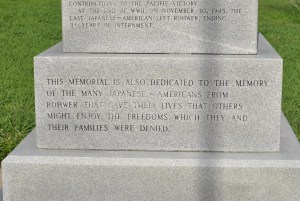
A few monuments exist today at the site, which honor the interned, along with the headstones of several that died here. The monuments honor the Japanese-Americans who served in the Second World War, with many of them coming from the Rohwer Relocation Center. Japanese-American soldiers were typically sent to the European front where, they would be less likely to side with or mix in with the enemy. In fact, Japanese-Americans made up the 442nd battalion and fought in some of the most vicious fighting experience by the US, specifically at Anzio, Salerno, and Monte Cassino. The names of those killed in action are listed on a few of the monuments along with memorable remarks about the Japanese-American experience at home and in war, fighting for the country that interned them and their families.
Visit the site if you have the opportunity. It can be found on Google Earth and Google Maps will give you the directions. Enjoy the photos here that I took during my visit and reflect upon the multi-layered composition of our nation as many of us struggle for a greater voice in the future of our nation during this time of racial unrest and political upheaval.





Tonight is uneventful.
I was notified yesterday via direct message on Twitter that Namri’d Publishing of Edgewood, NM, is awarding me an advertising package of “two reviews on Amazon, Goodreads and Barnes and Noble and sharing of your book on Facebook and Twitter at least weekly for one month” valued at $100. I have not heard of them and don’t know how they got my name, but I won’t look a gift horse in the mouth. They asked for a copy of one of my books and a cover photo, so tonight I sent them A Tale of Hell and Other Works of Horror. We’ll see how this goes. I tend to be leery of deals too good to be true, especially if they come out of the blue, but I do not see that I have anything to lose here either. They are not asking for any money (at least at this point). I looked up the company on the Internet, and it seems to be a straightforward, small publisher. If things go as well as I hope, then this will be a good deal for us both and I will always be grateful to them for this opportunity.
Interestingly, I have passed through Edgewood many times. For some time, my wife has lived and worked in Midland, TX, and when I go to see her, the most direct route from Aztec, NM, where I live, takes me through Edgewood. Often, I stay the night at an America’s Best Value Inn in the town of Moriarty, which is just east of Edgewood. Edgewood is about as typical small town America as they come, situated on the edge of the rolling plain just east of Albuquerque. From what I have seen, it is a beautiful little community with a large nature park.
Other than that, I have collected some information together for my taxes and have been advertising my upcoming interview on KSJE (90.9 FM, March 7 at 10:30 a.m. Mountain Standard Time) on Goodreads and sending out a few invitations to listen to it.
I usually keep the TV on in the background, and these days it’s usually on YouTube, which I love for the wide variety of programming (admittedly, some is of dubious sources, but nonetheless entertaining), but you can also find great articles on topics you can’t find on regular TV, such as staging of classical plays like “Death of a Salesman”, “Long Day’s Journey Into Night”, “The Iceman Cometh”, or “Waiting for Godot”. You can also find great biographies. One of my favorite programs of all time was A&E’s Biography. I can now watch its re-runs. The biography of John Steinbeck is playing now.
So now I sit at my laptop, typing this article, having hot tea, watching Biography, and waiting for my wife to call. After I finish this post, I will start my writing for the night.
 Phil Slattery, Writer, Publisher